

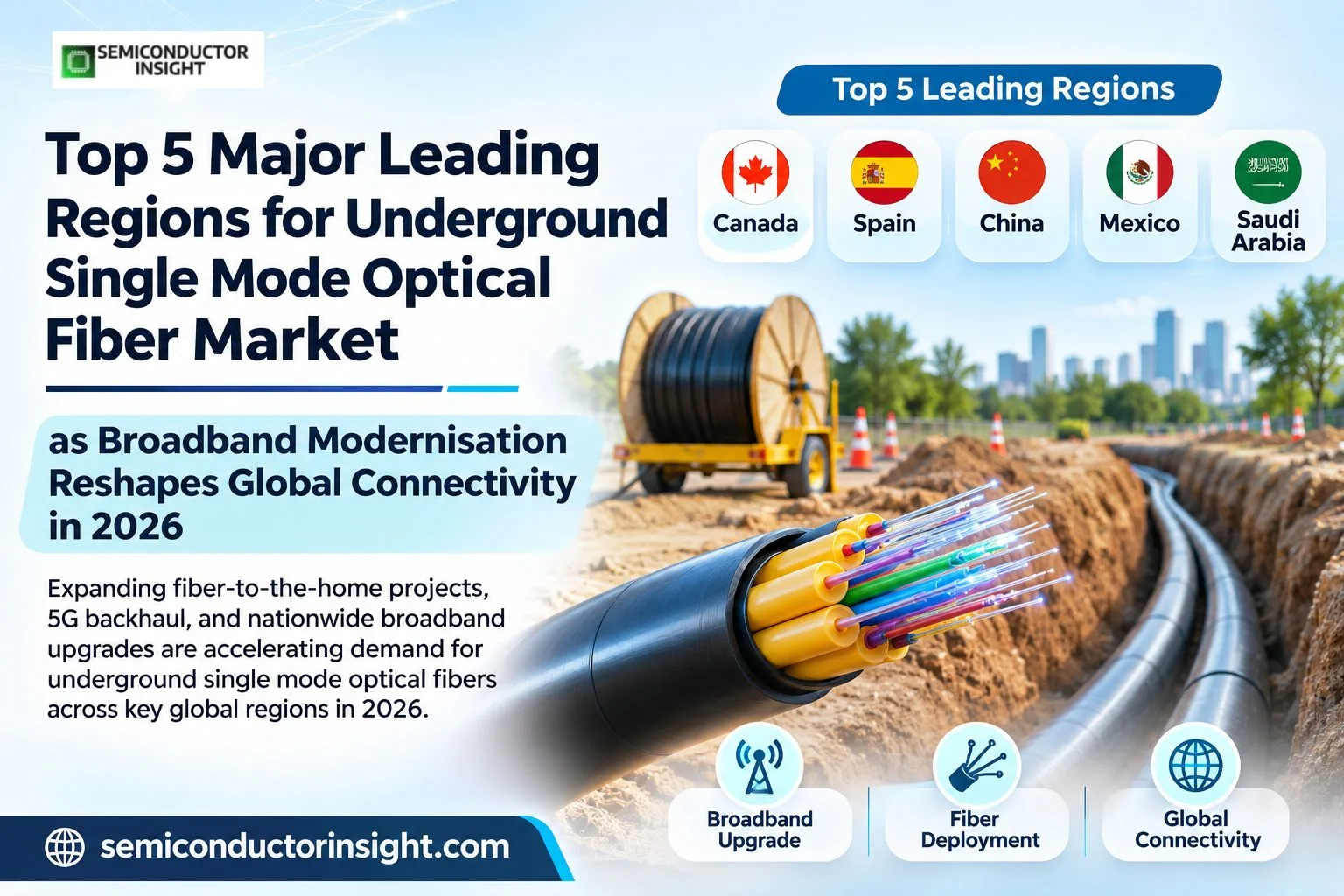
Top 5 Major Leading Regions for Underground Single Mode Optical Fiber Market as Broadband Modernisation Reshapes Global Connectivity in 2026
Underground Single Mode Optical Fiber Market covers optical fibre cables installed beneath roads, pavements, utility corridors and dedicated underground ducts to support high-capacity telecommunications networks. Using a single optical transmission path, single-mode fibre enables long-distance data transmission with low signal attenuation, making it suitable for FTTH connections, 5G backhaul, data centres, enterprise networks and international communication infrastructure.
Underground deployment provides protection against wind, fallen trees, and other weather-related interruptions, in contrast to aerial installations. However, installation necessitates careful planning regarding maintenance access, duct availability, current utilities, and civil works. In both developed and emerging telecoms economies, increased investment in fiber-to-the-premises infrastructure is thus opening up new possibilities for the construction of underground cables.
North America – Broadband Funding Is Creating New Underground Fibre Corridors
The United States and Canada represent important infrastructure markets, particularly as broadband expansion increasingly targets underserved communities. In the United States, the National Telecommunications and Information Administration’s Broadband Equity, Access, and Deployment (BEAD) programme represents a federal commitment of USD 42.45 billion towards broadband infrastructure. Its revised implementation process in 2026 has kept state-level network planning and deployment in focus. Fibre construction is particularly relevant for connecting remote communities, business parks and regional distribution points.
- Canada presents another important opportunity. According to the Canadian Radio-television and Telecommunications Commission’s 2026 report, approximately 72% of Canadian households had access to fibre at home.
- This creates a substantial foundation for additional underground network connections, particularly in rural communities and First Nations reserve areas.
Europe – Digital Decade Connectivity Targets Are Accelerating Fibre Modernisation
European fibre deployment is increasingly linked to the European Union’s Digital Decade 2030 objectives. The European Commission’s June 2026 Connectivity Coverage report found that FTTP coverage across the EU27 had reached 74.1% by mid-2025, while very-high-capacity network coverage stood at 85.6%.
Germany, France, Spain, Italy and the United Kingdom offer distinct infrastructure opportunities. Germany’s network modernisation involves extending fibre connections into residential and industrial areas, while France and Spain have established substantial FTTH deployment programmes. The UK is also replacing legacy copper infrastructure with full-fibre networks. Underground single-mode cables are particularly relevant for dense urban routes, industrial parks and metropolitan backhaul connections, where protected duct infrastructure can support long-term network expansion.
Asia Pacific – China and India Are Creating Enormous Fibre Deployment Requirements
Asia Pacific is an important region to examine because of its large telecommunications subscriber base, extensive manufacturing ecosystem and continuing broadband infrastructure expansion.
China’s Ministry of Industry and Information Technology reported 74.99 million kilometres of optical cable lines by the end of 2025, alongside 1.21 billion FTTH/O access ports. The country also recorded 6.91 billion fixed broadband subscriptions? No – 691 million fixed broadband subscribers, including 238 million connections operating at 1 Gbps or above. These figures demonstrate the scale of optical infrastructure supporting the country’s digital economy.
- India offers another significant development opportunity. By December 2025, approximately 694,911 kilometres of optical fibre cable had been laid under BharatNet, with 214,904 Gram Panchayats made service-ready. This expansion supports rural broadband, public institutions, education and digital services.
- Japan, South Korea and Australia also contribute through high-speed broadband networks, data-centre connectivity and advanced telecommunications infrastructure.
Latin America – Brazil Is Setting the Pace for Fibre-Based Broadband Expansion
Latin America’s underground optical fibre opportunity is closely connected to the replacement of older broadband technologies and the extension of connectivity beyond major metropolitan centres. Brazil is particularly important: government-reported Anatel data showed 53.9 million fixed broadband connections in December 2025, with optical fibre accounting for approximately 79% of total connections.
Mexico, Chile, Colombia and Argentina are also relevant markets as operators extend fibre networks into residential developments, commercial districts and industrial zones. Chile’s telecommunications regulator, SUBTEL, maintains fixed-internet connection statistics through June 2026, providing an ongoing indicator of network adoption.
For underground cable suppliers, metropolitan expansion, highway connectivity and intercity network routes offer distinct deployment opportunities. The commercial requirement increasingly involves cables compatible with existing ducts and installations that minimise disruption to established urban infrastructure.
Before Proceeding, Feel Free to Overlook Our Updated Report: https://semiconductorinsight.com/report/underground-single-mode-optical-fiber-market/
Middle East & Africa – Smart-City Infrastructure Is Creating New Fibre Deployment Priorities
The Middle East is developing a strong position in high-capacity telecommunications infrastructure, particularly through smart-city projects, enterprise connectivity and digital government services. The UAE maintained the world’s leading position in FTTH household coverage in 2024, according to its Telecommunications and Digital Government Regulatory Authority. Saudi Arabia is also expanding its digital infrastructure, with its Communications, Space and Technology Commission reporting 3.5 million households covered through its fibre open-access initiative.
In Africa, South Africa provides a measurable example of fibre adoption. ICASA reported approximately 3 million FTTH/B subscriptions in 2025, while total fixed broadband subscriptions reached 3.26 million. Kenya, Nigeria and Egypt are also important markets for expanding metropolitan fibre networks and connecting new data infrastructure.
The Installation Shift Is Changing How Fibre Networks Are Designed
Underground single-mode fibre deployment increasingly involves microtrenching, existing-duct utilisation, multi-duct systems and higher-fibre-count cable configurations. These approaches allow network operators to extend connectivity while managing road disruption, installation time and future maintenance requirements.
The most important distinction is that national FTTH and optical cable statistics represent the broader fibre ecosystem, not underground single-mode cable volumes alone. Nevertheless, they provide valuable indicators of the infrastructure demand supporting this specialised market.

Comments (0)