

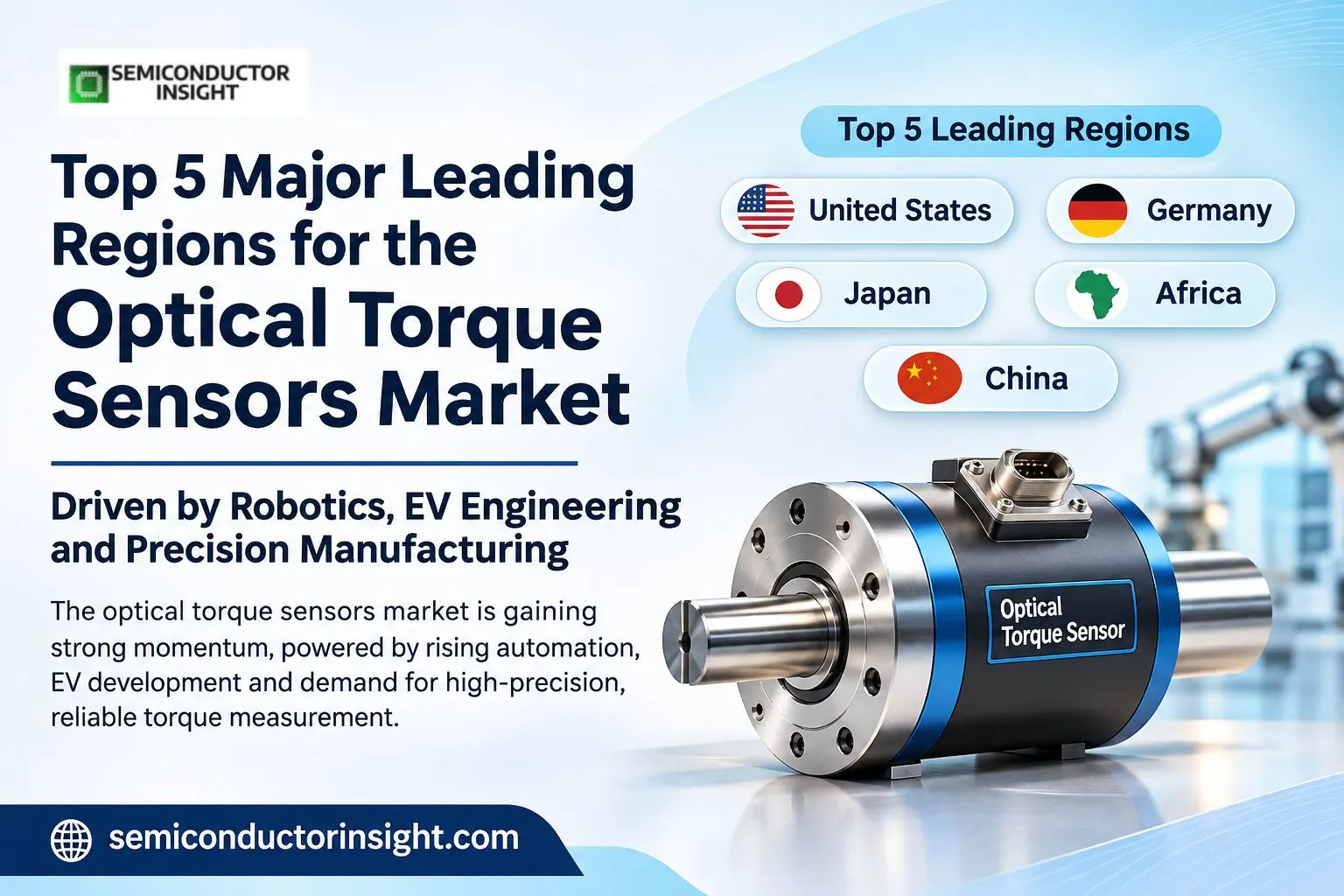
Top 5 Major Leading Regions for the Optical Torque Sensors Market Driven by Robotics, EV Engineering and Precision Manufacturing
Optical torque sensors are becoming increasingly relevant to precision engineering as manufacturers seek reliable ways to measure rotational force, shaft deformation and mechanical loading. Unlike conventional electrical strain-gauge systems, fibre-optic technologies, including Fibre Bragg Grating (FBG) sensors, can offer immunity to electromagnetic interference, multiplexing capabilities and suitability for demanding industrial environments.
Their applications extend to electric vehicle motor testing, industrial robots, wind turbine gearboxes, aerospace drivetrain systems and high-speed rotating machinery. Regional opportunities are closely connected to the concentration of advanced manufacturing, automation investments and engineering-intensive industries.
North America – Precision Testing Meets Electric Mobility and Aerospace Engineering
The United States remains an important potential market because of its automotive engineering, aerospace manufacturing and industrial automation ecosystem. According to the International Federation of Robotics (IFR), US factories installed approximately 38,500 industrial robots in 2025, an increase of 12%.
This creates a substantial installed base of automated equipment where accurate torque feedback can support drivetrain testing, robotic joint calibration and predictive maintenance. Canada also presents opportunities through wind energy and advanced manufacturing, while Mexico’s automotive production ecosystem creates additional requirements for motor and transmission testing.
Europe – Germany, France and the Netherlands Advance Precision Drivetrain Monitoring
Europe’s strongest opportunity comes from its established automotive engineering, industrial machinery and renewable energy industries. Germany accounted for 41% of European Union industrial robot installations in 2025, according to IFR.
Meanwhile, a particularly relevant development emerged from European research in March 2025, when researchers validated fibre-optic torque measurement on a Gamesa G97 2 MW wind turbine gearbox at the US National Renewable Energy Laboratory’s Flatirons Campus.
The experiment achieved an average normalised measurement error below 0.7%. With engineering centres in Germany, France, the Netherlands and Denmark, Europe offers an important environment for advancing optical sensing in wind turbine maintenance and precision machinery.
Asia Pacific – China, Japan and India Strengthen the Industrial Sensing Ecosystem
Asia Pacific represents the largest opportunity among the five regions because of its concentration of robotics, automotive production, electronics manufacturing and industrial equipment. China installed approximately 354,000 industrial robots in 2025, representing 59% of worldwide deployments. Japan recorded 36,219 installations, while India reached approximately 10,500 units, reflecting its expanding automation ecosystem. These developments create potential applications for optical torque measurement in robotic actuators, electric motor validation, automated assembly equipment and precision manufacturing. China’s rapidly expanding wind infrastructure also creates opportunities for monitoring high-load turbine gearboxes.
Don’t Forget to Surf Our Updated Report for More Detailed Analysis: https://semiconductorinsight.com/report/optical-torque-sensors-market/
Latin America – Brazil and Mexico Build New Opportunities in Automotive and Energy Equipment
- Latin America’s opportunity is developing around automotive manufacturing, industrial modernisation and renewable energy installations. Brazil installed approximately 4,300 industrial robots in 2025, an increase of 38%, with nearly 2,100 installations associated with automotive manufacturing.
- Mexico remains relevant through its automotive assembly and component manufacturing ecosystem. Wind energy adds another application opportunity, with Brazil recording approximately 2,253 MW of new onshore wind capacity in 2025.
- These industries can benefit from precision torque monitoring during motor testing, rotating equipment validation and drivetrain maintenance.
Middle East & Africa – Wind Infrastructure Creates a New Sensing Opportunity
The Middle East and Africa are emerging as specialised application markets, particularly through wind energy and industrial infrastructure investments. According to the Global Wind Energy Council’s 2026 reporting, Saudi Arabia added approximately 1,512 MW of wind capacity in 2025, while South Africa, Egypt and Morocco also expanded their installations. Africa’s cumulative wind capacity reached 11.1 GW by the end of 2025.
These developments create potential requirements for drivetrain monitoring, gearbox condition assessment and mechanical load measurement. As large renewable energy projects move towards commissioning and long-term maintenance, optical torque sensing could become relevant for improving equipment reliability and monitoring rotating components.
Why Wind Turbine Gearboxes Are Becoming an Important Testing Ground?
A notable research development illustrates the practical potential of optical torque sensing. A 2025 field-validation study used 23 fibre-optic sensors installed on a wind turbine gearbox ring gear to estimate dynamic mechanical torque. The research analysed 837 ten-minute measurement files and more than 113,000 shaft revolutions.
The results demonstrated the potential for accurate torque monitoring without relying on conventional rotating-shaft signal transmission arrangements. This creates an important pathway towards fleet-level gearbox monitoring and predictive maintenance.

Comments (0)