

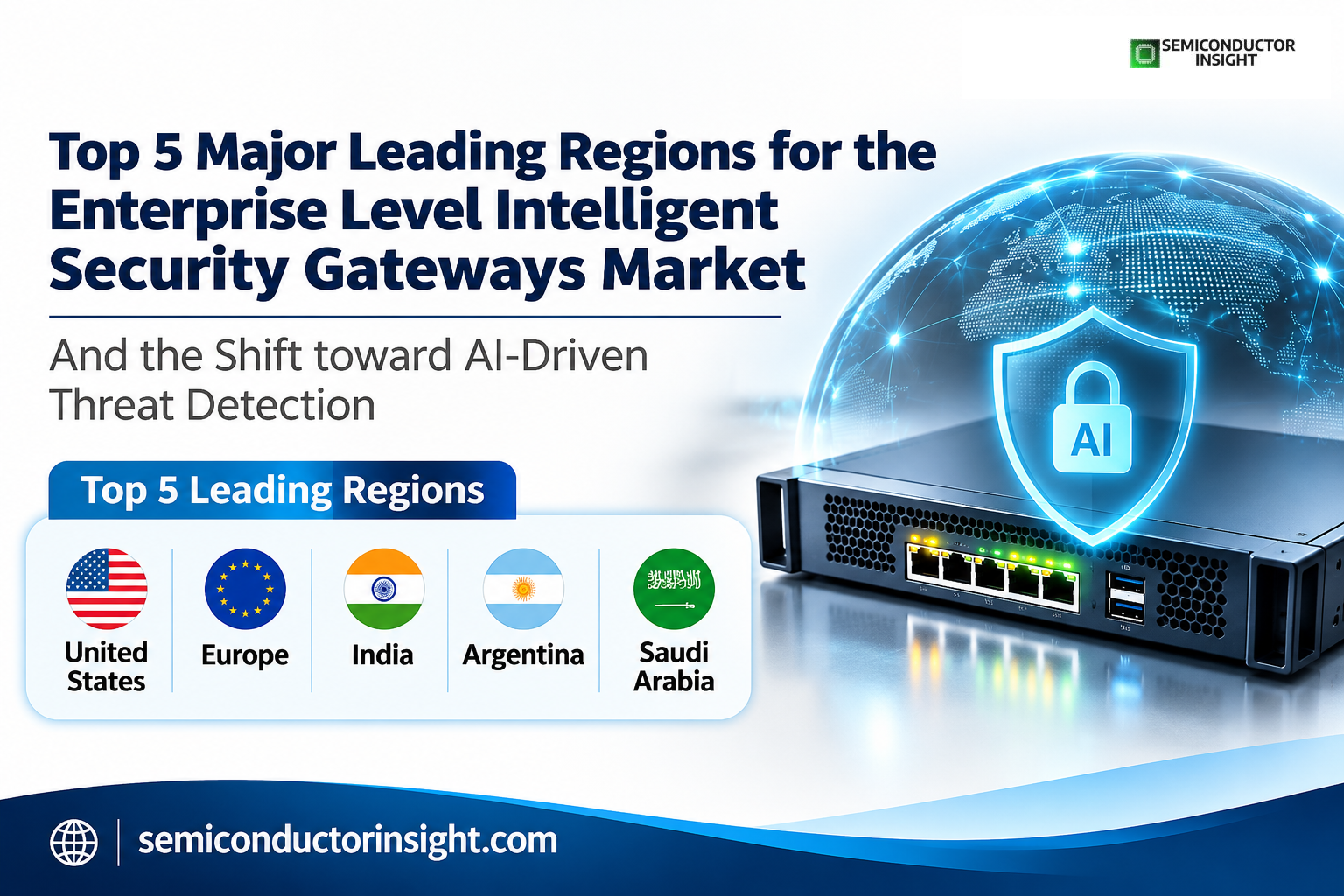
Top 5 Major Leading Regions for the Enterprise Level Intelligent Security Gateways Market and the Shift toward AI-Driven Threat Detection
Enterprise security is changing as employees access business applications from homes, branch offices, mobile devices and cloud platforms. Traditional network perimeters are no longer sufficient to protect organisations operating across multiple environments. Intelligent security gateways are evolving into integrated protection layers that inspect network traffic, authenticate users, filter malicious content and enforce access policies.
These platforms include next-generation firewalls, secure web gateways, unified threat management systems, intrusion prevention and secure access service edge (SASE) solutions. Their growing importance lies in combining several security functions rather than requiring businesses to manage disconnected protection products.
Zero Trust Is Rewriting the Gateway’s Job Description
- The traditional gateway primarily monitored traffic entering and leaving an enterprise network. Modern architectures increasingly verify individual users, devices and applications before granting access to sensitive resources.
- The US National Institute of Standards and Technology (NIST) published its zero-trust implementation guide, SP 1800-35, in June 2025. The project involved 24 industry collaborators and demonstrated 19 example implementations covering enterprise environments, multiple cloud platforms and hybrid workforces.
- This provides a practical indication of how organisations can integrate gateway security with identity management, microsegmentation and secure remote access.
AI Is Turning Traffic Inspection into Continuous Threat Analysis
Artificial intelligence is changing how security gateways identify suspicious behaviour. Instead of relying exclusively on predefined rules and signature databases, newer platforms can analyse traffic patterns, detect unusual access attempts and prioritise potentially malicious activity.
This capability is particularly relevant to ransomware, phishing, credential theft and automated attacks. However, AI-based inspection must also address false positives, encrypted traffic visibility and the risk of attackers manipulating automated detection systems. Enterprise buyers are therefore evaluating the accuracy of threat detection alongside processing capacity, integration and response time.
North America
North America remains an important market for enterprise security gateways because of its extensive cloud infrastructure, financial services industry, technology companies and critical infrastructure networks. The United States is particularly influential in the development of zero-trust architectures and integrated cybersecurity platforms.
NIST’s 2025 implementation guide is an important reference for enterprises moving beyond traditional perimeter-based protection. Its practical models demonstrate how firewalls, identity systems, secure web gateways and microsegmentation can work together. Financial institutions, healthcare networks, government agencies and cloud service providers are among the application environments where this integrated approach is relevant.
Europe
Europe’s enterprise security environment is increasingly shaped by regulatory accountability and the need to protect interconnected digital infrastructure. The NIS2 Directive establishes cybersecurity requirements across 18 critical sectors, including energy, healthcare, transport, banking, digital infrastructure and public administration.
This regulatory framework increases the importance of network monitoring, access control, incident reporting and cybersecurity risk management. For gateway suppliers, opportunities extend beyond traditional corporate IT into manufacturing facilities, utilities, logistics networks and cloud service providers. Organisations must also consider supply-chain security and the protection of third-party access.
Our most recent updated related study is available for free at this link: https://semiconductorinsight.com/report/enterprise-level-intelligent-security-gateways-market/
Asia Pacific
Asia Pacific is developing into a significant enterprise cybersecurity market as businesses expand digital payments, cloud services, online commerce, and telecommunications and connected manufacturing. India, China, Japan, South Korea and Singapore have different cybersecurity priorities, but all face the need to protect increasingly interconnected digital environments.
India’s CERT-In reported 29, 44, 248 cybersecurity incidents during 2025, compared with 20, 41,360 in 2024. The agency also issued 1,530 security alerts and 65 advisories during 2025. These figures cover reported incidents across sectors and do not represent attacks specifically blocked by security gateways. Nevertheless, they illustrate the scale of cybersecurity activity requiring stronger enterprise monitoring and response capabilities.
China is also strengthening its network data protection framework. Its Regulations on Network Data Security Management took effect on 1 January 2025, establishing requirements for organisations handling network data. This creates additional relevance for gateways that support traffic monitoring, data protection and controlled access to enterprise systems.
Latin America
Latin America’s enterprise security gateway demand is connected to digital banking, telecommunications, e-commerce, government platforms and the growing adoption of cloud-based business applications. Brazil and Mexico are particularly important commercial environments, while Chile, Colombia and Argentina are expanding their digital services and cybersecurity capabilities.
Businesses operating across multiple countries need protection that can be centrally managed while addressing different regulatory and operational requirements. Managed security services, cloud-delivered firewalls and secure web gateways are relevant options for organisations that lack large internal cybersecurity teams. Financial services, retail, telecommunications and public-sector networks provide important application areas.
Middle East & Africa
The Middle East is investing in digital government, financial technology, smart infrastructure and cloud data centres. Saudi Arabia and the UAE are particularly relevant as enterprises modernise their digital infrastructure and strengthen cybersecurity governance. In Africa, banking, telecommunications, energy and public services are creating demand for scalable network protection.
For organisations operating across multiple locations, intelligent gateways can provide centralised policy enforcement, encrypted traffic inspection and secure remote connectivity. Managed security platforms are especially relevant where specialist cybersecurity personnel and infrastructure investment remain limited.
Security Gateways Are Becoming Enterprise Control Points
The enterprise level intelligent security gateways market is moving towards integrated platforms that connect network visibility, identity verification, cloud protection and automated threat response. As organisations adopt hybrid infrastructure and increasingly complex digital workflows, gateway value will depend on how effectively these systems coordinate security across users, devices, applications and locations. The next phase of adoption will favour solutions that offer strong protection without compromising network performance or business continuity.

Comments (0)