

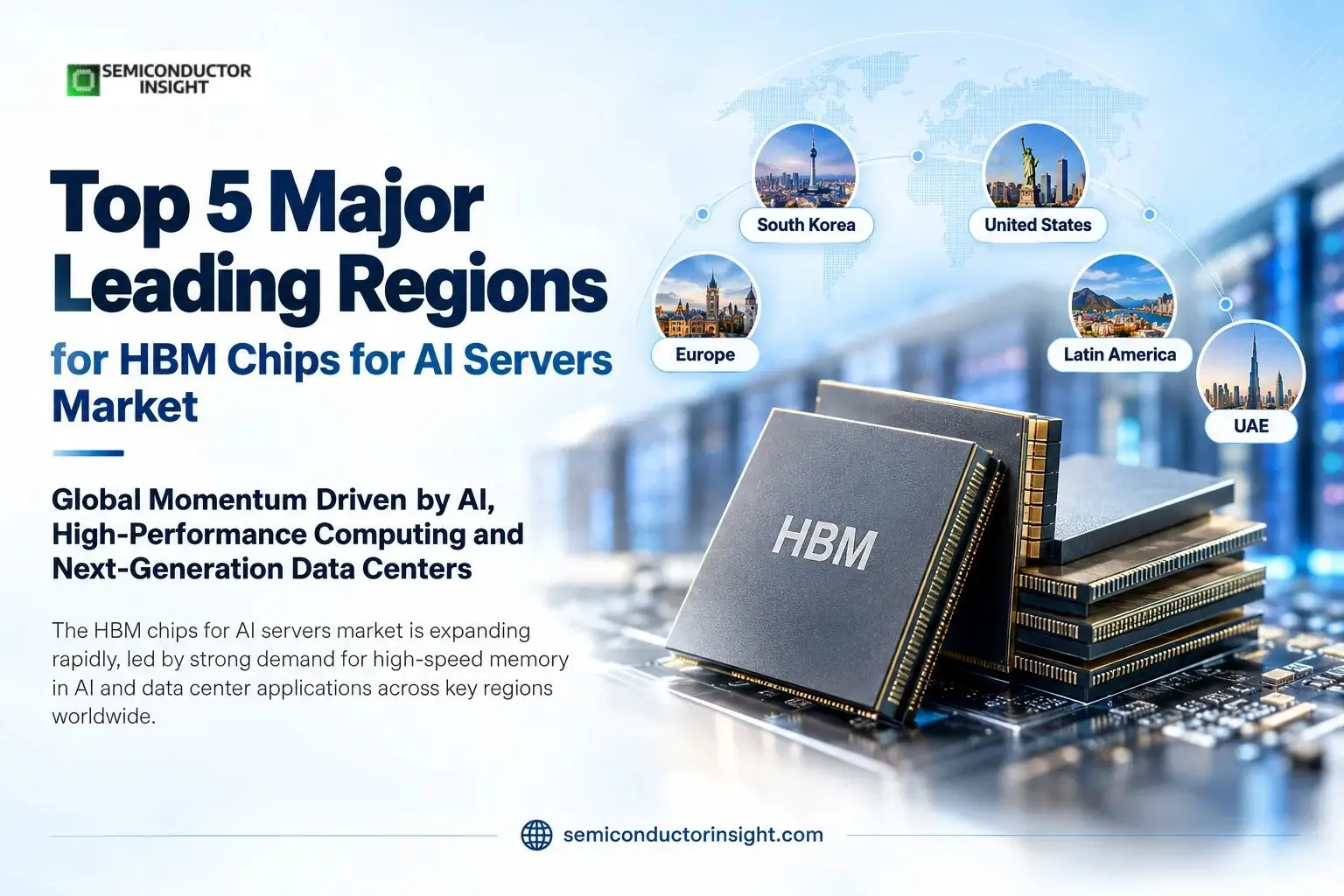
Top 5 Major Leading Regions for HBM chips for AI servers market and the Shift toward HBM4, Advanced Packaging and High-Bandwidth AI Infrastructure
High-bandwidth memory (HBM) has become a critical component in advanced AI servers because processors need to access enormous volumes of data quickly. HBM stacks several memory dies vertically and intimately combines them with AI accelerators through sophisticated packaging, in contrast to traditional DRAM modules that are placed apart from the CPU. This configuration helps lower the energy needed to convey data while supporting high data-transfer rates.
The scale of infrastructure investment highlights the opportunity. The International Energy Agency reported that data centres consumed around 485 terawatt-hours of electricity in 2025 and projects consumption could reach 950 TWh by 2030. This is not HBM-specific demand, but it demonstrates the expanding infrastructure supporting AI workloads.
HBM4 Moves from Roadmap to Commercial Production
- The transition from HBM3E to HBM4 is changing memory design priorities.
- In February 2026, Samsung announced HBM4 mass production and commercial shipments, reporting a consistent transfer speed of 11.7 gigabits per second per pin, with capability up to 13 Gbps.
- The company also highlighted a 4-nanometre logic base die in its design.
- Micron’s published HBM4 specifications describe a 2,048-bit interface and bandwidth of up to 2.8 terabytes per second for its 12-high configuration.
- Such specifications show why HBM development involves more than increasing capacity: interface width, power efficiency, thermal behaviour and integration with the processor all influence system performance.
Advanced Packaging Is Part of the Memory Equation
HBM cannot deliver its full value in isolation. It must be integrated with computing dies using sophisticated packaging and interconnect technologies. TSMC’s CoWoS platform combines system-on-chip components with HBM stacks to support high-performance computing products. Its 2025 annual report describes several CoWoS variants designed to accommodate increasingly complex chip configurations.
This creates a tightly connected production chain involving DRAM manufacturing, stacking, packaging, testing and accelerator design. Yield problems at any stage can affect the number of usable finished packages, making manufacturing coordination as important as raw memory capacity.
Asia Pacific – The Core of HBM Manufacturing
South Korea is central to HBM development through SK hynix and Samsung. SK hynix reported in July 2026 that it had begun HBM4 mass shipments in the second quarter and planned to ramp production during the second half of the year. Taiwan also plays a key role through advanced foundry and packaging capabilities. Together, these capabilities make Asia Pacific a major centre for memory production and integration.
You can freely browse our most recent updated report to learn more about it before scrolling further: https://semiconductorinsight.com/report/hbm-chips-for-ai-servers-market/
North America – AI Accelerator Design and Memory Innovation
The United States contributes through AI chip designers, hyperscale cloud operators, semiconductor research and memory manufacturing. Micron’s HBM4 portfolio includes 36 GB 12-high products and 48 GB 16-high samples listed on its product roadmap for 2026. These developments reflect demand for greater memory capacity in advanced computing systems.
Europe – Semiconductor Equipment and Research Expertise
Europe contributes specialist semiconductor equipment, materials, research institutions and chip-design capabilities. Although it is not a leading centre of HBM production, its expertise in manufacturing equipment and precision engineering supports the wider semiconductor supply chain. Its role is particularly relevant as manufacturers seek better process control and higher yields for complex packaging.
Latin America – Emerging Infrastructure and Engineering Opportunities
Latin America’s immediate role is more closely connected to digital infrastructure, engineering services and supporting supply-chain activities than to high-volume HBM fabrication. As cloud and AI services expand, regional data-centre investment could increase demand for imported AI servers, but this should not be confused with local HBM manufacturing capacity.
Middle East & Africa – Investment in AI Computing Infrastructure
The UAE and Saudi Arabia are investing in digital infrastructure and AI capabilities, creating potential demand for high-performance servers equipped with HBM-based accelerators. Their current significance is primarily as emerging infrastructure markets rather than established HBM manufacturing hubs.
The Next Milestone Is System-Level Performance
HBM chips for AI servers market will increasingly depend on how effectively memory, processors and packaging work together. HBM4, taller memory stacks and advanced integration are expanding design possibilities, while thermal control, production yield and power consumption remain central engineering considerations.
The strongest gains will come from improving the complete AI computing system, not simply increasing the amount of memory attached to a chip.

Comments (0)