

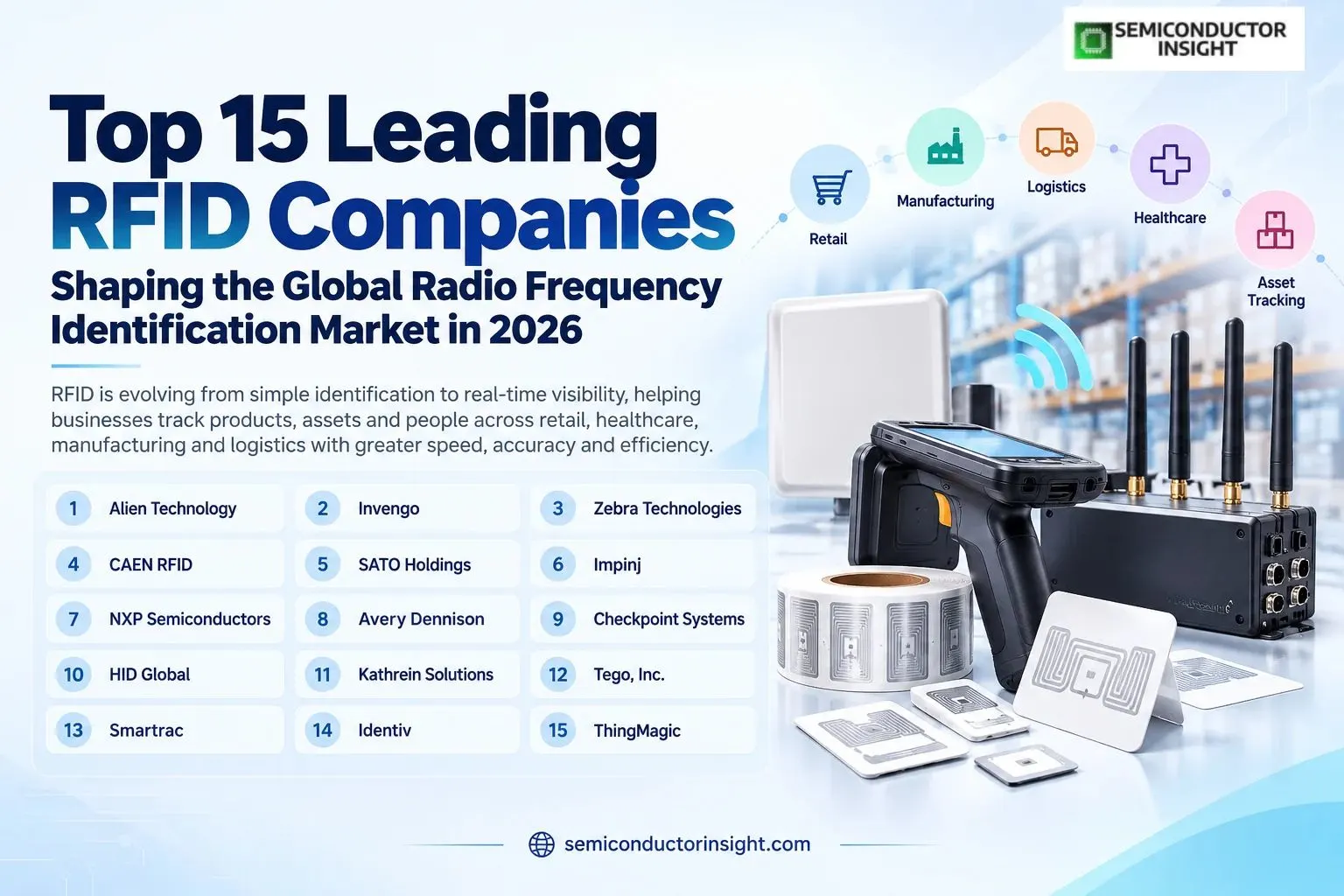
Top 15 Leading RFID Companies Shaping the Global Radio Frequency Identification Market in 2026
Radiofrequency identification (RFID) is evolving from a simple identification method into a real-time visibility layer for retail, healthcare, manufacturing, logistics and asset-intensive operations. By allowing tagged items to be identified without direct line of sight, RFID can help organisations track thousands of products, automate inventory checks and maintain digital records as goods move between factories, warehouses, stores and customers.
The competitive landscape includes several distinct groups: chipmakers that improve tag performance, inlay manufacturers that scale item-level identification, reader specialists that capture data, and solution providers that connect RFID events to everyday business operations.
- The most useful way to compare these companies is to examine what each contributes to the RFID ecosystem and how its latest products, partnerships or deployments address real-world tracking needs.
Alien Technology and the Push for Reliable High-Volume Item Identification
Alien Technology’s importance in the RFID market lies in its passive UHF RFID integrated circuits, particularly the Higgs family, which supports item-level identification across retail, logistics and industrial applications. Its technology addresses a persistent commercial problem: making tags small and affordable without sacrificing readability when products are densely packed or difficult to scan.
- The company’s Higgs portfolio spans different memory and performance requirements.
- For example, Higgs 3 provides up to 800 bits of total memory, while Higgs 9 offers up to 1,024 bits.
- Alien also specifies read distances of up to 13 metres for certain Higgs IC configurations, although actual performance depends on the tag antenna and operating environment.
- These capabilities make its components relevant to high-volume labelling and applications requiring more than a basic identification number.
Invengo and the Integration of Readers, Antennas and Smart Labels
Invengo occupies a practical position in the RFID ecosystem by offering more than individual tags. Its portfolio covers handheld readers, fixed UHF readers, antennas, dry and wet inlays, NFC products and hard tags designed for challenging surfaces. This breadth is useful for businesses that want to build an RFID installation around compatible identification and reading equipment rather than source every component separately.
Its product range addresses distinct operational requirements, from portable stock checks to automated warehouse tracking and on-metal asset identification. The XC-RF868 smart reader, for example, supports six RF antenna ports, while the company’s catalogue includes multiple handheld and fixed-reader models. In 2026, this hardware-led approach remains relevant as organisations extend RFID from isolated pilots into connected workflows across receiving, storage, dispatch and asset management.
Zebra Technologies and the Shift from Scanning to Continuous Inventory Visibility
Zebra Technologies has a substantial role in enterprise RFID because it connects identification hardware with the mobile computers, printers and operational systems already used by frontline teams. Its RFID portfolio includes handheld readers, fixed readers, antennas, encoded labels and integrated portals. This allows retailers and logistics operators to capture item movements at different points rather than rely solely on manual barcode scans.
A particularly important distinction is the company’s coverage of both mobile and fixed reading. Workers can perform cycle counts using handheld equipment, while portals and fixed infrastructure can detect tagged items moving through doorways, receiving areas and shipping zones. Zebra also offers RFID printing and encoding services, including pre-tested supplies. Its position in the enterprise hardware ecosystem makes it relevant to retailers seeking better stock visibility and warehouses trying to reduce manual checking.
CAEN RFID and the New Generation of Portable Reading
CAEN RFID focuses on RAIN RFID readers, specialised tags and devices that turn smartphones or tablets into mobile data-collection tools. Its September 2026 launch of the skID⁷ portable reader illustrates this approach. The device uses the Impinj E710 reader platform, replacing the previous R2000 platform, while retaining Bluetooth, USB Type-C and an IP65 protection rating.
The skID⁷ supports EPC Class 1 Gen 2 and ISO 18000-63, with a typical read range of up to 3 metres under specified conditions. Its compact format is suited to stock counts, mobile point-of-sale operations, field service and asset checks. Rather than requiring a dedicated terminal for every task, this kind of reader lets businesses add RFID functionality to existing mobile equipment, potentially simplifying deployment for smaller teams and distributed facilities.
SATO Holdings and RFID beyond Conventional Retail Labelling
SATO’s strength is the connection between RFID identification, label production and operational workflows. Its solutions are particularly relevant where an item needs to remain identifiable through several stages of handling, such as apparel distribution, food management, manufacturing and healthcare logistics.
A notable 2026 example is SATO’s contribution to Singapore’s next-generation blood supply management system. The RFID-enabled system supports online blood ordering and automatic tracking of blood components across the country’s Health Sciences Authority Blood Services Group and public and private hospital blood-bank laboratories. This is a more demanding use case than ordinary retail inventory because identification must support traceability and patient-safety processes. SATO also introduced a paper-based RFID label designed to reduce reliance on PET plastic, connecting product identification with packaging sustainability.
To Stay Tuned with More meaningful and In-Depth Insights, Do Visit here: https://semiconductorinsight.com/report/global-radiofrequency-identification-rfid-market/
Intermec Technology within Honeywell’s RFID Ecosystem
Intermec should be understood as a legacy product brand within Honeywell’s broader productivity and industrial automation portfolio, rather than an independent current parent company. Its RFID technology remains relevant to installed enterprise systems, particularly in warehouses, field service, and industrial asset management and retail inventory operations.
Honeywell’s IP30 passive UHF RFID reader is an example of this continuing product lineage. It adds RFID read-and-write functionality to compatible Intermec mobile computers, including selected CN and CK series devices. Its ability to support multiple frequency bands helps accommodate different operating regions, while compatibility with existing mobile terminals can protect earlier technology investments. For organisations with established Intermec deployments, the key consideration is how to maintain RFID functionality while modernising connected workflows.
STid and RFID for Secure Identification in Industrial Environments
STid approaches RFID from the perspective of secure identification, access management and vehicle tracking. Its products span UHF readers, industrial tags, vehicle identification equipment and smart access technologies. This positions the company in applications where a tag must do more than identify stock: it may also need to support access decisions, distinguish authorised vehicles or withstand demanding operating conditions.
- Its published URD UHF reader specifications include support for up to four remote antennas and reading distances of up to 10 metres, depending on the tag and environment.
- The reader supports EPC Class 1 Gen 2 and ISO 18000-6C, along with interfaces such as RS232, RS485, TCP/IP, USB and Wi-Fi.
- These features are relevant to industrial gates, logistics yards and automated identification points where equipment must communicate with existing control systems.
GAO RFID and the Breadth of Application-Specific Hardware
GAO RFID competes through a broad catalogue of readers, tags, antennas and associated tracking equipment. Its products cover multiple RFID frequency bands and specialised use cases, including livestock identification, access control, industrial assets, healthcare equipment and warehouse inventory. This breadth is useful for businesses that need to match the tag and reader to a particular environment instead of forcing one standard configuration across every asset type.
Its published catalogue includes UHF readers supporting two or four antenna ports, as well as models rated for outdoor use. One listed four-port reader supports read rates of up to 430 tags per second, while a separate product category includes HF handheld equipment with a stated scan speed of 50 tags per second. These are product-specific figures rather than universal system performance guarantees. The practical value lies in offering equipment for different read distances, tag populations and installation conditions.
Impinj and the Chip Technology behind Modern RAIN RFID
Impinj has a foundational role in the RAIN RFID ecosystem because its endpoint chips and reader technology are used by partners to build tags, inlays and complete identification systems. The company’s M800 family supports item-level applications where tags must remain readable among densely packed products or on materials that can complicate radio-frequency performance, including liquids and metals.
The company reports that its partners have launched more than 85 inlays based on M800-series tag chips, with over 40 receiving quality and performance certification through Auburn University’s RFID Lab ARC programme. Impinj’s Gen2X technology is designed to improve inventory speed, tag readability and data protection. In January 2026, Impinj and EM Microelectronic announced a Gen2X licensing agreement, extending the technology’s reach across the RFID chip ecosystem. These developments matter because performance improvements at the chip level can influence thousands of downstream tag designs.
Avery Dennison and the Move toward More Sustainable Smart Labels
Avery Dennison is an important participant in RFID inlays and intelligent labelling, particularly where tags must be integrated into products, packaging and everyday supply-chain workflows. Its 2026 activity reflects two connected priorities: expanding RFID into more product categories and reducing the barriers that prevent label converters from offering smart labels.
In February 2026, the company introduced its AD IdentiFresh inlay series for fresh-food categories including bakery, meat, deli and produce. These environments can be difficult for RFID because moisture and product density affect tag readability. In August, Avery Dennison also announced AD Fusion, a programme designed to make RFID inlay integration more accessible to label and packaging converters. Its CleanFlake RFID tags received RecyClass Technology Approval for PET bottle recyclability in July 2026, strengthening the link between identification technology and packaging circularity.
NXP Semiconductors and the Expansion of RAIN RFID Tag Capabilities
NXP Semiconductors supplies RFID chips used in retail, logistics, healthcare, product authentication and connected packaging. Its role is especially significant as businesses increasingly want tags to carry more useful information and perform reliably across high-volume deployments.
In January 2026, NXP announced UCODE X, a RAIN RFID chip designed around read and write sensitivity, configurable features and low power consumption. The company highlighted potential applications in retail, logistics and healthcare, including smaller RFID labels. NXP’s 2026 technical discussion also emphasised the value of extended tag memory, which can help support richer item-level information for provenance, automation and digital product passport initiatives. The broader shift is from using RFID solely to identify an item toward using it as a reliable link between a physical product and its digital record.
Checkpoint Systems and RFID-Enabled Retail Operations
Checkpoint Systems combines RFID technology with retail inventory, loss-prevention and store-management solutions. Its position is particularly relevant to apparel, footwear, beauty, duty-free retail and other environments where product availability and item-level control influence both customer experience and store operations.
In 2026, Checkpoint introduced READFINITY, an all-in-one RFID reader family designed to integrate with existing point-of-sale infrastructure and self-service kiosks. The approach reflects a change in how retailers use RFID: instead of treating it as a backroom inventory tool, they can incorporate identification into checkout, stock verification and connected-store workflows. The company has also highlighted applications involving fresh-food traceability and airport duty-free tracking. These use cases show how RFID can support both routine stock control and more specialised operational requirements.
HID Global and the Identification of Hard-to-Track Industrial Assets
HID Global is relevant to RFID deployments that require durable identification, secure credentials or reliable tracking in harsh environments. Its portfolio extends beyond conventional retail labels into industrial equipment, logistics, manufacturing and access-related applications. In these settings, tags may be exposed to metal surfaces, temperature extremes, vibration, water, oils or other conditions that can compromise ordinary labels.
HID’s IronTag UHF family is designed for on-metal asset tracking and was originally developed for aircraft-part identification. The tags are intended to withstand demanding manufacturing and operating conditions, making them suitable for equipment, components and fleet-related assets. In June 2026, HID published updated asset-tracking and logistics and automation-and-manufacturing RFID materials, reflecting the continuing relevance of durable tags as organisations seek more dependable records of asset location and movement.
Nedap and the Conversion of RFID Reads Into Retail Decisions
Nedap’s RFID proposition is centred on turning item-level visibility into actionable retail inventory information. Its Inventory Engine platform supports retailers seeking to maintain a more accurate picture of stock across stores, warehouses and omnichannel fulfilment operations. This is important because collecting RFID data is only one part of the task; the data must also help employees decide what to replenish, locate, fulfil or investigate.
Nedap’s recent retail coverage includes examples involving Superdry, Tecovas and other retailers using RFID-enabled inventory processes. Its approach reflects the shift from periodic stock counts to more frequent inventory visibility, helping store teams make decisions based on the current location and availability of items. As retailers combine physical stores with online fulfilment and in-store collection, this connection between RFID data and inventory software becomes an important part of the overall solution.
Tageos and the Scaling of RFID Inlays across Product Categories
Tageos is an additional major participant in RFID inlays and labels, supplying components used by businesses that need to identify products at scale. Its relevance comes from the ability to support a variety of form factors and applications, including retail merchandise, logistics, industrial goods and other tagged products.
The company has worked with Impinj on inlays based on M700- and M800-series endpoint chips. Impinj’s published partner material has highlighted more than 35 Gen2X-enabled inlays and tags launched by Tageos at an earlier stage of the technology’s rollout, illustrating how chip-level improvements can be translated into commercial label formats. For RFID adoption, this ecosystem matters: a new chip feature only becomes useful to retailers and manufacturers when inlay suppliers can incorporate it into tags that fit real products, production lines and operating environments.
Honeywell and the Link between RFID Capture and Industrial Workflows
Beyond the Intermec product lineage, Honeywell’s wider productivity and industrial automation portfolio helps connect RFID capture to operational workflows in warehouses, manufacturing facilities and field-service environments.
RFID is most useful when a read event can trigger a meaningful action, such as confirming receipt, recording an asset movement or reconciling inventory.

Comments (0)