

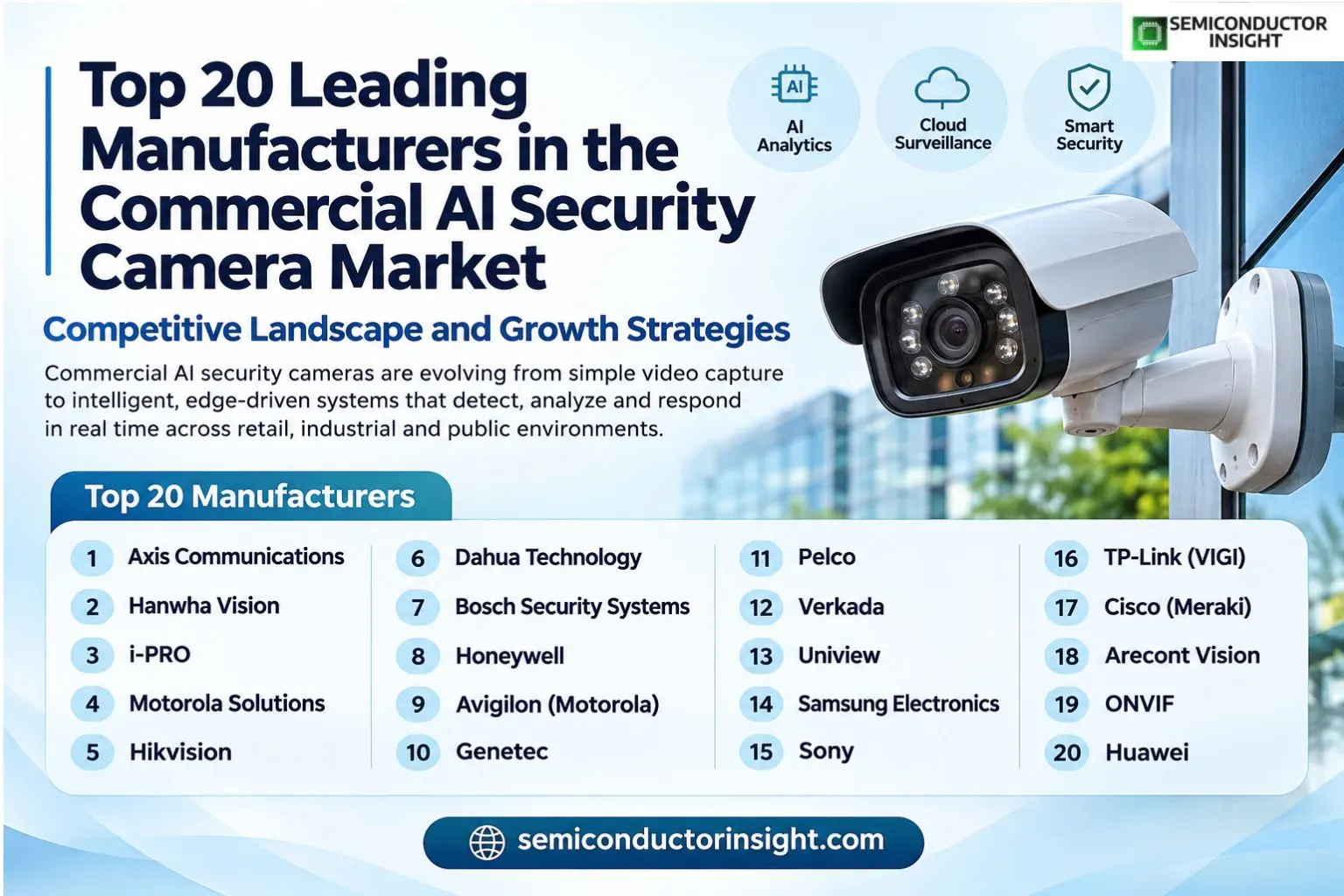
Top 20 Leading Manufacturers in the Commercial AI Security Camera Market: Competitive Landscape and Growth Strategies
The commercial AI security camera industry is undergoing a major technological transition. Traditional surveillance systems were primarily designed to capture and store footage, leaving security personnel responsible for reviewing recordings and identifying suspicious activity. Today’s commercial AI cameras are increasingly capable of detecting people and vehicles, recognizing unusual movement patterns, identifying unattended objects, monitoring restricted areas and generating alerts without requiring continuous human observation.
The market now extends across network cameras, AI-enabled image sensors, edge computing processors, video management software, cloud surveillance platforms and intelligent video analytics. Retail stores use camera intelligence to understand customer movement and monitor checkout activity, while warehouses apply automated detection to restricted zones, loading bays and worker safety. Airports, manufacturing plants, office campuses, hospitals and financial institutions are also adopting intelligent video systems to connect physical security with operational management.
Axis Communications: Purpose-Built AI Processing and Intelligent Network Camera Infrastructure
Axis Communications has a strong position in commercial AI security cameras through its development of network cameras with onboard analytics, advanced imaging and integrated cybersecurity. Its ARTPEC system-on-chip architecture is particularly important because it allows video processing and AI-based object detection to take place directly within the camera. This reduces dependence on centralized servers and makes intelligent monitoring practical across retail facilities, industrial sites, transportation infrastructure and large commercial buildings.
A significant 2026 development is Axis’s continued expansion of ARTPEC-9-based camera capabilities. At its 2026 Security and Integrate Exhibition in Australia, the company highlighted AV1 video encoding, which can improve encoding efficiency by up to 20% compared with previous standards. This is particularly relevant for installations operating hundreds or thousands of cameras, where storage and network bandwidth become major considerations. In India, Axis also achieved BIS ER-01 certification in July 2026, an important development for its domestic product compliance and deployment strategy. Its combination of edge analytics, video compression and cybersecurity makes it a particularly important technology provider in enterprise surveillance.
Hanwha Vision: High-Resolution AI Surveillance for Large Commercial Environments
Hanwha Vision is strengthening its position through high-resolution network cameras, AI-based object classification, thermal surveillance and intelligent search capabilities. Its Wisenet camera ecosystem is relevant to large commercial properties where a limited number of high-performance cameras may need to cover expansive areas without sacrificing identification detail. AI-based person and vehicle detection also helps operators filter unnecessary activity and prioritize incidents requiring attention.
On October 29, 2026, Hanwha Vision introduced a 45MP AI camera lineup designed for broad-area surveillance. The cameras support 45MP imaging at 15 frames per second and 33MP at 25 frames per second, combining high pixel density with onboard AI analytics. Another important development came in September 2026, when Hanwha Vision’s integration with Milestone XProtect introduced Similarity Search for cameras powered by the Wisenet 9 chipset. Operators can use an image of a person or vehicle to locate visually similar subjects across recorded footage. These capabilities make Hanwha particularly relevant to airports, logistics facilities, retail complexes and industrial campuses where rapid investigation is as important as continuous recording.
i-PRO: Generative AI at the Camera Edge and Context-Rich Incident Detection
i-PRO is developing an important differentiation in commercial security through its focus on edge-based AI, advanced image processing and cybersecurity-oriented surveillance equipment. Its cameras are designed to perform intelligent video analysis without requiring every task to be transferred to a central server. This is particularly valuable for hospitals, campuses, utilities and commercial buildings where rapid alerts, controlled data access and uninterrupted surveillance are important operational requirements.
Its March 19, 2026 announcement introduced its first cameras with generative AI operating fully at the edge. The X-series fisheye cameras support 360-degree coverage and natural-language interaction with live video, allowing operators to investigate scenes and receive contextual alerts without depending on cloud services or external analytics servers. In October 2026, i-PRO also introduced a remote-head camera designed for space-constrained and discreet surveillance installations. Its partnership with Kepler Vision Technologies in September 2026 further extended AI monitoring into patient safety applications. The company’s direction demonstrates how commercial surveillance cameras are evolving into intelligent computing devices rather than remaining passive image-capture equipment.
Motorola Solutions: Integrated Video Security Across Enterprise and Public-Safety Networks
Motorola Solutions has an important role in the commercial AI security camera industry because of its ability to connect video surveillance with access control, command-centre software, communications and public-safety operations. Its strategy extends beyond selling cameras to creating integrated security environments in which video intelligence can support incident response and coordinated decision-making. This is particularly relevant to airports, government facilities, transportation operators, industrial campuses and large commercial organizations.
Its November 2026 investor presentation reported approximately 5.5 million fixed video cameras deployed across more than 300,000 sites. More than 90% of its fixed video camera portfolio incorporated embedded AI capabilities, demonstrating how extensively intelligent analytics have become integrated into its video security offering. The company also reported $2.1 billion in video security and access-control sales in its investor overview. Its ability to connect camera alerts with command centres, access-control events and emergency communication systems creates a significant advantage in complex multi-site deployments.
Avigilon: AI-Powered Video Investigation and Enterprise Camera Intelligence
Avigilon has developed a recognizable position in commercial AI surveillance through intelligent video analytics, high-resolution cameras, appearance-based search and integrated access-control solutions. Its technology is particularly useful in facilities where security teams need to investigate incidents across multiple buildings, entrances and camera networks. Instead of reviewing recordings individually, operators can use AI-supported search capabilities to narrow down relevant footage based on visual characteristics and recorded events.
Its current deployment figures illustrate the scale of the ecosystem. Avigilon reports more than 5 million fixed video cameras installed across over 300,000 sites, alongside more than 1 million secured doors and operations across 150 countries. These figures demonstrate how the brand connects video surveillance with wider building-security infrastructure. As part of Motorola Solutions, Avigilon also benefits from integration opportunities across command-centre technology, public-safety communications and access control. Its competitive importance therefore comes from the complete surveillance workflow, extending from camera detection to investigation and response.
Genetec: Open-Architecture Video Management and Multi-Vendor AI Integration
Genetec plays a significant role in commercial AI surveillance through Security Center, its unified security platform that connects video surveillance, access control, intrusion monitoring and operational intelligence. Its importance is particularly visible in enterprises managing cameras from multiple manufacturers. Rather than requiring organizations to replace their existing surveillance infrastructure, its open architecture allows compatible camera systems and analytics technologies to operate within a common environment.
A major 2026 development is the continued expansion of Security Center SaaS. Its platform updates have introduced direct-to-cloud support for Bosch and i-PRO cameras, alongside existing Axis camera compatibility. The company has also expanded the integration of edge-generated analytics, including object detection, line crossing and gunshot detection events. Genetec’s 2026 State of Physical Security report identified video surveillance as a priority technology for approximately 44% of surveyed organizations, compared with 32% in 2025. Its focus on interoperability, cloud deployment and connected security operations makes it particularly relevant to organizations managing geographically distributed commercial facilities.
Ambarella: Edge AI Processors Powering the Next Generation of Security Cameras
Ambarella occupies a different but strategically important position in the commercial AI camera ecosystem. Rather than competing primarily as a finished camera manufacturer, it supplies image-processing and computer-vision processors that enable other security companies to develop intelligent cameras. Its CVflow architecture supports AI inference, image enhancement, video encoding and multi-stream processing, allowing camera manufacturers to incorporate sophisticated analytics without depending entirely on external computing hardware.
On January 5, 2026, Ambarella introduced its CV7 system-on-chip, manufactured using a 4nm process. The processor combines 8K video processing, encoding and decoding with onboard AI capabilities. Its applications include multi-imager enterprise security cameras, robotics and industrial automation. An important customer-development example appeared in 2026 when i-PRO introduced its first generative AI cameras using Ambarella’s CV72 processor. Ambarella also disclosed customer activity involving IDIS, Axis and IQSight in its 2026 investor communications. These relationships demonstrate how semiconductor suppliers influence the capabilities of finished commercial security cameras.
VIVOTEK: Intelligent Retail Surveillance and AI-Enabled Connected Cameras
VIVOTEK has developed its commercial surveillance business around network cameras, intelligent video analytics, cloud-connected monitoring and integrated security management. Its solutions are relevant to retail stores, transportation facilities, corporate offices and logistics environments where cameras need to deliver more than basic intrusion detection. Retail-oriented applications include people counting, occupancy monitoring, customer movement analysis and activity-based alerts.
A major structural development occurred in April 2026 when VIVOTEK’s branded business combined with March Networks. The integration creates opportunities to connect VIVOTEK’s camera hardware with March Networks’ video intelligence, cloud storage and investigation software. In February 2026, VIVOTEK also introduced generative AI enhancements and safety detection capabilities within its VORTEX platform. Its Chroma24 AI cameras, introduced in January 2026, further highlight the importance of colour imaging in low-light surveillance environments. The company’s expanding relationship with March Networks is especially relevant because commercial customers increasingly want unified camera and software ecosystems rather than separate surveillance products.
For More Detailed Insights, You Can Surf Our Latest Report Here: https://semiconductorinsight.com/report/commercial-ai-security-camera-market/
Bosch Security Systems: Deep-Learning Analytics for Complex Commercial Environments
Bosch Security Systems has a strong technical presence in intelligent surveillance through its FLEXIDOME, DINION, AUTODOME and MIC camera families. Its Intelligent Video Analytics Pro technology uses deep-learning models to distinguish people, vehicles and other relevant objects in complex scenes. These capabilities are especially important in transport infrastructure, industrial plants, commercial campuses and perimeter-security installations where lighting variations, moving vehicles and crowded environments can make conventional motion detection unreliable.
Its IVA Pro portfolio covers several specialized applications, including buildings, perimeter protection, traffic, intelligent tracking, appearance analysis and personal protective equipment detection. This is particularly relevant to manufacturing facilities, where security cameras can also identify workers entering restricted areas or failing to wear required protective equipment. In 2026, Bosch’s integration into Genetec Security Center SaaS expanded the availability of its camera analytics events through direct-to-cloud workflows. Its Flexidome camera developments also feature AI-based person and vehicle detection. Bosch’s combination of specialized analytics and established commercial camera infrastructure positions it as an important participant in intelligent video surveillance.
Hikvision: DeepinView Intelligence and Cybersecurity-Oriented Network Cameras
Hikvision has an extensive portfolio of commercial AI surveillance technologies, including DeepinView cameras, AcuSense detection, network video recorders and AI-enabled video management solutions. Its product development focuses on improving detection accuracy, reducing unnecessary alerts and supporting applications such as perimeter protection, traffic monitoring, industrial surveillance and commercial property security. Its Guanlan AI model initiative also reflects the increasing role of large-scale AI technologies in video interpretation and intelligent surveillance.
A notable 2026 development occurred on July 3, when Hikvision announced that its DeepinView iDS-2CD7x network camera series had obtained EUCC cybersecurity certification at the Substantial assurance level, corresponding to EAL3 with additional flaw-remediation requirements. The assessment was conducted under the European cybersecurity certification framework, making it an important development for security-conscious commercial installations. The certification is particularly relevant as enterprises increasingly evaluate camera firmware, network protection, security auditing and software maintenance alongside imaging and AI performance.
Dahua Technology: WizMind Deep Learning and Multi-Application Video Intelligence
Dahua Technology has established a significant position through its WizMind and WizSense product families, which combine AI-enabled cameras, network video recorders, thermal imaging and intelligent analytics software. Its commercial applications extend across retail, industrial security, transportation and large commercial buildings. The company’s AI systems are designed to identify people and vehicles, support facial recognition, generate video metadata and perform automatic number-plate recognition. These functions allow security teams to search footage more efficiently and connect surveillance with operational requirements.
Its WizMind portfolio covers several hardware categories, including IP cameras, PTZ cameras, thermal cameras, XVRs, NVRs and software platforms. Certain network recorder configurations support up to 128 camera channels, which is relevant for larger installations requiring centralized video management. Its AI Codec technology also targets bandwidth and storage optimization, with the company reporting storage reductions of up to 50% against H.265 in typical conditions for specified implementations. The breadth of its product architecture makes Dahua particularly relevant to organizations seeking combined camera, recording and analytics infrastructure.
ONVIF: Open Interoperability Standards Connecting AI Security Camera Ecosystems
ONVIF is not a commercial camera manufacturer, but its contribution to the AI security camera industry is essential because it develops standards that allow compatible devices from different manufacturers to communicate. Its profiles support video streaming, device discovery, event management and interoperability between cameras and video management systems. This becomes particularly important when commercial customers operate surveillance infrastructure from multiple suppliers and want to avoid being locked into one proprietary ecosystem.
Its 2026 activities demonstrate how interoperability is expanding towards cloud-based surveillance and stronger digital trust. In July 2026, ONVIF released the Profile V draft for cloud video, aiming to support vendor-independent cloud surveillance systems. Its June 2026 specification update also introduced additional analytics metadata capabilities, including multidimensional sensor data. Another important September 2026 development was the release candidate for TLS Add-on 2.0, addressing cybersecurity and encryption requirements. ONVIF’s collaboration with the Coalition for Content Provenance and Authenticity also supports stronger digital video authenticity. These developments make the organization important to commercial AI camera deployment, particularly where enterprises require flexible integrations and reliable video evidence.
Verkada: Cloud-Managed AI Cameras and Natural-Language Security Search
Verkada is an important participant in cloud-managed commercial security because it combines cameras, access control, environmental sensors, alarms and centralized software within a unified platform. Its approach is particularly relevant to retail chains, educational institutions, corporate offices and businesses managing multiple locations. Rather than requiring individual camera systems to be managed separately, its Command platform provides centralized configuration, video investigation and security administration.
A significant 2026 development came through its AI-powered deterrence launch in February, which uses vision, audio and language models to identify potential intrusions and trigger contextual audio warnings. In May 2026, Verkada also introduced a new generation of cameras and expanded AI detection capabilities. Its September 2026 product updates introduced a more advanced AI search model, multi-condition natural-language searches and improved unified timelines connecting camera activity with access-control events. The company also announced six government-grade camera models, including two-camera and four-camera multisensor configurations. Its October 2026 product developments further highlighted the integration of AI agents with physical security workflows. These capabilities demonstrate the growing shift from video recording towards proactive commercial security operations.
March Networks: AI Video Investigation and Transaction-Linked Commercial Surveillance
March Networks has an important position in commercial surveillance through its video management platforms, intelligent search, cloud recording and business intelligence capabilities. Its solutions are particularly relevant to banking, retail, restaurants and distributed commercial operations where video recordings can be connected with transaction information and operational activity. This makes surveillance useful not only for investigating theft or unauthorized access but also for identifying procedural issues and understanding business operations.
A major 2026 development was the launch of Searchlight AI at ISC West, introducing generative AI capabilities that allow users to interact with video, transaction and operational information through conversational queries. On August 11, 2026, the company announced its mid-year product release, adding AI-powered search, cloud intelligence, broader VIVOTEK camera support and integration with C•CURE access control. The April 2026 combination with VIVOTEK’s branded business also created an opportunity to connect established camera hardware with enterprise video analytics. Its approach is particularly valuable for retailers managing hundreds of locations, where the ability to search across camera recordings and transaction records can improve investigations and loss-prevention workflows.
Milestone Systems: Open Video Management and AI-Driven Security Investigations
Milestone Systems is a major software participant in the commercial AI security camera ecosystem through its XProtect video management platform. Its open-platform architecture enables businesses to connect cameras, analytics applications and other security technologies from different manufacturers. This is especially important for large organizations that have already installed multiple camera generations and want to introduce AI functionality without replacing their entire surveillance infrastructure.
A particularly relevant development occurred on September 29, 2026, when Milestone highlighted the integration of Hanwha Vision’s Similarity Search into XProtect. The feature enables investigators to begin with an image of a person or vehicle and locate visually similar subjects across recorded footage. Existing search functions cover person attributes, vehicle characteristics, license plates and barcodes. Milestone’s 2026 product releases also include cloud capabilities and developments towards an AI-native open security platform. A study highlighted in its 2026 press-release portfolio reported that XProtect reduced security investigation time by up to 60% and delivered 133% ROI in the studied deployment. These developments reinforce its importance in software-led commercial surveillance.
Cisco Meraki: Smart Cameras Connecting Physical Security with Enterprise IT Networks
Cisco Meraki has a distinctive position in commercial surveillance because its MV smart cameras connect video security with enterprise networking and centralized IT management. Its architecture is relevant to organizations that want to manage cameras, wireless access points and network switches through a unified administrative environment. The cameras support machine-learning-based people and vehicle detection, object tracking and motion heatmaps, making them useful for both security and commercial operations.
Its May 26, 2026 camera datasheet describes an architecture that combines onboard processing, local video storage and cloud-managed administration. The platform supports deployments ranging from a single camera to more than 10,000 cameras. It also eliminates the requirement for a separate network video recorder in supported configurations through onboard storage and cloud archiving. The MV Sense capability allows custom computer-vision models to run directly on compatible cameras. This creates applications in retail footfall measurement, office occupancy analysis, queue monitoring and workplace safety. Its strength lies in simplifying large commercial deployments through integration with existing IT infrastructure.
Honeywell: Integrated Building Security and AI Video Management
Honeywell is relevant to the commercial AI camera market because it connects video surveillance with building automation, access management and facility operations. Its strategic importance comes from serving environments where physical security needs to work alongside building management systems, visitor controls and operational monitoring. This includes corporate campuses, retail networks, hospitals, manufacturing facilities and commercial real estate.
A significant 2026 development was its March 26 collaboration with Rhombus, which introduced AI-powered cloud video and access solutions for commercial buildings. The partnership combines Honeywell’s access-control and building automation expertise with Rhombus’ cloud-managed video platform. The companies are working towards integrating AI analytics with access-control workflows, allowing organizations to connect video events with building-entry information. The offering initially targeted North America, with plans for broader regional availability. This development is particularly important because enterprises increasingly prefer connected security platforms rather than separate systems for cameras, access control and building operations.
Eagle Eye Networks: Cloud AI Search across Existing Camera Infrastructure
Eagle Eye Networks has developed a strong cloud-centric approach to commercial AI surveillance through its video management platform, cloud-connected recording infrastructure and intelligent search capabilities. Its technology is particularly relevant to retail chains, financial institutions, commercial property operators and multi-location businesses that need centralized video access without maintaining complex local analytics infrastructure at every site.
Its Smart Video Search capability allows users to search recorded footage using natural-language descriptions of people, vehicles and objects. The system can identify characteristics such as clothing colours, vehicle types and colours, and commonly encountered objects including backpacks, handbags and bicycles. Importantly, its cloud-based AI processing can add intelligent search capabilities to existing compatible camera infrastructure without requiring dedicated AI hardware at every camera location. This is commercially relevant for businesses that want to upgrade older surveillance installations gradually rather than replace hundreds of cameras at once. Its API-based ecosystem also creates opportunities for third-party security applications and enterprise integrations.
Rhombus Systems: AI-Driven Physical Security and Intelligent Building Operations
Rhombus Systems is developing an integrated approach to commercial security through cloud-managed cameras, access-control hardware, sensors and AI-powered video analysis. Its relevance extends beyond traditional surveillance because its platform is designed to help organizations connect security information with daily building operations. This is particularly useful for businesses managing multiple offices, manufacturing facilities, schools and retail locations.
Its October 14, 2026 launch of Rhombus MIND represents an important development in the use of generative AI for physical security. The AI assistant enables users to ask questions about camera activity, access-control events and connected security data through natural-language interactions. It can also generate reports and support operational actions through the platform. Earlier, in March 2026, Rhombus partnered with Honeywell to connect cloud video security with access management and building automation. The combination is relevant because commercial customers increasingly want to know not only what happened on camera but also which access events, locations and operational conditions were associated with an incident.
IDIS: AI Fisheye Surveillance and Specialized Commercial Camera Applications
IDIS has a notable position in the commercial AI camera industry through its network cameras, video management systems, recording solutions and specialized surveillance equipment. Its products are relevant to education, retail, transportation and enterprise security, where wide-area visibility and reliable video evidence are essential. Fisheye cameras are particularly useful in environments such as classrooms, reception areas, retail floors and large indoor spaces because a single device can provide broad visual coverage and reduce blind spots.
An important 2026 development was the recognition of its 13MP AI Fisheye Camera, model DC-Y8D11WRA, in the 2026 Campus Security Awards. The camera was featured in the official awards handbook on July 28, 2026, highlighting its relevance to educational security installations. Ambarella’s 2026 investor communications also identified IDIS as a customer using its CV72 processor in a premium 4K dome camera with AI-based perception capabilities. This illustrates the relationship between camera manufacturers and semiconductor suppliers in delivering advanced imaging and intelligent video analytics.

Comments (0)