

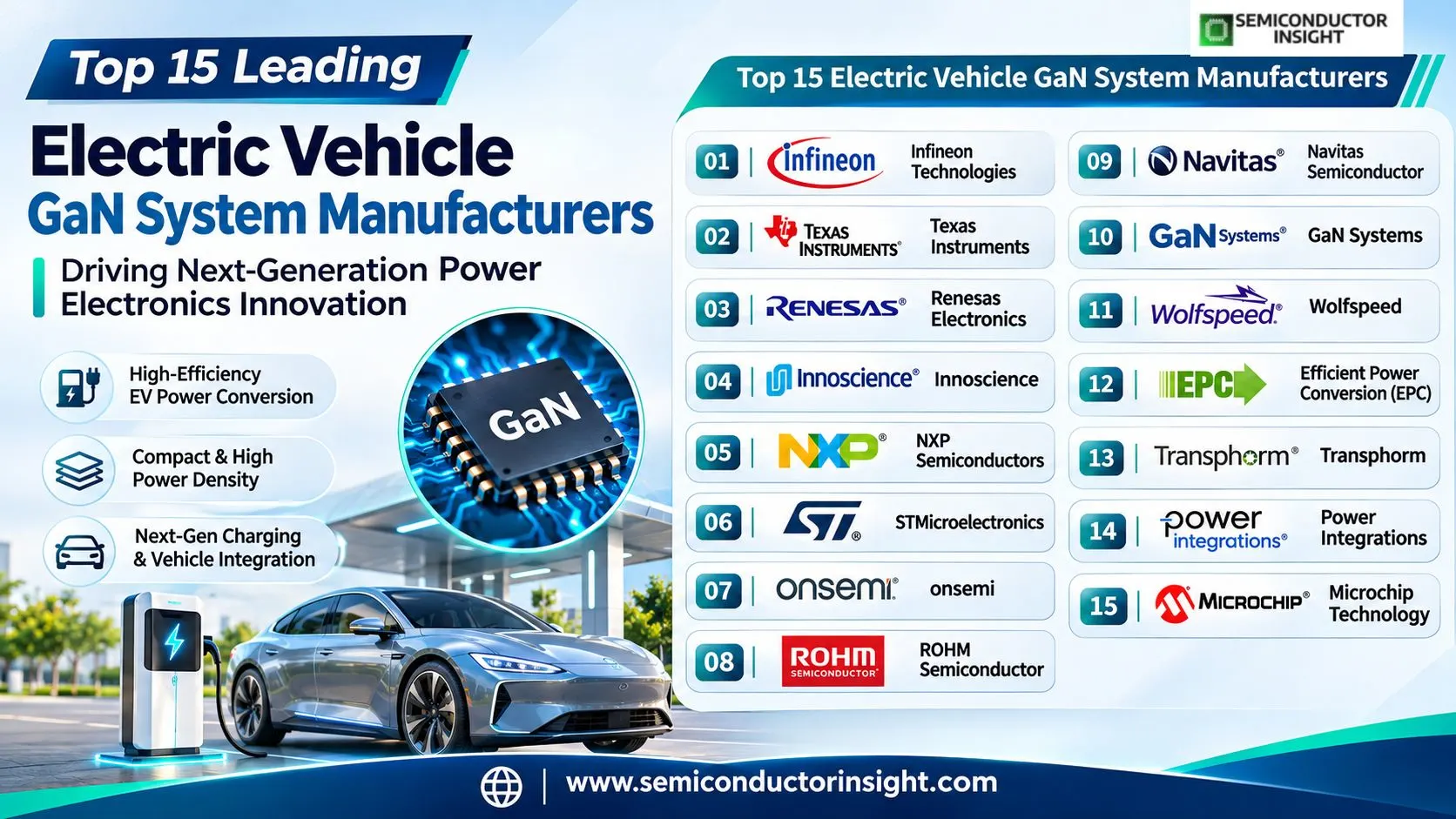
Top 15 Leading Electric Vehicle GaN System Manufacturers Driving Next-Generation Power Electronics Innovation
Electric Vehicle GaN System Market covers the development and deployment of gallium nitride (GaN)-based power semiconductor devices and integrated power systems used to convert, control and distribute electrical energy in electric vehicles.
These systems are relevant to onboard chargers, DC-DC converters, traction-related auxiliary power electronics, battery-management support circuits and high-frequency charging architectures.
Market leadership map
The strongest competitive positions are emerging in three different areas: automotive-qualified GaN devices, complete onboard-charger and DC-DC reference architectures, and vehicle-level integration partnerships. A company with a large GaN catalogue is not automatically a leading EV supplier; evidence of automotive qualification, vehicle deployment or a relevant design platform carries greater weight.
The ranking below therefore gives greater prominence to companies with a demonstrable connection to EV power conversion. It also distinguishes announced technology from products already in production or deployed in vehicles.
Infineon Technologies – Automotive qualification and system-level integration
Infineon holds a strong position because its EV proposition extends beyond selling individual GaN transistors. Its automotive portfolio connects power switches with gate drivers, digital control, isolation and onboard-charging architectures. The company’s CoolGaN automotive roadmap covers 48 V/12 V DC-DC conversion, high-voltage onboard chargers and high-voltage-to-low-voltage conversion, with automotive-suitable products undergoing qualification and sampling. Its OBC architecture supports 11 kW and 22 kW charging designs, while commercial-vehicle solutions are being developed around 400 V and 800 V battery systems. This breadth is important for automakers seeking to standardise power-electronics platforms across passenger cars, commercial vehicles and future bidirectional charging systems.
A particularly important part of Infineon’s competitive position is its acquisition of GaN Systems. Rather than treating GaN Systems as an unrelated competitor, the acquisition brings its technology and expertise into Infineon’s wider power-semiconductor offering. This strengthens Infineon’s ability to combine GaN devices with its existing automotive power portfolio. The company’s technical work on GaN topology selection for onboard chargers and traction-related applications also points towards a system-design strategy, not simply a component-sales strategy.
Texas Instruments – High-efficiency charging architectures backed by reference designs
Texas Instruments stands out through its work on GaN-based onboard chargers and high-voltage power conversion. Its EV GaN portfolio addresses single-phase onboard chargers and high-to-low-voltage DC-DC converters, where high switching frequency can reduce the size of transformers, inductors and other magnetic components. TI reports a combined system-level efficiency of 96.5% for its highlighted GaN solution, with switching frequencies exceeding 500 kHz in CLLLC conversion and 120 kHz in power-factor-correction stages. These are relevant design figures for automakers seeking compact charging systems without sacrificing conversion performance.
One of TI’s strongest 2026 developments is its TIDA-010957 reference design, published in March 2026. It covers a 15 kW to 30 kW bidirectional, three-phase GaN power stage, using 650 V-rated devices in a three-level topology for DC bus voltages up to 900 V. The design operates at an equivalent switching frequency of 125 kHz and reports 98.9% efficiency at full power. Bidirectional conversion is especially relevant as EV platforms move towards vehicle-to-home, vehicle-to-grid and other two-way energy applications.
Renesas Electronics – A broader GaN portfolio after the Transphorm acquisition
Renesas has strengthened its position by bringing GaN power devices, control technologies and reference designs under one semiconductor platform. Its acquisition of Transphorm was completed in June 2024, giving Renesas access to established GaN technology and allowing it to combine power switches with controllers, drivers and other power-management components. The company lists applications ranging from a 1.2 kW high-voltage GaN inverter and a 3.6 kW Vienna rectifier to a 500 W onboard battery charger for two-wheel electric vehicles. That two-wheeler application is particularly relevant in markets where compact, cost-sensitive electric mobility is expanding.
Renesas also introduced a significant high-voltage GaN package in September 2026: a 650 V device with dual-side cooling in an 8 mm × 8 mm package and an on-resistance of 20 mΩ. The company reported a 57% smaller package footprint compared with its TOLT package reference. The announced device is positioned for high-density 800 V data-centre power architectures rather than being an EV-specific product launch. Nevertheless, the development demonstrates Renesas’ progress in compact high-voltage packaging, a capability relevant to future automotive power-conversion designs.
Innoscience – A vehicle-deployment example for 650 V GaN
Innoscience deserves a high position because its GaN technology has moved beyond laboratory demonstrations into a named vehicle programme. In December 2025, Innoscience and Inovance Automotive announced the successful installation of a 6.6 kW GaN-based onboard charger in Changan vehicles. The system integrates the onboard charger and DC-DC converter into a two-in-one unit, using 650 V GaN devices. The companies reported a 30% increase in power density to 4.8 kW/L, an improvement of more than 2 percentage points in overall efficiency, and a 20% reduction in system weight compared with the referenced products.
This is an important commercial signal for the Electric Vehicle GaN System Market. It shows how GaN can support the consolidation of two traditionally separate onboard power functions into a more compact package. Innoscience’s value proposition also includes manufacturing scale and process development: its 2026 company reporting describes plans to expand 8-inch GaN wafer production and highlights automotive-grade GaN products used in bidirectional 6.6 kW OBC plus 3.5 kW DC-DC systems. These developments make Innoscience a significant contender, particularly in the Asian EV supply chain.
You can freely browse our most recent updated report to learn more about it before scrolling further: https://semiconductorinsight.com/report/electric-vehicle-gan-system-market/
Efficient Power Conversion (EPC) – GaN device innovation and strategic technology licensing
EPC is an important specialist in enhancement-mode GaN power devices, with a portfolio aimed at high-frequency and high-density power conversion. Its market relevance comes from its focus on the device characteristics that influence system design, including low on-resistance, gate charge and switching performance. In February 2026, EPC announced a strategic GaN technology licensing and second-sourcing agreement with Renesas. The arrangement gives Renesas access to EPC’s low-voltage eGaN technology and supply-chain ecosystem, with both companies planning to establish internal wafer-fabrication capabilities for the licensed products.
The agreement is strategically important because it extends EPC’s influence beyond its own component shipments. It creates another route for its GaN technology to reach high-volume power-conversion markets through a larger semiconductor supplier. EPC’s 2026 product activity also includes its Gen 7 family, with the 25 V EPC2378 and 18 V EPC2370 designed for high-current DC-DC conversion. These are not high-voltage EV onboard-charger devices, so their relevance is strongest in lower-voltage power stages and supporting conversion systems rather than the main traction inverter.
Nexperia – Expanding 650 V options for compact power stages
Nexperia is building its GaN position through a broad portfolio covering low-, medium- and high-voltage devices, including bidirectional GaN switches. Its June 2026 expansion of the 650 V GaN FET range added devices in 35 mΩ, 50 mΩ and 70 mΩ classes, with packages including TO-247-3, TO-247-4, TOLL and TOLT. This range gives power-system designers more flexibility to select devices according to conduction loss, thermal performance and packaging requirements. Nexperia’s product catalogue also includes production-status 650 V devices in compact CCPAK and other package formats.
For EV applications, the relevance is in high-voltage conversion and the potential for more compact power-electronics assemblies. However, the June 2026 650 V portfolio announcement describes the devices as industrial-grade and does not establish a specific vehicle production programme. Nexperia’s separate June 2026 collaboration with Semikron Danfoss concerns SiC-based automotive traction-inverter modules, not a GaN vehicle module. Keeping that distinction clear is important: Nexperia is a meaningful GaN device supplier, while it’s publicly announced automotive module collaboration is currently focused on SiC.
Navitas Semiconductor – High-power GaN expertise with a changing application focus
Navitas has developed a recognisable position in GaN power semiconductors through its GaNFast, GaNSafe and GaNSlim product families, alongside its SiC portfolio. Its technology range includes devices spanning from low-voltage products to 650 V GaN FETs, giving designers options for different power-conversion stages. At PCIM 2026, the company highlighted GaN devices ranging from 0.8 mΩ at 100 V to 11 mΩ at 650 V, as well as bidirectional GaN products. Such characteristics are relevant to high-frequency conversion and compact power-stage development.
An important 2026 consideration is Navitas’ strategic shift towards high-power markets, particularly AI data centres, grid infrastructure and industrial electrification. Its second-quarter 2026 SEC-filed investor presentation describes a reallocation of resources towards these segments and an expansion of its 800 V power architecture activity. This does not remove its relevance to EV power electronics, but it does mean that its current public growth emphasis is broader than vehicle charging alone. For a market ranking, Navitas remains a significant GaN technology company, while its near-term EV-specific momentum should be assessed separately from its high-power infrastructure opportunity.
Power Integrations – High-voltage GaN ambitions for emerging 800 V platforms
Power Integrations is differentiated by its internally developed PowiGaN technology and its focus on highly integrated power-conversion products. Its GaN switches are incorporated into power-conversion ICs, helping reduce external component requirements in suitable designs. The company’s technology roadmap has moved into higher voltage classes, with its 1,250 V and 1,700 V GaN technologies aimed at demanding power architectures. These voltage levels are relevant to the broader development of high-voltage electrical systems, including future 800 V EV power infrastructure and auxiliary conversion applications.
The most notable 2026 announcement came on 5 August, when Power Integrations demonstrated 2,200 V PowiGaN technology. The company positioned it for next-generation high-voltage systems, including EVs, renewable energy and high-voltage DC infrastructure. This is a technology demonstration, not evidence that 2,200 V GaN products are already deployed in mass-production vehicles; the company indicated that physical products would follow later. Its significance lies in the attempt to extend GaN into voltage ranges traditionally dominated by other power-semiconductor technologies.
ROHM Semiconductor – Strengthening GaN manufacturing for EV power conversion
ROHM is increasing its focus on GaN supply capability as demand expands from consumer charging products into higher-voltage power conversion. In February 2026, the company announced plans to combine its own GaN development and manufacturing technologies with process technology licensed from TSMC. The stated objective is to establish an end-to-end, in-group production system and strengthen supply capability for applications that include electric vehicles and onboard chargers. This is significant because automotive adoption requires not only efficient devices but also consistent manufacturing quality, process control and dependable long-term supply.
ROHM’s opportunity is linked to the transition towards higher-voltage onboard charging and more compact vehicle power systems. The company’s announcement specifically identifies EV onboard chargers as an expanding application for GaN, although it does not disclose a named 2026 vehicle programme or a production volume for automotive GaN devices. Its partnership-led manufacturing strategy nevertheless places it among the companies to watch as the supply chain develops from discrete GaN products towards automotive-grade power solutions.
STMicroelectronics – Connecting GaN development with automotive power-electronics expertise
STMicroelectronics brings a broad power-semiconductor and automotive electronics background to the GaN market. Its technology information identifies EV onboard chargers and mild-hybrid DC-DC converters as suitable applications for GaN, particularly where high switching frequency and low switching losses can reduce system size. ST also highlights bidirectional switching as a useful capability for certain onboard-charger topologies. Its packaging work, including embedded and low-parasitic-inductance approaches, is relevant because high-speed GaN switching places greater demands on layout, thermal management and electromagnetic compatibility.
In May 2026, ST announced seven new 700 V PowerGaN enhancement-mode transistors, with continuous-current ratings spanning 6 A to 29 A and typical on-resistance from 53 mΩ to 270 mΩ. The devices were offered in DPAK, TO-LL and PowerFLAT packages. The announcement focused on AI servers, robotics and industrial systems rather than a dedicated EV product launch, so these parts should not be described as already deployed in vehicle onboard chargers. However, the combination of 700 V devices, automotive application knowledge and power-conversion packaging gives ST a credible platform for further EV-oriented GaN development.
onsemi – Building a GaN portfolio around automotive power systems
onsemi entered a more visible phase of GaN development through its GaNEXUS portfolio, announced in June 2026. The initial range covers 40 V to 650 V devices, including 650 V GaN FETs with integrated protection features. The company is positioning the portfolio for automotive power systems as well as AI infrastructure, industrial automation and energy applications. For EVs, the company identifies low- and medium-voltage GaN for compact DC-DC conversion, while high-voltage GaN is intended for efficient isolated power stages.
The manufacturing strategy is another point of differentiation. In December 2025, onsemi announced a collaboration with GlobalFoundries to develop and manufacture 650 V lateral GaN-on-silicon devices using a 200 mm process platform. The companies planned to combine GaN technology with onsemi’s drivers, controllers and thermally enhanced packaging, with sampling expected to begin in the first half of 2026. This is a meaningful step towards a more integrated EV power portfolio, particularly for onboard chargers and DC-DC converters, although the announcement itself does not confirm a mass-production vehicle award.
GaN Systems – A specialist technology platform now within Infineon
GaN Systems remains an important name in the EV GaN landscape because of the technology and expertise it contributed to Infineon following the acquisition. Its relevance is best understood through its legacy as a specialist GaN power-device business, rather than as a separate independent competitor in the current market. The combination gives Infineon access to an additional GaN technology base that can complement its automotive power-semiconductor portfolio, including work on onboard charging and high-voltage-to-low-voltage conversion.
For market profiling, GaN Systems should therefore be presented as an acquired technology platform within Infineon, not counted as a fully independent supplier alongside its parent. Its contribution is strategically important because EV manufacturers increasingly evaluate complete power stages, not only the transistor itself. The value of the acquisition is reflected in the broader development of Infineon’s CoolGaN automotive roadmap and its efforts to connect device technology with automotive-qualified system solutions.
Transphorm – The GaN technology base supporting Renesas’ expansion
Transphorm is another acquired business whose market influence continues through its parent company. Renesas completed the acquisition in June 2024, bringing Transphorm’s GaN power technology into a larger semiconductor portfolio. The transaction expanded Renesas’ wide-bandgap capabilities and was accompanied by the introduction of 15 GaN-based winning-combination reference designs. This gave Renesas a route to offer GaN switches alongside controllers, drivers and related power-management products.
Its relevance to EV power systems is tied to the broader Renesas GaN portfolio, which includes high-voltage conversion and onboard-charging applications. The important distinction for a current company ranking is that Transphorm is not a separate independent listed competitor following the acquisition. It is more accurately described as a technology foundation within Renesas’ GaN business. This distinction avoids double-counting while recognising the role Transphorm’s devices and engineering capabilities played in expanding Renesas’ position.
Inovance Automotive – Turning GaN devices into production-ready EV power systems
Inovance Automotive represents the vehicle-system integration side of the market. Unlike the semiconductor manufacturers above, its importance is not based on selling GaN chips; it lies in converting those devices into onboard power systems that automakers can integrate into vehicle platforms. Its collaboration with Innoscience produced a 6.6 kW two-in-one onboard power system, combining the onboard charger and DC-DC converter. The system was reported as successfully installed in Changan vehicles in December 2025, making it one of the clearest publicly announced examples of GaN moving into an actual vehicle programme.
The reported system improvements – 4.8 kW/L power density, a 20% reduction in weight and an efficiency improvement of more than 2 percentage points – illustrate why vehicle integrators are important to the market’s commercial development. Semiconductor performance only becomes meaningful to an automaker when it translates into a smaller, lighter, reliable and manufacturable power unit. Inovance’s role in this partnership demonstrates how GaN suppliers and automotive electronics companies can jointly accelerate adoption.
Semikron Danfoss – Power-module engineering and the automotive integration ecosystem
Semikron Danfoss is relevant as a power-module and system-integration participant rather than as a pure-play GaN transistor manufacturer. Its capabilities in module packaging, thermal management and power-electronics integration are important to EV architectures, where switching devices must operate reliably under demanding electrical and thermal conditions. In June 2026, the company announced a strategic collaboration with Nexperia focused on SiC-based automotive traction-inverter modules. This was not a GaN collaboration, but it illustrates the company’s role in bringing semiconductor technologies into automotive-ready power modules.
Its inclusion is therefore based on the wider EV power-electronics ecosystem and its ability to influence how advanced semiconductor devices are packaged and adopted. As GaN expands into onboard chargers, auxiliary converters and selected high-frequency power stages, module engineering partners can become important in thermal design, electrical interconnection and manufacturability. It would be inaccurate, however, to describe the June 2026 Nexperia partnership as a GaN traction-inverter programme.

Comments (0)