

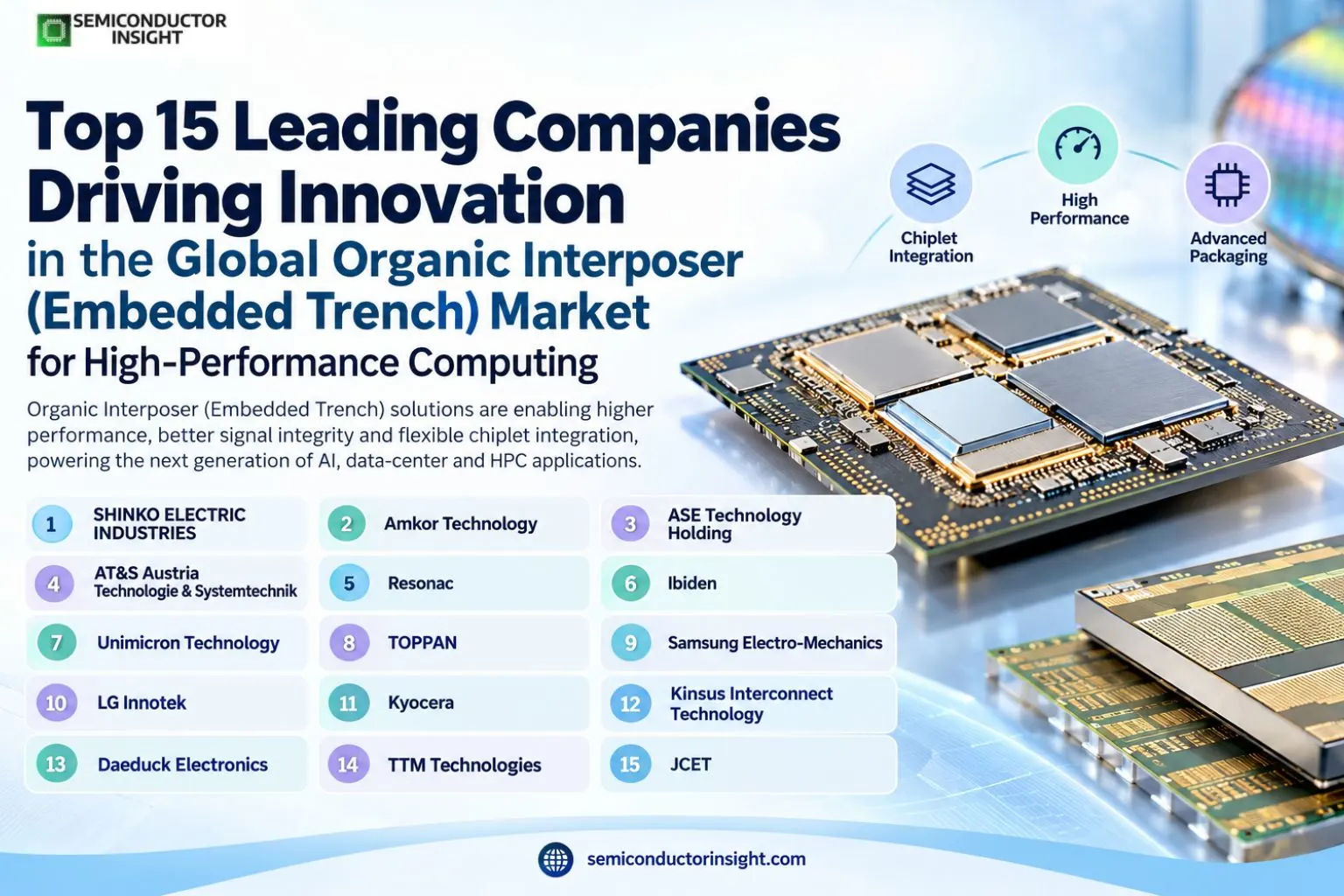
Top 15 Leading Companies Driving Innovation in the Global Organic Interposer (Embedded Trench) Market for High-Performance Computing
Organic Interposer (Embedded Trench) solutions are reshaping how high-performance chips talk to each other. These polymer-based platforms with precisely engineered trench structures deliver fine-line interconnects, improved signal integrity, and flexible power delivery for chiplet-based AI accelerators, high-bandwidth memory stacks, and data-center processors.
In contrast to full silicon interposers, they enable hybrid integrations that keep up with the rapidly increasing computation densities in 2026 and beyond, scale more easily to bigger panel forms, and remove certain cost obstacles.
SHINKO ELECTRIC INDUSTRIES continues advancing substrates that serve as active integration platforms rather than passive carriers. At the 2026 IMPACT conference the company outlined roadmaps linking compute dies, HBM, high-speed interconnects, power networks, and emerging optical I/O. In September 2026 it secured Japan Display’s Mobara fab spanning hundreds of thousands of square meters to establish a core advanced-packaging base, with production targeted for fiscal 2028.
Parallel work includes 22-layer glass-core concepts reinforced against stress and edge defects, plus a NEDO-backed photonics-electronics project aiming for at least tenfold productivity gains in optical chiplet packaging. These moves position Shinko to supply the denser, multi-function substrates demanded by next-generation AI systems.
Amkor Technology is scaling interposer and high-density fan-out capacity at a rapid clip under multi-year customer commitments. A October 2026 expansion with NVIDIA targets more than 300 percent growth in South Korean interposer-wafer output by the end of 2028, while a two-phase Arizona campus represents an estimated 12 billion dollar investment with more than 90,000 square meters of clean-room space planned.
Computing revenues already posted sequential and year-over-year gains driven by HDFO CPU programs and additional 2.5D networking packages entering production. Capital spending for 2026 is set near 2.5 billion dollars, with further increases expected as the company converts advance payments from a dozen customers into new lines supporting AI infrastructure.
ASE Technology Holding is pushing panel-level packaging that improves package count per carrier. In late 2026 the company showcased FOEB technology for AMD’s Venice CPU on 310 by 310 mm panels, yielding roughly 25 interposers after edge loss versus 22 on traditional 300 mm wafers an approximate 14 percent gain with initial production eyed for early 2027 at limited scale in Kaohsiung.
Capital spending for 2026 was raised to 10.5 billion dollars to support leading-edge advanced packaging, including organic RDL approaches such as FOCoS-B. These efforts directly address the throughput and cost pressures of larger reticle-size interposers needed for high-performance compute.
AT&S Austria Technologie & Systemtechnik remains a key European supplier of high-end package substrates that incorporate embedded-bridge architectures. The company is among the qualified sources for EMIB-T style substrates used in complex multi-die packages, delivering the fine circuitry and thermal management required for AI and server applications.
Ongoing capacity at its Malaysian facilities supports the shift toward larger, denser organic platforms that reduce reliance on pure silicon interposers while maintaining signal integrity across multiple dies.
Resonac is anchoring collaborative development of panel-level organic interposers through the 27-member JOINT3 consortium. The group is building an Advanced Panel Level Interposer Center at the Shimodate plant to house a prototype line for 515 by 510 mm panels, with operations scheduled to begin in 2026. Participants span materials, equipment, and design tools, enabling verification of structures that closely match production conditions. The initiative targets higher throughput and lower cost per interposer for AI, HPC, and advanced consumer packages by moving beyond wafer-scale limits.
Ibiden is committing substantial new capital to AI-oriented IC package substrates. In October 2026 the company announced roughly 151 billion yen of investment centered on its Kawama site in Gifu, with equipment due to ramp from fiscal 2029.
Additional capacity at the Ono plant is supported by multi-billion-dollar customer prepayments that are expected to triple output for NVIDIA platforms starting in early 2028. These expansions address the tight supply of high-function substrates that currently constrain AI server and accelerator production.
To find out more, feel free to browse our latest updated report: https://semiconductorinsight.com/report/organic-interposer-embedded-trench-market/
Unimicron Technology is locking in longer-term AI substrate capacity amid rising demand. NVIDIA-related expansion at the KF plant is scheduled to add output from the second quarter of 2027 and reach full operation by mid-2028.
The company has approved equipment pre-orders valued at tens of billions of Taiwan dollars to support new lines and process upgrades, while targeting AI-related revenue above 60 percent of total sales. These steps help relieve substrate bottlenecks for large multi-die packages used in data-center accelerators.
TOPPAN is mapping a multi-year path from glass-core structures toward organic RDL interposers. Presentations at industry forums in 2026 highlighted challenges such as back-cracking and second-level reliability while outlining progressive improvements in data traffic handling and power efficiency.
Work continues on glass interposers combined with RDL layers, positioning the company to supply hybrid platforms that bridge near-term glass adoption and longer-term organic scaling for high-bandwidth applications.
Samsung Electro-Mechanics is advancing organic-bridge technology as a practical alternative to silicon interposers. Joint development with Qualcomm has produced FC-BGA substrates embedding organic bridges featuring five to seven RDL layers, targeted line/space of 1.5-2 μm, and via sizes of 4-5 μm, aiming for 500-1,000 die-to-die connections per millimeter.
At the 2026 KPCA Show the company displayed 2.1D and 2.5D substrates optimized for AI accelerators, alongside expanded NVIDIA substrate capacity at Sejong and Busan sites. These platforms reduce dependence on constrained silicon interposer capacity while supporting high-speed interconnects for inference and training workloads.
LG Innotek has introduced larger-format AI substrates that expand available real estate. At the 2026 KPCA Show it presented its first FC-BGA samples exceeding 100 mm on a side approximately 40 percent larger area than prior 85 mm designs targeted at high-performance accelerators. Parallel collaboration with NVIDIA is expanding dedicated substrate production to support computing and networking chips, contributing to the broader 2.5-fold substrate capacity growth planned across NVIDIA’s supply chain over three years.
Kyocera continues refining organic interposer and high-density substrate technologies that support chiplet integration and fine-pitch interconnects. Its process platforms address warpage control and signal integrity requirements for AI and networking packages, enabling reliable multi-die assemblies that operate under the thermal and electrical loads of modern data-center environments.
Kinsus Interconnect Technology supplies advanced organic substrates used in high-performance packaging flows. The company’s capabilities in fine-line circuitry and multi-layer build-up support the transition toward larger interposer formats and embedded trench structures that improve power delivery and reduce latency between logic and memory dies.
Daeduck Electronics contributes high-density organic platforms tailored for AI and server applications. Its manufacturing focus on precise trench and via formation helps meet the interconnect density needed for heterogeneous integration, allowing system designers to place more chiplets within a single package envelope.
TTM Technologies delivers specialized organic interposer and substrate solutions for demanding compute and networking markets. Process expertise in controlled impedance and multi-layer routing supports the signal-integrity requirements of embedded-trench designs used in next-generation accelerators and switches.
JCET (including its advanced packaging operations) is expanding organic RDL interposer capacity to serve domestic and global AI accelerator demand. Panel- and wafer-level approaches enable higher package counts and cost-effective scaling, complementing silicon-based solutions while supporting the rapid growth of chiplet-based architectures in high-performance computing.

Comments (0)