

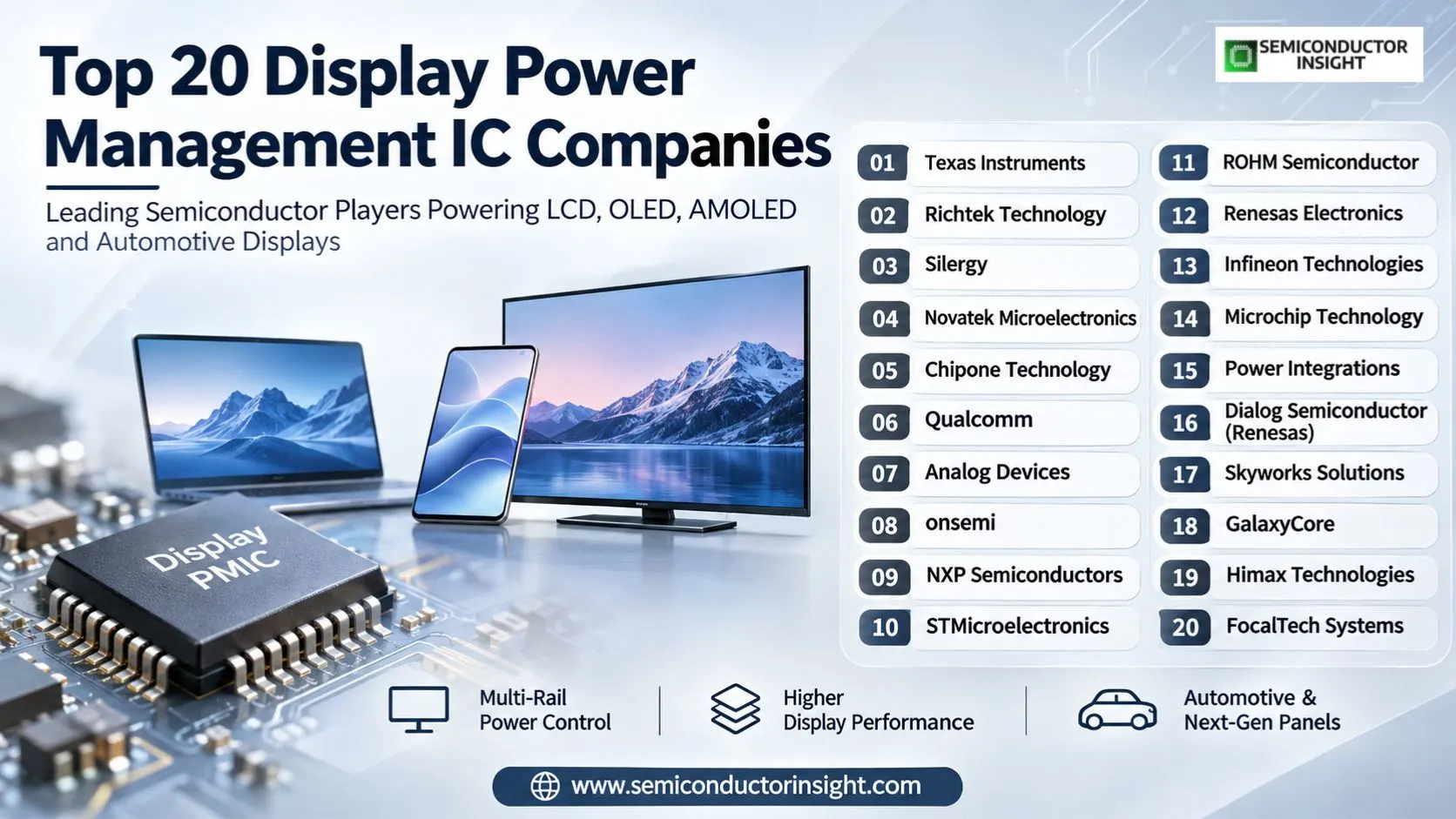
Top 20 Display Power Management IC Companies Shaping the Next Generation of LCD, OLED and Automotive Screens
Display Power Management IC (PMIC) market operates at the intersection of display engineering, semiconductor design and power-efficiency optimisation. These chips perform a critical function that is often overlooked when evaluating display performance: they generate, regulate and sequence the multiple voltage rails required by LCD, OLED, AMOLED and emerging display technologies. Their responsibilities can include supplying source and gate drivers, controlling positive and negative bias voltages, managing gamma references, regulating backlighting and protecting sensitive display components against electrical faults.
As displays move towards higher resolutions, thinner designs, flexible panels, higher refresh rates and larger automotive screens, power architecture is becoming increasingly sophisticated. A modern display module may require several precisely controlled power rails, integrated protection functions and communication with the display driver or application processor. For example, AMOLED panels commonly require ELVDD, ELVSS and AVDD supplies, while TFT-LCD architectures can require AVDD, VGH, VGL and VCOM-related circuitry.
Texas Instruments – Building a Broad Voltage-Control Platform for LCD and OLED Panels
Texas Instruments holds an important position in display power management through its dedicated LCD and OLED power portfolio. Its product range covers LCD bias supplies, AMOLED power supplies, level shifters and gamma buffers, allowing display designers to select components according to panel size and electrical requirements. Its TPS65160, for example, integrates four-channel LCD bias functionality, supporting boost and buck conversion with outputs reaching 20 V.
The TPS65146 combines three-channel LCD bias with an LDO, VCOM buffer and reset functionality in a 24-pin package. These specifications make TI relevant to notebook, monitor, television and industrial display designs. Its portfolio also addresses AMOLED applications from compact wearable screens to notebook panels, giving it exposure to multiple display categories rather than a single device segment.
Richtek Technology – Combining AMOLED Bias and Automotive Display Power Solutions
Richtek has developed a specialised portfolio covering AMOLED power supplies, LCD bias circuits, display PMICs and automotive panel power modules. Its RT4733 is particularly relevant to wearable AMOLED applications, integrating five channels, including three LDO regulators and two negative outputs. It operates from a 2.9 V to 5.5 V input range, with positive and negative AMOLED supply outputs designed for compact OLED panels.
The company’s wider product catalogue also includes RT4706 triple DC-DC conversion and RT4723 dual-output AMOLED bias solutions. In automotive applications, Richtek’s display solutions extend to TFT-LCD power modules with programmable voltage control and AEC-Q100 Grade 2 qualification. This combination of wearable and automotive design coverage strengthens its position in applications where power stability, compact packaging and display reliability are essential.
Silergy – Extending Multi-Rail Integration into Mini-LED and OLED Displays
Silergy is developing its display PMIC portfolio around highly integrated, multi-channel power solutions for LCD, OLED and Mini-LED panels. Its dedicated Display PMIC category identifies the need to manage several supply requirements within increasingly complex display architectures. This is particularly relevant to Mini-LED designs, where backlight control and panel power regulation must work together to maintain brightness consistency and reduce unnecessary energy consumption.
- Silergy’s Q2 2026 product catalogue, updated on 12 June 2026, includes separate display and automotive PMIC categories, indicating continued attention to specialised application requirements.
- Its wider PMIC portfolio also highlights flexible configuration and functional-safety support.
- The company’s opportunity lies in combining multiple power functions into compact semiconductor solutions for consumer electronics, automotive displays and advanced panel modules.
Novatek Microelectronics – Linking Display Drivers with Integrated Power-Control Development
Novatek’s importance comes from its broad display-driver and system-control ecosystem, particularly in LCD, AMOLED and automotive applications. Its 2025 annual-report information identifies mobile AMOLED driver ICs, foldable-phone display drivers, tablet solutions, automotive driver ICs and wearable display products within its portfolio. The company is also developing Mini-LED driver ICs, automotive AMOLED drivers, AR/VR display drivers and AI gaming-monitor SoCs.
A notable technical milestone came in December 2025, when Novatek introduced a next-generation PMIC with improved GMA OP ripple performance and dynamic Vint operational-amplifier adjustment. The feature is intended to reduce low-luminance display artefacts, including water-ripple effects, while supporting changing frame-rate conditions. This development illustrates how power management is increasingly connected to image quality rather than being treated as a standalone voltage-generation function.
Chipone Technology – Strengthening Panel-Level Power Management for OLED and Large Displays
Chipone Technology has a direct connection to the display power management IC segment through its portfolio of panel display drivers, power management chips and display-control ICs. Its product applications span LCD, LED, OLED and AR/VR systems, with end uses in smartphones, televisions, laptops, tablets, monitors and wearable devices. One notable development is its OLED power-management solution for a 15.6-inch 4K UHD AMOLED notebook panel, which the company identifies as the first product of its kind to enter mass production in China.
This is an important application because large AMOLED panels require coordinated power delivery to multiple display components while maintaining image stability. Chipone also reports OLED driver verification with BOE and mass production of OLED wearable chips with mobile-device manufacturers. These panel relationships give the company relevance in the transition towards higher-resolution and larger-format OLED displays.
Himax Technologies – Expanding Display Power Integration into Automotive and OLED Panels
Himax is a significant display semiconductor supplier with capabilities spanning display-driver ICs, timing controllers, touch controllers and power-management ICs. Its annual-report disclosures describe PMICs as essential components for supplying precise voltage to source drivers, gate drivers, timing controllers and panel cells. The company is extending its display technology into OLED notebooks, tablets and automotive screens. Its 2026 investor presentation highlights OLED driver and timing-controller development, including solutions supporting resolutions up to 4K2K and 8K4K in selected product categories.
In its 2026 business updates, Himax also discussed a broader notebook OLED portfolio incorporating display drivers, TCON, PMIC and touch controllers. This integrated approach is important because power sequencing, image timing and touch performance increasingly need to be engineered together, especially in automotive displays and premium notebooks.
To find out more, feel free to browse our latest updated report: https://semiconductorinsight.com/report/global-display-power-management-ic-market/
Global Mixed-mode Technology (GMT) – Addressing Electronic Paper and Specialised Display Power
Global Mixed-mode Technology has an especially relevant position in display PMICs because its solutions cover LCD, OLED, electroluminescent, electronic-paper and automotive panels. Its electronic-paper portfolio demonstrates how display power requirements can differ significantly from conventional LCD and OLED systems. The G8200 PMIC, for example, supplies source- and gate-driver power, includes a VCOM amplifier and temperature sensor, and provides two DC-DC channels and two LDO channels. Its programmable rails are controlled through an I²C interface.
GMT has also developed power solutions for colour electronic-paper displays, including the G2194, which provides six DC-DC and six LDO channels. The G2195, designed for larger electronic-paper signage, includes 12 DC-DC controller channels and supports multiple panel voltage requirements. These products position GMT in specialised display categories where power sequencing and panel-specific voltage control are particularly important.
Analog Devices – Bringing Precision Power Engineering to Automotive OLED and Micro-LED Displays
Analog Devices is relevant to display power management through its precision analogue and power-conversion technologies, particularly in advanced automotive display architectures. Its technical guidance on automotive displays explains that OLED and Micro-LED systems require TFT bias PMICs and dedicated display power supplies. A typical consumer OLED power architecture may combine two boost converters with an inverting buck-boost converter to generate the required voltage rails.
Automotive implementations can demand higher supply current because of larger panel dimensions, alongside additional reference voltages for TFT bias. These requirements make power accuracy, thermal behaviour and electrical protection increasingly important. ADI’s engineering focus is particularly relevant to vehicle dashboards, centre information displays and multi-screen cockpit systems, where several displays must operate reliably under changing vehicle electrical conditions.
Monolithic Power Systems – Connecting Display Power and Backlight Control
Monolithic Power Systems (MPS) participates in display power and control through its dedicated product family, which includes backlight drivers, LDOs, power-management components and display-related solutions. Its broader power portfolio is useful for display manufacturers seeking to integrate power conversion, current regulation and control functions into compact systems.
Backlight management remains important for LCD televisions, monitors, notebooks and automotive instrument clusters, where brightness adjustment must be balanced against power consumption and thermal limits. MPS’s Q3 2025 investor overview explicitly lists display power and control as a product category, including white-LED backlight drivers and LDO solutions. Its relevance is therefore strongest in the wider display power ecosystem, particularly where backlight control and supporting power rails are required alongside panel-driver electronics.
Renesas Electronics – Supporting Automotive TFT-LCD Power and Precision Voltage Regulation
Renesas has a strong technical foundation in display power regulation through integrated TFT-LCD DC-DC converters, gamma buffers, digitally controlled potentiometers and backlight LED drivers. Its ISL78419 is an automotive TFT-LCD power supply designed for central displays, rear-seat entertainment systems and virtual dashboards. The device includes a 1.5 A integrated boost switch, charge-pump-generated VON and VOFF supplies, an LDO for logic voltage, a VCOM amplifier and an I²C interface.
It is also AEC-Q100 qualified, making it relevant to automotive electronics where operating reliability is a major design consideration. Renesas’ wider display IC portfolio supports the analogue voltage requirements that feed LCD column drivers, including gamma-reference and contrast-control functions. Its strength lies in the combination of power conversion and precision analogue control for automotive and industrial display modules.
STMicroelectronics – Integrating Three-Rail AMOLED Power for Compact Devices
STMicroelectronics has a dedicated LCD/OLED display power portfolio with a particular emphasis on AMOLED power management for smartphones and portable consumer electronics. Its STMP30 PMIC integrates three DC-DC converters to generate ELVDD, ELVSS and AVDD, the three important supply rails used by AMOLED display systems. The device supports a 2.9 V to 4.8 V input range and includes adjustable output voltage, SWIRE and I²C communication, inrush-current management and thermal and short-circuit protection.
Its always-on display capability is especially relevant to smartphones and wearable products, where the screen may need to show limited information without consuming the energy required for full display operation. The three-rail integration also reduces the need for separate external power circuits, supporting compact module designs.
Magnachip Semiconductor – Developing Multi-Channel OLED Panel Power Solutions
Magnachip is an important participant in display PMIC development, particularly for OLED panel applications. Its disclosed PMIC architecture supplies power to source drivers, gate drivers and timing controllers through multiple functional blocks, including boost converters, buck converters, operational amplifiers and positive and negative LDOs. This integrated approach is designed to improve voltage stability and manage the power requirements of OLED panels.
Its reported product applications include UHD televisions, LCD/LED televisions, smartphones, notebooks and set-top boxes. The company’s 2026 filing also describes products at different development stages, including mass production and customer qualification. The combination of established display applications and qualification-stage products gives Magnachip relevance in the continuing transition towards more integrated display power circuits.
LX Semicon – Connecting Display Driver Expertise with Panel Power Requirements
LX Semicon is relevant to the display power management ecosystem through its focus on display-driver ICs and panel control technologies. Display-driver manufacturers operate closely with PMIC suppliers because the source and gate drivers require carefully regulated voltages, synchronised power sequencing and stable reference levels. LX Semicon’s relevance is therefore strongest in the broader display chipset supply chain, particularly for television, monitor, notebook and mobile display applications.
Its positioning should be understood as part of the integrated panel-electronics ecosystem rather than assuming that every display-driver product is itself a standalone PMIC. For buyers evaluating display power solutions, the company’s driver-chip expertise is important when assessing compatibility between panel control, voltage generation and image performance.
FocalTech Systems – Supporting Compact Display Modules through Driver Integration
FocalTech Systems participates in the display semiconductor supply chain through display-driver and touch-display technologies. Its relevance to display power management comes from the close coordination required between touch controllers, display drivers and the power architecture of mobile panels. Smartphones and tablets increasingly use integrated touch-and-display solutions to reduce module thickness, simplify connections and improve system-level efficiency.
In such designs, the display power subsystem must deliver stable voltages without interfering with touch sensing or display timing. FocalTech’s position is therefore best viewed through its display-interface and driver ecosystem, rather than treating all its products as dedicated display PMICs. Its application relevance includes mobile devices and other compact interactive displays.
Raydium Semiconductor – Contributing to High-Resolution Panel Control Architectures
Raydium Semiconductor is associated with display-driver ICs for mobile and large-panel applications. Its contribution to the display power ecosystem is linked to the voltage and timing requirements of the panels supported by its driver products. As OLED and high-resolution LCD displays demand more complex source-driver and gate-driver arrangements, coordination between driver ICs and PMICs becomes increasingly important.
Raydium’s role is most relevant when panel manufacturers evaluate the complete display chipset, including driver architecture, voltage requirements and system compatibility. It should be classified as a display semiconductor ecosystem participant rather than a confirmed broad-line standalone display PMIC supplier.
Samsung Electronics – Using Display Manufacturing Scale to Influence Power Architecture
Samsung Electronics has an important position in the display semiconductor ecosystem through its involvement in OLED panel manufacturing and system semiconductor technologies. OLED panels require carefully managed positive and negative power rails, and the exact electrical requirements vary with panel size, brightness, refresh rate and product design.
Samsung’s influence is particularly relevant in smartphone, tablet, notebook and television display development, where panel specifications can shape PMIC design requirements. Its role in this company landscape is broader than that of a merchant display-PMIC supplier: it is a major display technology and manufacturing participant whose panel developments influence the specifications that component suppliers must meet.
MediaTek – Integrating Display and System Power Requirements in Connected Devices
MediaTek participates in display power management through its broader mobile and multimedia semiconductor platforms. Its system-on-chip products coordinate display processing, refresh-rate management and other device functions, while dedicated PMICs and supporting power components supply the required electrical rails.
This distinction is important: MediaTek’s influence is largely at the system-platform level, rather than through a broad standalone display-bias product catalogue. Its relevance increases as smartphones and tablets adopt adaptive refresh rates, high-resolution OLED panels and advanced display processing. Such devices require close coordination between the application processor, display driver and power subsystem to balance image quality with battery consumption.
ROHM Semiconductor – Supporting Functional-Safety-Oriented Automotive Display Systems
ROHM’s contribution is particularly relevant to automotive display electronics. Its automotive solutions combine panel drivers, timing controllers, LED backlight drivers and power-management components for instrument clusters and centre information displays. The company has also described an automotive panel chipset combining gate and source drivers, a timing controller and a PMIC, with communication between ICs to support functional-safety-oriented operation. This type of architecture matters as vehicles adopt larger instrument displays, centre screens and additional passenger-facing panels. ROHM’s wider power portfolio includes PMICs, switching regulators and linear regulators, giving automotive designers access to multiple components needed to construct reliable display power systems.
Diodes Incorporated – Providing Dedicated LCD and AMOLED Bias Components
Diodes Incorporated has a direct connection to display power management through its LED drivers for LCD backlights and AMOLED PMICs. Its display power portfolio includes devices that regulate current and voltage for white LEDs used in LCD panels, alongside PMICs that provide three programmable DC voltages for AMOLED biasing. The company also offers boost-converter solutions for LCD and OLED bias applications. Its ZXLD1615 evaluation-board documentation, for example, describes a converter capable of generating output voltages up to 28 V from a 2.5 V to 5.5 V input. These capabilities are relevant to mobile displays, portable electronics and compact display modules where high-voltage bias must be generated from a low-voltage battery supply.
NXP Semiconductors – Connecting Display Power Requirements with Automotive Electronics
NXP is relevant to the wider automotive display electronics ecosystem through its automotive processing, connectivity and power-management technologies. Modern vehicle displays are connected to multiple systems, including instrument clusters, infotainment processors, cameras, vehicle networks and driver-assistance interfaces. These systems require stable power delivery and careful coordination between the display module and the vehicle’s electrical architecture.
NXP’s strongest relevance is at the system and automotive electronics level, rather than as a direct specialist supplier of a broad range of standalone LCD and AMOLED bias PMICs. It is therefore an important adjacent participant when evaluating integrated automotive display platforms and their power-management requirements.

Comments (0)