

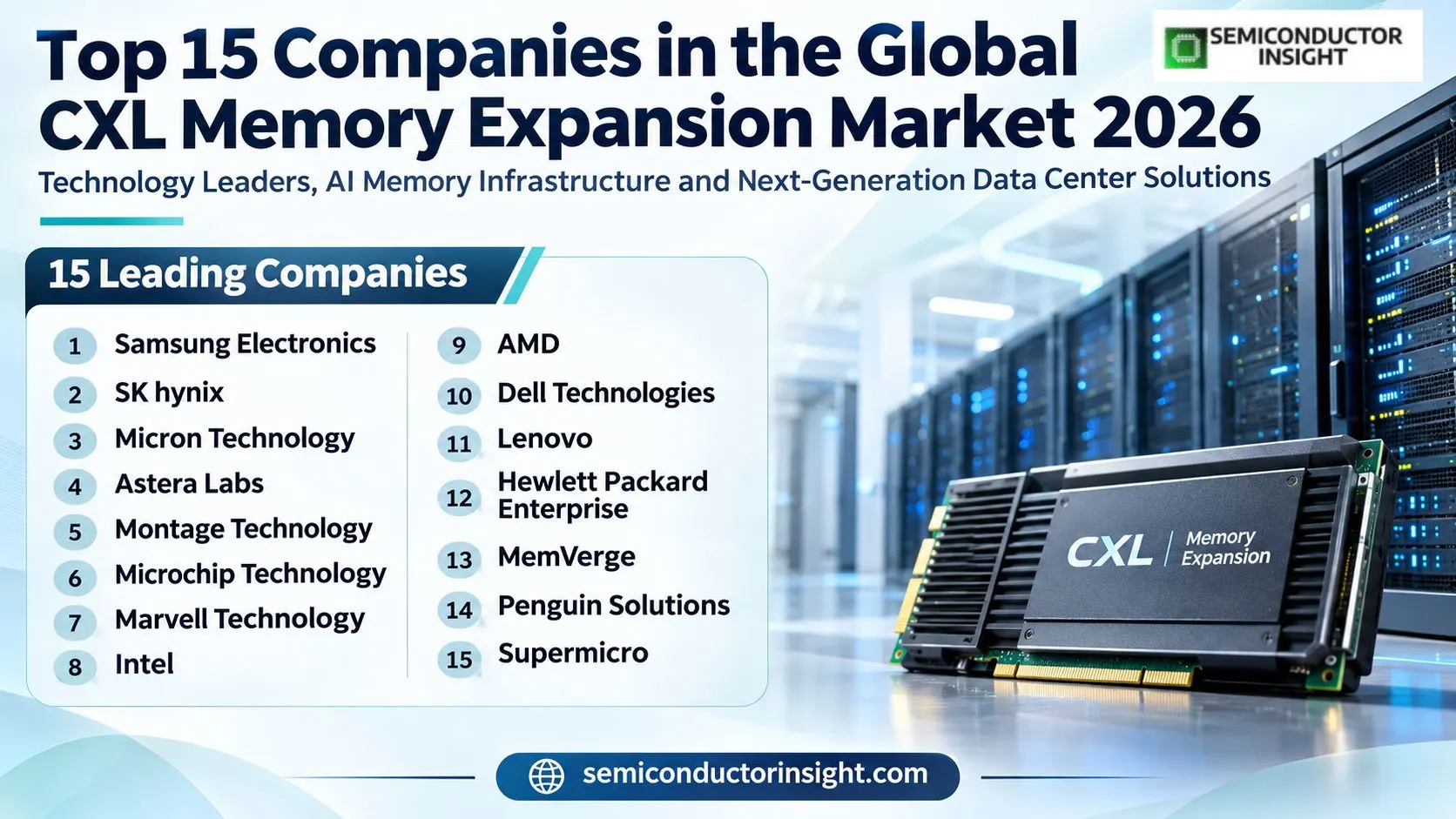
Top 15 Companies in the Global CXL Memory Expansion Market 2026: Technology Leaders, AI Memory Infrastructure and Next-Generation Data Center Solutions
CXL Memory Expansion Market is developing around a fundamental change in how data centres manage memory. Traditionally, server memory has been installed directly alongside CPUs through DIMM slots, creating physical limits on capacity, bandwidth and upgrade flexibility. Compute Express Link (CXL) is changing this architecture by enabling processors, accelerators and memory devices to communicate through a cache-coherent interconnect built on PCI Express technology.
This development is particularly relevant to artificial intelligence infrastructure, where large language models, recommendation engines, high-performance computing and in-memory databases require increasingly large memory footprints. Instead of purchasing additional servers whenever memory capacity becomes insufficient, data centre operators can use CXL Type 3 devices to expand memory independently of the host’s conventional DIMM configuration.
Samsung Electronics – Moving CXL Memory from Standalone Expansion Modules Towards Fabric-Based Pooling
Samsung Electronics is one of the most important memory suppliers in the CXL ecosystem because it combines DRAM manufacturing with memory-module engineering and advanced data centre integration. Its CXL Memory Module-DRAM (CMM-D) portfolio is designed to increase memory capacity without requiring conventional motherboard DIMM expansion. The company’s latest MD310 platform represents a particularly important development. It supports CXL 3.2 and PCIe 6.0, with a 256 GB DDR5 memory configuration and bandwidth of up to 72 GB/s. Its EDSFF E3.S 2T form factor is intended for high-density server environments. This is a significant shift from earlier CXL products that primarily focused on attaching additional memory to an individual server. Samsung’s open PCIe/CXL fabric architecture enables multiple hosts to dynamically share and allocate pooled memory. Its collaboration with Montage Technology on memory expansion controllers also strengthens its position across the hardware ecosystem. The company’s focus on AI infrastructure, memory pooling and high-capacity DRAM makes it a central participant in the transition towards disaggregated memory architectures.
SK hynix – Building AI-Optimised CXL Memory around Higher Capacity and Shared Resources
SK hynix is strengthening its CXL portfolio through its CMM-DDR5 product family, which targets servers requiring memory expansion beyond conventional DIMM configurations. Its first-generation 96 GB CMM-DDR5 module completed customer validation in April 2025 using the CXL 2.0 standard. A 128 GB product was also undergoing customer validation at that time. At OCP Global Summit 2026, the company demonstrated its second-generation 256 GB CXL 3.2 memory module, reporting bandwidth of up to 80 GB/s and approximately 30% better energy efficiency than the previous generation. The product also incorporates CXL pooled-memory functionality, allowing multiple servers to access a shared memory resource. SK hynix’s participation in Future of Memory and Storage 2026 further highlighted its interest in combining CXL with HBM, advanced NAND and tiered memory architectures. Its development strategy is particularly relevant to AI inference, where long-context models and expanding key-value caches increase the need for memory capacity beyond traditional server configurations.
Micron Technology – Establishing an Early Commercial Foundation for CXL Memory Expansion Modules
Micron Technology has built an important position in the CXL market through its CZ120 memory expansion module family. The company’s approach combines DRAM manufacturing, module-level integration and platform qualification, which are essential for bringing CXL memory into enterprise servers. The CZ120 is available in 128 GB and 256 GB configurations, using an E3.S 2T form factor and PCIe Gen 5 x8 connectivity. Each module incorporates two DDR4 memory channels and supports up to 36 GB/s of memory read/write bandwidth under the company’s specified test conditions. Micron also demonstrated how eight 256 GB modules could provide up to 2 TB of additional memory in a compatible system, subject to platform limitations. An important part of its strategy has been cross-platform qualification involving CPU providers, OEMs, operating systems and hypervisors. This matters because CXL adoption depends on much more than the physical memory device. The module must work reliably across the complete server environment. Micron’s established CZ120 platform gives it a relevant position in AI inference, in-memory databases, cloud computing and memory-intensive enterprise applications.
Astera Labs – Connecting Disaggregated Memory Through Smart Controllers and High-Speed Fabric Switching
Astera Labs is emerging as a specialist in the connectivity infrastructure required for CXL memory expansion and pooling. Its Leo Smart Memory Controller family, Scorpio fabric switches and Aries connectivity products address different parts of the memory and PCIe interconnect architecture. The September 2026 expansion of the Leo portfolio is particularly significant. The new Leo X-Series targets fabric-attached memory for AI inference and long-context workloads, while Leo 2 E-Series and P-Series support CPU-attached DDR4 and DDR5 expansion with PCIe 6 and CXL 3.2. Astera reported that its new E-Series and P-Series products double memory bandwidth and capacity compared with the previous generation. The company also reported up to 62% faster time to first token and up to 22% more tokens per second in internal tests involving its Leo X-Series and Scorpio fabric architecture. These are company-reported results rather than universal performance guarantees. Astera’s competitive strength comes from connecting memory controllers, switching and system management into a coordinated architecture rather than focusing on memory modules alone.
Montage Technology – Advancing CXL 3.2 Memory Controllers for Next-Generation Server Architectures
Montage Technology is an important semiconductor participant in the CXL memory expansion segment because its controllers provide the bridge between host processors and external DRAM resources. Its M88MX6852 Memory eXpander Controller supports CXL 3.1 and a PCIe 6.2 physical interface, with transfer rates reaching 64 GT/s over an x8 connection. The controller integrates a dual-channel DDR5 memory interface supporting speeds up to 8,000 MT/s, alongside two RISC-V microprocessors for application management and security functions. It is designed for EDSFF E3.S modules and PCIe add-in cards. A major development followed on 31 July 2026, when Montage announced trial production of its CXL 3.2 MXC controller. The new device supports PCIe 6.x, CXL.mem and CXL.io, and incorporates dual DDR5 memory controllers. This development is particularly important for server manufacturers looking to introduce memory pooling without designing an entire controller architecture internally. Montage’s relationships with Samsung, SK hynix, AMD and Intel also position it as an important ecosystem supplier.
Microchip Technology – Addressing Enterprise Memory Reliability Through Smart Memory Controllers
Microchip Technology occupies a specialised position in CXL memory expansion through its Smart Memory Controller portfolio. Its SMC 2000 family is designed to connect external DDR memory to host processors through CXL Type 3 interfaces. The product family includes 16×32G and 8×32G configurations, supporting CXL 1.1 and 2.0, DDR4 memory and PCIe 5.0 connectivity. A major differentiator is its emphasis on reliability, availability and serviceability rather than memory capacity alone. The controllers incorporate error-correction capabilities, telemetry, security functions and management features that are relevant to enterprise data centres. This is particularly important for applications such as financial databases, cloud infrastructure, virtualisation and scientific computing, where memory errors can disrupt business-critical operations. Microchip’s controller technology also supports the transition towards memory systems in which capacity can be expanded independently of the host processor’s conventional DIMM slots. Its contribution is therefore concentrated in the controller and interface layer that makes CXL memory modules practical for enterprise deployment.
Marvell Technology – Turning Memory Expansion Into a Rack-Level AI Infrastructure Strategy
Marvell Technology has moved beyond conventional memory expansion controllers through its Structera portfolio, which addresses both memory capacity and resource pooling. The Structera X family focuses on CXL memory expansion, while Structera S addresses switching and connectivity for shared memory architectures. On 17 March 2026, Marvell introduced Structera S 30260, a 260-lane CXL switch designed for rack-level memory pooling. It connects with Structera X expansion controllers, Structera A near-memory accelerators and Alaska P PCIe/CXL retimers. This creates an integrated approach to building memory resources outside individual servers. The company expanded its portfolio again on 12 October 2026 with the announcement of Structera X 3406 and 3506. These second-generation CXL 3.2 controllers support six DDR4 or DDR5 memory channels and PCIe Gen 6 connectivity, with up to 9 TB of DDR4 or 6 TB of DDR5 capacity per controller according to Marvell’s product announcement. Sampling is expected in the first quarter of 2027. Marvell’s partnerships with Samsung, SK hynix and hyperscale infrastructure customers make its memory fabric strategy particularly relevant to large AI data centres.
Intel – Enabling Host-Side CXL Memory Expansion Across Xeon Server Platforms
Intel plays a foundational role in the CXL memory expansion market because of its contribution to the standard and its integration of CXL connectivity into server processors. Its fourth-generation and fifth-generation Xeon Scalable processors, followed by Xeon 6, support CXL and PCIe 5.0. The Xeon 6 platform provides up to 64 lanes of CXL 2.0 connectivity at transfer rates of up to 32 GT/s per lane, enabling memory expansion and sharing through compatible Type 1, Type 2 and Type 3 devices. Intel’s Flat Memory Mode is another relevant development because it enables system memory expansion using lower-cost memory resources, including DDR4 in supported CXL configurations. The company’s role extends into the wider validation ecosystem, where processor compatibility, memory mapping, firmware and operating-system support determine whether expansion devices can operate reliably. Intel’s influence is therefore not limited to CPU shipments. Its host platform capabilities are essential to the commercial deployment of controllers and memory modules developed by companies such as Micron, Montage and Astera Labs.
AMD – Creating More Memory Expansion Flexibility through EPYC Processor Connectivity
AMD is strengthening its position in the CXL ecosystem through the fifth-generation EPYC 9005 processor family. The architecture supports up to 64 lanes of CXL 2.0 connectivity, depending on motherboard implementation, alongside PCIe Gen 5 connectivity. The EPYC 9005 range extends to 192 cores and 384 threads in selected models, with 12 DDR5 memory channels and up to 6 TB of supported DDR5 memory per socket under specified configurations. These characteristics make the platform relevant to memory-intensive virtualisation, AI infrastructure, analytics and high-performance computing. AMD’s published technical guidance also explains how older DDR4 memory can potentially be reused through compatible CXL expansion boards, even though DDR4 modules cannot be installed directly into the newer DDR5 DIMM sockets. This provides an interesting opportunity for enterprises seeking to extend the useful life of existing memory inventory. Its support for CXL Type 3 devices and memory pooling is also helping server manufacturers develop more flexible configurations. Dell’s PowerEdge R7725 platform provides a practical example of CXL memory expansion using fifth-generation AMD EPYC processors.
To Stay Tuned with More meaningful and In-Depth Insights, Do Visit here: https://semiconductorinsight.com/report/cxl-memory-expansion-market/
Dell Technologies – Bringing CXL Memory Expansion Into Configurable Enterprise PowerEdge Servers
Dell Technologies is an important system-level participant because it is translating CXL technology into configurable enterprise server platforms rather than limiting adoption to experimental memory devices. Its PowerEdge portfolio includes systems designed to support external CXL Type 3 memory through expansion cards. The PowerEdge R770 and R7725 are particularly relevant examples. Dell’s technical documentation identifies configurations that combine conventional DDR5 DIMMs with CXL memory expansion add-in cards. In the R770, a supported configuration can accommodate 3,072 GB of native memory and an additional 1,536 GB through CXL devices, bringing the documented system capacity to 4,608 GB. The R7725 configuration can reach 3,072 GB in total under its specified arrangement. Dell has also published performance and configuration guidance explaining how CXL memory appears as a separate NUMA node and why its latency characteristics differ from local DRAM. This is valuable for customers running in-memory databases, AI/ML workloads and large-scale virtualisation because it provides practical guidance on matching memory capacity with application requirements.
Lenovo – Integrating CXL Memory Into ThinkSystem Enterprise and High-Performance Computing Platforms
Lenovo is contributing to the CXL expansion market through its ThinkSystem server architecture and technical enablement of non-DIMM memory configurations. Its Lenovo Press documentation explains how CXL 2.0 enables memory expansion through EDSFF modules and other compatible device formats. ThinkSystem V4 platforms using Intel Xeon 6 processors support CXL 2.0 memory in the E3.S 2T form factor. This is relevant for enterprise customers that need to expand memory without redesigning the entire server motherboard. Lenovo’s engineering approach is particularly important because CXL integration requires coordination between processor connectivity, firmware, BIOS configuration, memory device qualification and operating-system support. Its documentation also distinguishes supported E3.S memory configurations from add-in cards, which were not supported in the cited initial platform guidance. This distinction matters for procurement teams because not every CXL memory module can be installed interchangeably across server platforms. Lenovo’s position is strongest in translating emerging CXL memory standards into validated enterprise server configurations for databases, virtualised workloads and high-performance computing.
Hewlett Packard Enterprise – Connecting CXL Memory Development With AI and High-Performance Computing Infrastructure
Hewlett Packard Enterprise is an important adjacent participant in the CXL memory expansion ecosystem because of its extensive involvement in AI servers, high-performance computing and memory-intensive enterprise infrastructure. Its relevance is linked to the growing need for larger memory footprints in GPU-accelerated computing, scientific simulation and large-scale data analytics. HPE’s Cray and ProLiant infrastructure provides a platform context in which memory bandwidth, processor connectivity and accelerator integration are important procurement considerations. However, HPE’s inclusion should be distinguished from companies with explicitly documented commercial CXL Type 3 memory modules or controllers. Publicly available product information does not establish a directly comparable 2026 CXL memory expansion module portfolio to Samsung’s MD310 or Micron’s CZ120. Its market relevance therefore lies in the enterprise server and HPC integration layer, where compatibility with emerging CXL memory devices can become increasingly important as the ecosystem matures. For buyers, the distinction between general CXL ecosystem participation and a validated CXL memory expansion configuration is essential when evaluating HPE platforms.
MemVerge – Making Shared CXL Memory Usable Through Software-Defined Memory Management
MemVerge is differentiating itself from semiconductor and server manufacturers by focusing on the software infrastructure needed to manage expanded and shared memory. Its Memory Machine X platform is designed to organise memory resources across local DRAM, CXL-attached memory and storage tiers. This is particularly relevant because adding external memory does not automatically ensure that applications use it efficiently. Software must determine where data should reside, when memory pages should move and how multiple servers can access shared resources. MemVerge’s Global IO-free Shared Memory Object technology, known as GISMO, enables applications to access memory objects across multiple nodes through memory semantics rather than relying exclusively on conventional network-based data transfers. In its published Ray AI framework testing, MemVerge reported 675% faster remote gets and 280% faster shuffles across four nodes. Its product materials also demonstrate applications involving MySQL, vector databases and LLM inference. The company is therefore addressing an important commercial requirement: turning CXL memory pooling into a usable infrastructure resource for enterprise applications.
Penguin Solutions – Bringing Reusable DDR4 Memory into the CXL Expansion Market
Penguin Solutions is a significant addition to the competitive landscape because it is addressing a practical issue in AI infrastructure: expanding memory capacity without relying entirely on new DDR5 procurement. On 12 November 2026, the company introduced its SMART CXL-8F2W-D4 memory expansion add-in card, designed to accommodate up to eight DDR4 RDIMMs. The solution uses Marvell’s Structera X CXL controller and supports compatible CXL 2.0 platforms. It is particularly interesting for data centres replacing older servers, where usable DDR4 inventory could otherwise become stranded. Penguin combines the hardware with its Zefr memory screening and qualification process to test recovered modules before deployment. On 16 November 2026, it also announced a strategic collaboration with Marvell covering direct-attached CXL expansion and a longer-term roadmap for photonic memory sharing across multiple racks. The SMART CXL card is expected to be available for qualified customer deployment by the end of 2026. This gives Penguin a distinctive position in the market through memory reuse, hardware validation and AI infrastructure integration.
Supermicro – Translating CXL-Ready Server Architecture into AI and Enterprise Computing Systems
Supermicro is an additional relevant participant because its server engineering business serves the same AI, cloud and high-performance computing infrastructure segments that are creating demand for CXL memory expansion. Its role should be understood primarily through system design and platform integration rather than as a standalone CXL memory controller manufacturer. Supermicro’s server configurations built around compatible Intel Xeon and AMD EPYC processor platforms provide the underlying processor, PCIe connectivity, memory slots, cooling and firmware environment required for external memory devices. The commercial opportunity is particularly relevant to AI inference, virtualisation and in-memory analytics, where memory capacity per server can become a limiting factor. However, CXL Type 3 compatibility must be verified at the individual motherboard and server configuration level. A processor supporting CXL does not automatically mean that every Supermicro server supports every CXL memory expansion device. This makes system qualification, firmware compatibility and validated add-in-card configurations important areas for its future participation.

Comments (0)