

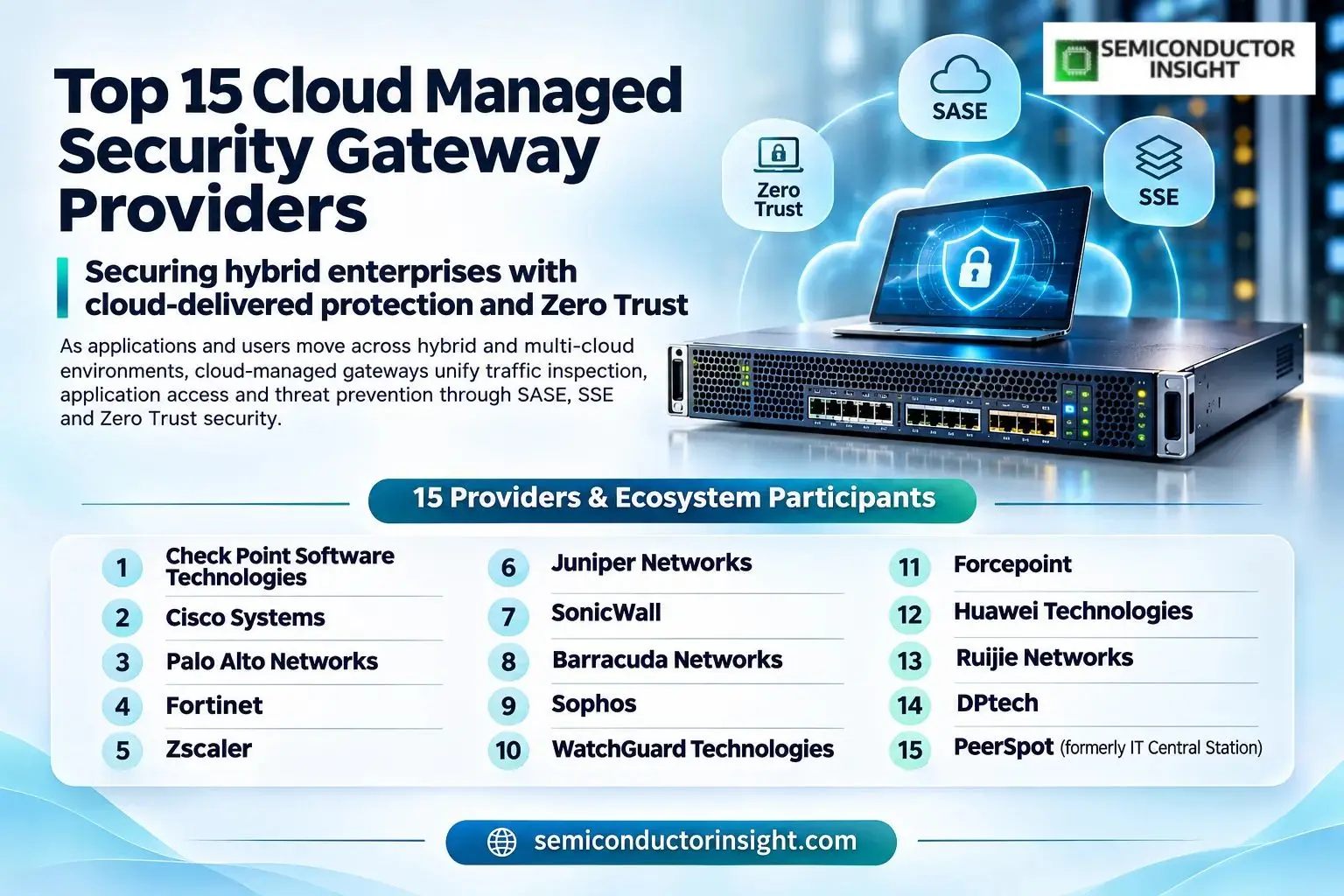
Top 15 Cloud Managed Security Gateway Providers Driving Innovation in Enterprise Cybersecurity and Zero-Trust Architecture
The Cloud Managed Security Gateway Market is evolving as enterprises move applications, sensitive information and network operations into hybrid and multi-cloud environments. Traditional perimeter firewalls are increasingly being complemented by cloud-delivered security platforms that inspect internet traffic, control application access, identify malicious connections and enforce security policies across geographically distributed users.
- The market is closely connected with Secure Access Service Edge (SASE), Security Service Edge (SSE), Firewall-as-a-Service (FWaaS), Secure Web Gateway (SWG), Cloud Access Security Broker (CASB) and Zero Trust Network Access (ZTNA).
- These technologies allow organisations to apply security controls without depending entirely on physical security appliances at individual office locations.
Check Point Software Technologies – Extending Cloud Security through Hybrid SASE and AI-Based Threat Prevention
Check Point is strengthening its position in cloud-managed security through its Check Point SASE platform, which combines secure internet access, private application connectivity, SaaS security and threat prevention. Its approach is particularly relevant to enterprises managing employees, branch offices and cloud workloads through different network environments. The company reports more than 12,000 SASE customers secured and over 80 global data centres, demonstrating the infrastructure supporting its distributed security architecture.
An important November 18, 2026 development is its expanded collaboration with Microsoft to deploy Check Point SASE on Microsoft Azure. The initiative is designed to improve global deployment flexibility, traffic routing and resilience. Its September and October 2026 platform updates also introduced improved AI application controls, browser security integration and a 100 MB threat-prevention file-scanning limit, compared with the earlier 10 MB limit. These developments strengthen its relevance in organisations seeking centrally managed security without compromising application performance.
Cisco Systems – Bringing Network Intelligence and AI Agent Protection into One Security Environment
Cisco is developing its cloud-managed security capabilities through Cisco Secure Access, which combines Zero Trust Network Access, Secure Web Gateway, CASB, FWaaS, Data Loss Prevention and Remote Browser Isolation. Its major advantage is the ability to connect security policies with wider networking and observability environments, including Cisco SD-WAN, Identity Services Engine, Splunk and ThousandEyes. This integration is useful for enterprises that want visibility into user identity, device conditions, application activity and network performance through a coordinated management environment.
A notable November 2026 development is Cisco’s introduction of AI semantic inspection capabilities for Model Context Protocol (MCP) traffic. The technology examines interactions between AI agents and MCP servers to identify risks such as prompt injection, tool poisoning and unauthorised data transfers. Cisco Secure Access therefore addresses an expanding requirement involving both human users and autonomous software agents. Its platform brings multiple security functions under a common cloud management architecture rather than treating web filtering and private access as isolated services.
Palo Alto Networks – Expanding Prisma Access into a Flexible Multi-Tenant Cloud Security Platform
Palo Alto Networks has established a significant presence in cloud-delivered enterprise security through Prisma Access, which protects remote users, branch locations and private applications. Its Strata Cloud Manager provides a central management environment for security policies, visibility and operational monitoring. An important area of differentiation is its ability to support enterprises and managed service providers operating multiple customer environments.
In September 2026, Palo Alto Networks introduced pay-as-you-go licensing for managed service providers through Prisma Access and its Strata Multitenant Cloud Manager. The model supports Prisma Access SASE SWG deployments starting at 50 users and SASE Enterprise deployments starting at 100 users. Its August 2026 resilience enhancements also introduced multi-region failover for selected cloud security services. These developments are commercially relevant because service providers can adjust tenant capacity without repeatedly purchasing fixed customer-specific licences, while enterprises gain additional continuity options.
Fortinet – Combining Cloud-Delivered Security with High-Performance Firewall Infrastructure
Fortinet’s contribution to the Cloud Managed Security Gateway Market comes from its integration of network firewalls, cloud security services, endpoint protection and security operations. FortiSASE extends Fortinet’s Security Fabric architecture into cloud-delivered access protection, while FortiGate provides hardware and virtual firewall capabilities for data centres, branches and cloud environments.
Two 2026 developments demonstrate this strategy. In July, Fortinet announced the FortiGate 1200G series with FortiSASE Outpost, enabling cloud-delivered security services to operate within customer-controlled environments. On October 27, it announced FortiLink SASE Service, designed to secure smaller branches and distributed facilities without requiring a dedicated on-site firewall. This is particularly relevant for organisations managing numerous retail outlets, remote offices and operational facilities. Fortinet’s approach connects centralised cloud security administration with local enforcement requirements, making hybrid deployment an important part of its proposition.
Zscaler – Building a Zero Trust Security Gateway for AI-Driven Enterprise Connectivity
Zscaler approaches cloud-managed security through its Zero Trust Exchange platform, which establishes application-level connectivity rather than relying on broad network-level access. Its architecture is designed to connect users, devices and workloads to authorised applications while inspecting traffic and enforcing access policies. Zscaler Internet Access and Zscaler Private Access address secure web access and private application connectivity, respectively.
A significant June 2026 development was its introduction of new security capabilities for autonomous AI agents. These include AI Broker functionality for governing agent communications through MCP and agent-to-agent connections, together with endpoint AI security capabilities. In March 2026, Zscaler also announced expanded data sovereignty capabilities, while its July partnership with Schwarz Digits introduced a sovereign Zero Trust SASE offering using Germany’s STACKIT cloud infrastructure. These developments highlight its relevance for multinational enterprises managing AI workloads and sensitive information under different national data regulations.
Juniper Networks – Advancing Secure Edge Architecture through AI-Driven Networking
Juniper Networks, now part of HPE, brings its networking expertise into the cloud-managed security environment through Juniper Secure Edge and Security Director Cloud. Its platform combines Secure Web Gateway, Firewall-as-a-Service, CASB, Data Loss Prevention and advanced threat prevention. A particularly useful capability is its support for cloud-delivered security alongside existing on-premises security deployments, allowing enterprises to transition towards SSE without completely replacing their existing infrastructure.
In 2026, HPE Networking Secure Edge documentation and Security Director Cloud release updates continued to expand the platform’s management capabilities. The architecture supports IPsec and GRE connectivity, SAML and LDAP identity integration, and centralised administration. Juniper also reports that its Secure Edge FWaaS identifies applications and inspects traffic for exploits and malware with over 99.8% effectiveness, based on its stated product performance. Its integration with AI-driven SD-WAN makes it relevant to organisations seeking coordinated network optimisation and cloud security enforcement.
A Brief Look at Our Detailed Analysis Report: https://semiconductorinsight.com/report/cloud-managed-security-gateway-market/
SonicWall – Taking Cloud Secure Edge into New Geographic and AI Security Environments
SonicWall is expanding its cloud security portfolio through Cloud Secure Edge, which combines secure internet access, private application connectivity and identity-based access policies. The platform is particularly relevant to organisations that need to protect remote employees, contractors and unmanaged devices without extending conventional network access to every endpoint.
A significant development occurred on September 2, 2026, when SonicWall announced three additional Cloud Secure Edge Points of Presence in Seoul, Johannesburg and Riyadh. This expansion brings security enforcement closer to users in Asia-Pacific, Africa and the Middle East. Its October 2026 product updates also introduced application discovery capabilities covering more than 6,000 categorised applications, helping administrators identify shadow IT and shadow AI usage. September updates further introduced controls for requiring approved corporate accounts when employees access selected AI applications. These capabilities demonstrate the platform’s transition from conventional remote access protection towards broader cloud-based application governance.
Barracuda Networks – Strengthening SecureEdge with Integrated Data Protection and AI Inspection
Barracuda Networks is developing its Cloud Managed Security Gateway capabilities through Barracuda SecureEdge, a cloud-first platform combining secure remote access, SD-WAN connectivity, web filtering and Zero Trust application protection. The solution is relevant to distributed organisations and managed service providers that need to protect remote users, branch networks and cloud-hosted applications through a common environment.
Its October 2026 SecureEdge updates introduced two particularly important capabilities: Data Loss Prevention and AI Prompt Inspection. The DLP functionality includes custom and built-in classifiers organised into four compliance profiles, allowing organisations to identify and control sensitive information moving through digital services. AI prompt inspection is increasingly relevant as employees use generative AI applications to process company information. Barracuda’s October release also expanded its SecureEdge Access capabilities, reinforcing the platform’s movement from basic ZTNA towards a broader Security Service Edge architecture.
Sophos – Integrating Cloud Gateway Access with Centralised Endpoint and Network Security
Sophos approaches cloud-managed gateway protection through its combination of Sophos Central, Zero Trust Network Access and Sophos Firewall. Its ZTNA architecture allows organisations to provide access to internal applications based on user identity and device trust rather than exposing entire network segments. This is particularly useful for businesses managing remote employees, third-party service providers and hybrid infrastructure.
A relevant 2026 development was the release of Sophos ZTNA Gateway versions 2.2.1 and 2.3.0 on October 6. These updates included platform upgrades, Kubernetes maintenance, security improvements and reliability fixes for customer-managed gateway deployments on VMware ESXi and Microsoft Hyper-V. Sophos also supports both cloud gateway and on-premises gateway deployment models, allowing customers to select an architecture according to their application location and infrastructure requirements. This flexibility strengthens its position among organisations looking for integrated endpoint, firewall and application-access security.
WatchGuard Technologies – Simplifying Cloud Firewall Management for Distributed Businesses
WatchGuard Technologies is extending its security portfolio through FireCloud, a managed cloud-based Firewall-as-a-Service platform designed to protect remote users from internet-based threats. Its offering is particularly relevant to small and medium-sized enterprises and managed service providers that want centrally administered protection without deploying and maintaining separate security appliances for every remote employee.
Its October 29, 2026 FireCloud update introduced a beta capability to import network resources directly from existing Firebox configurations. The feature can use existing Mobile VPN with SSL configuration information to help create network resources in FireCloud. Another important enhancement allows administrators to define access to entire internal networks or subnets rather than creating separate resources for individual hosts. The November 5 release continued the platform’s maintenance and improvement cycle. These developments demonstrate a practical focus on migration simplicity, remote network access and operational convenience.
Forcepoint – Making Data-Centric Security the Foundation of Cloud Gateway Protection
Forcepoint has an important position in cloud-managed gateway security through its data-centric approach, connecting Secure Web Gateway, CASB, ZTNA and Data Loss Prevention. Its Forcepoint Data Security Cloud | SSE platform is designed to protect information as it moves between enterprise users, websites, SaaS applications and private resources. This approach is particularly relevant to financial institutions, government organisations and businesses that process confidential customer or commercial information.
An important technical distinction is its integration of Forcepoint DLP with both CASB and SWG services. The SmartEdge Agent supports web security controls, cloud application policy enforcement and secure access to private applications on Windows and macOS. Its 2026 product documentation and licensing materials continue to cover cloud-deployed web security, CASB, remote browser isolation and full ZTNA capabilities. The platform’s relevance comes from connecting access control with content inspection, rather than simply allowing or denying network connections.
Huawei Technologies – Expanding Cloud Firewall Intelligence Across Internet and Virtual Network Boundaries
Huawei is participating in cloud-managed security through Huawei Cloud Firewall, a cloud-native network protection service designed for internet-facing cloud assets and virtual private cloud environments. Its architecture provides intrusion detection and prevention, unified access control, traffic analysis, log auditing and threat tracing. This makes the service particularly relevant to organisations operating interconnected virtual networks and cloud-hosted enterprise applications.
A notable July 14, 2026 update to Huawei Cloud Firewall documentation describes AI-supported intelligent defence and elastic scaling for changing business requirements. Its security model addresses two important boundaries: the internet-to-cloud asset boundary and the connections between virtual private clouds, on-premises data centres and other cloud networks. The latter is especially significant for enterprises managing multiple workloads that require segmentation and controlled communication. Huawei’s approach combines network-level visibility with cloud-native enforcement, supporting security administration in complex virtual infrastructure environments.
Ruijie Networks – Bringing AI-Native Cloud Edge Security to the SME Ecosystem
Ruijie Networks is expanding its cloud-managed networking and security proposition through its Cybrey sub-brand, introduced on April 27, 2026. Its Cloud Edge Agentic Network architecture integrates several capabilities, including AI-driven networking, Security Service Edge, AIOps, network operations management and unified management. The offering is particularly relevant to small and medium-sized enterprises that need coordinated network and security administration without the complexity of maintaining multiple specialised platforms.
The associated hardware portfolio includes CF firewalls, CR gateways, CAP access points and CS switches, supported by Cybrey Cloud. Ruijie reports five-times faster deployment, an 80% reduction in configuration complexity and a 90% remote issue resolution rate for the solution. Although these are vendor-reported performance claims rather than independently established industry benchmarks, they illustrate the company’s emphasis on reducing administrative effort. Its combination of cloud-managed gateways, wireless infrastructure and SSE makes it an interesting participant in the SME security segment.
DPtech – Connecting Cloud Data Centre Security with Multi-Tenant Network Virtualisation
DPtech has a specialised position in cloud infrastructure security through its Secure Cloud Data Center Solution. Rather than concentrating exclusively on remote workforce access, its architecture addresses the security requirements of virtualised data centres where applications operate within shared resource pools. This is particularly relevant to cloud service providers, large enterprise data centres and organisations managing multiple tenants within common infrastructure.
One of its distinguishing capabilities is hardware-based security virtualisation, which supports the separation of security resources in multi-tenant environments. Its solution also supports VXLAN cloud networking, automated resource deployment and standardised cloud management interfaces. These features address three important engineering requirements: protecting virtual machines, isolating tenant environments and deploying security resources consistently as cloud infrastructure expands. DPtech’s relevance in this market is therefore more closely connected to cloud gateway infrastructure and data centre security management than to conventional employee-focused SSE platforms.
IT Central Station (Now PeerSpot) – Influencing Enterprise Gateway Selection Through Verified Technology Reviews
IT Central Station, which became PeerSpot in January 2022, occupies a different position from the other companies in this list. It is not a cloud security gateway manufacturer or a provider of firewall-as-a-service technology. Instead, its relevance comes from its role in helping enterprise technology buyers evaluate cybersecurity products through professional user reviews, product comparisons and implementation experiences.
For the Cloud Managed Security Gateway Market, this type of platform provides insight into how organisations assess Secure Web Gateway, SSE, SASE, ZTNA and cloud firewall solutions. Its review ecosystem can help buyers examine practical considerations such as policy administration, integration requirements, technical support, deployment complexity and day-to-day management. PeerSpot’s value is particularly relevant when comparing products from Cisco, Palo Alto Networks, Fortinet, Zscaler and other security vendors. It should therefore be considered an industry intelligence and purchasing-influence participant, not a direct competitor in the gateway product category.

Comments (0)