

Top 15 Bidirectional Trigger Diode Manufacturers Powering Advanced Power Electronics and Industrial Control Systems Worldwide
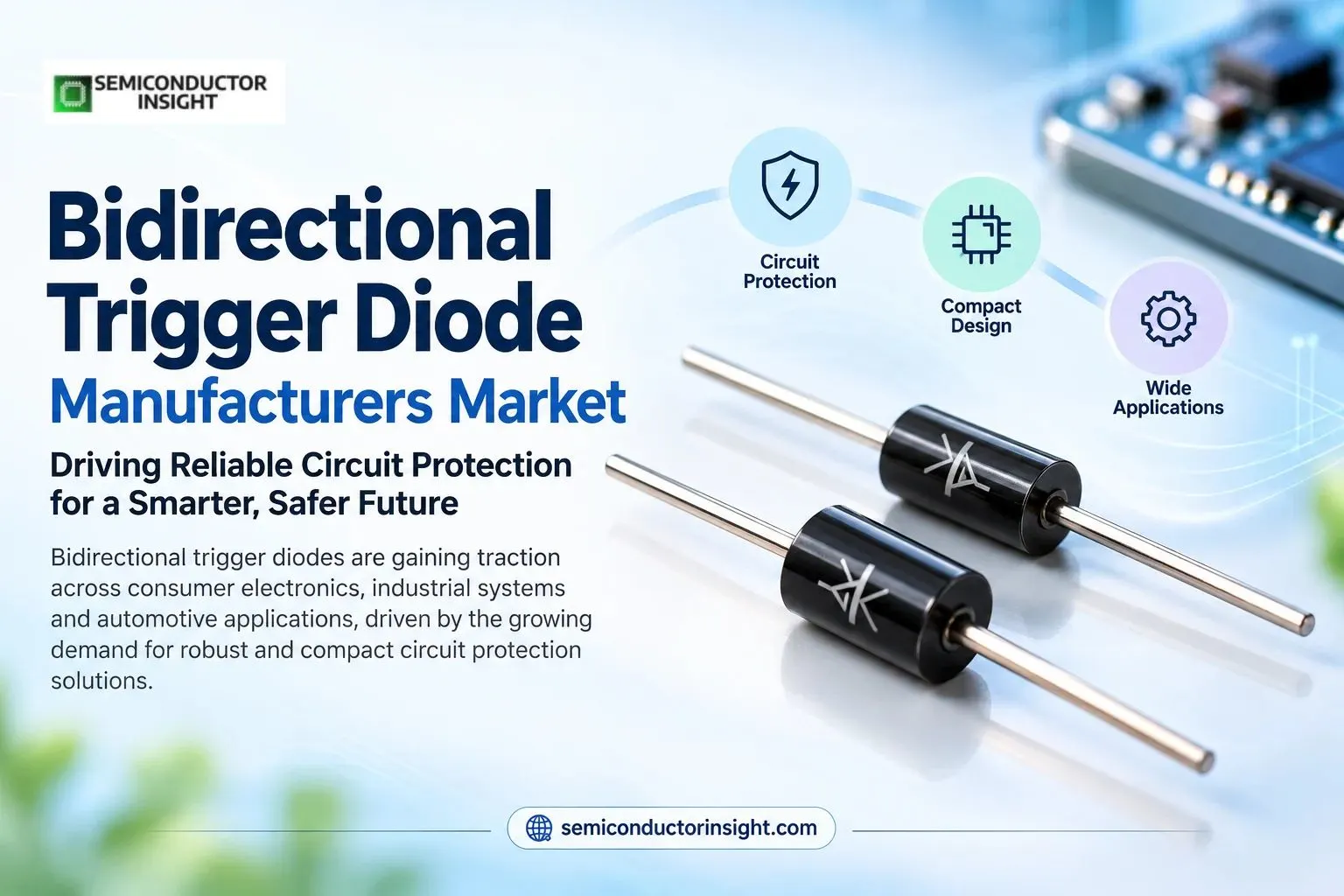
Bidirectional Trigger Diode Market covers the manufacturing, supply, distribution, and use of bidirectional trigger diodes, commonly known as DIACs (diodes for alternating current).
These are two-terminal semiconductor devices that remain in a high-resistance state until the voltage across them reaches a specified breakover voltage. Once this threshold is reached, the device begins conducting in either direction.
STMicroelectronics continues to shape bidirectional trigger diode solutions through its long-running DB3 and DB4 series, delivering fixed-voltage reference performance that simplifies TRIAC gate control in AC phase-control circuits. These devices typically operate with breakover voltages around 32 V and 40 V, low breakover currents, and tight symmetry of about 3 V, packaged in classic DO-35 glass and surface-mount SOT-23 options that support both through-hole and automated assembly lines.
Designers rely on them for fluorescent lamp ballasts, light dimmers, electronic transformers for halogen lamps, and variable-speed hand tools, where consistent triggering across both halves of the AC waveform reduces flicker and improves reliability. In 2026, distributor inventories remain robust, with tens of thousands of DB3 units readily available and ongoing factory lead times supporting high-volume appliance and lighting production. The ECOPACK-compliant construction further aligns the devices with modern environmental requirements while maintaining industrial-grade temperature operation.
Littelfuse stands out for high-energy SIDAC families that extend bidirectional and unidirectional triggering into higher-voltage ignition and power-control roles. Series such as the Kxxxzy and K2xx0yHU offer breakover ranges spanning roughly 79 V to 330 V, with pulse-current capabilities reaching hundreds of amperes in short bursts, housed in DO-15, DO-214, and TO-92 packages. These parts serve gas-igniter systems, metal-halide and xenon lamp starters, high-voltage power supplies, and natural-gas or oil ignition circuits where reliable voltage-triggered switching is essential.
Recent datasheet revisions through 2025 keep the portfolio current for AC-oriented designs, and the devices continue to appear in both standard and high-energy variants that handle repetitive pulse demands. Their presence in protection and control applications underscores the shift toward robust solid-state alternatives in lighting and industrial ignition platforms.
Taiwan Semiconductor supplies compact bidirectional trigger diodes such as the LLDB3 series in hermetically sealed MINI-MELF packages, targeting space-constrained AC control boards. These devices feature breakover voltages near 32 V with symmetry on the order of a few volts, low breakover currents around 10 µA, and power dissipation ratings suitable for small-signal triggering.
The glass construction and tin-plated terminals support reliable soldering and corrosion resistance, making them practical for dimmer circuits, TRIAC gate drives, and consumer electronics requiring consistent bidirectional behavior. Availability in surface-mount formats helps manufacturers meet automated production needs across Asian and global assembly lines in 2026. The focus on discrete power and protection portfolios keeps these trigger diodes integrated into broader AC switching solutions.
Diotec Semiconductor delivers a practical range of DB3, DB31, DB32, and DB4 bidirectional trigger diodes along with surface-mount options such as the BR100-03LLD series. Typical breakover windows sit between 28 V and 36 V, with peak currents rated at 2 A and packages including DO-35 axial and SMD formats supplied in ammo packs of 5,000 pieces.
These parts address TRIAC and thyristor triggering, AC switches, dimmer circuits, and commercial-grade control applications, offering light-protected variants that resist false triggering. Strong distributor stock levels measured in the tens of thousands of units in 2026 ensure ready supply for European and international electronics production. The emphasis on RoHS-compliant, fault-tolerant designs supports reliable performance in everyday lighting and motor-control environments.
Take a Quick Glance at Our In-Depth Analysis Report: https://semiconductorinsight.com/report/bidirectional-trigger-diode-market/
Nexperia contributes discrete bidirectional devices that complement trigger and protection functions in modern AC and signal interfaces. While much of its recent activity centers on ultra-low-capacitance bidirectional ESD protection diodes in compact DFN packages, the broader discrete portfolio supports related switching and transient-handling needs in consumer and automotive electronics. Devices with reverse stand-off voltages in the low-volt range and high ESD robustness appear in high-speed data and power-adjacent circuits that often share board space with trigger functions.
Packaging innovations such as flip-chip variants with side-wettable flanks enable automated optical inspection, aligning with 2025-2026 automotive and industrial quality demands. The combination of small footprints and robust bidirectional characteristics aids designers integrating protection alongside traditional trigger elements.
Topdiode Group focuses on volume-oriented bidirectional trigger diodes within its discrete semiconductor lineup, serving consumer electronics, industrial controls, and general AC switching applications. The portfolio includes standard DIAC-style devices suited for TRIAC triggering in lighting and appliance circuits, with packaging options that support cost-sensitive high-volume assembly.
These components help maintain steady supply into Asian manufacturing hubs where demand for reliable yet economical trigger solutions remains strong. In the current environment, the group’s discrete offerings continue to fill needs for basic phase-control and dimmer functions across multiple product categories. Consistency in availability supports ongoing production of everyday electronic controls.
onsemi maintains an active presence with both DIAC and SIDAC families, including DB3-style trigger diodes and higher-voltage MKP-series SIDACs that cover breakover ranges from roughly 110 V to 250 V. Axial packages handle peak currents suitable for ignition and surge-related triggering, while the devices find use in high-voltage power supplies, sodium-vapor lamp starters, and AC control circuits.
The combination of lower-voltage DIACs for precise TRIAC firing and higher-energy SIDACs for pulse applications gives designers flexibility across consumer and industrial platforms. Ongoing availability of these parts in 2026 supports continued design-ins for motor controls and lighting systems that require dependable bidirectional switching.
Vishay Intertechnology appears among suppliers supporting bidirectional trigger and related discrete functions for AC power and protection circuits. Its discrete portfolio addresses needs in motor-control, adapter, and power-supply designs where consistent triggering or transient handling is required. Recent emphasis on high-sensitivity families expands options for compact circuits that pair trigger behavior with efficient board layouts.
These solutions help OEMs meet reliability expectations in consumer electronics and industrial equipment. The breadth of discrete offerings keeps Vishay relevant for engineers specifying bidirectional devices alongside other power components.
Central Semiconductor has offered silicon DIAC devices such as the CT-32 series in hermetically sealed DO-35 packages, providing fixed-voltage reference triggering with low breakover currents and peak on-state ratings around 2 A. These parts historically served TRIAC gate circuits requiring stable bidirectional performance. Although some older glass-package lines have moved toward end-of-life status due to shifting demand, the company’s discrete expertise continues to inform alternative sourcing and related trigger solutions.
Designers still reference the established electrical characteristics breakover windows near 28-36 V and tight symmetry for legacy and replacement applications. The focus remains on high-reliability glass construction for industrial environments.
Continental Device India Limited (CDIL) supplies bidirectional trigger diodes as part of its discrete semiconductor range, supporting regional and export demand for TRIAC and SCR interfacing. The devices address lighting control, appliance switching, and industrial AC applications common in South Asian manufacturing. CDIL’s position among key suppliers helps ensure local availability of trigger components that meet international quality expectations.
In 2026 the company’s discrete lines continue to serve both domestic production and global channels for cost-effective bidirectional switching. Consistency in packaging and electrical performance supports steady adoption in dimmer and motor-control circuits.
Wuxi Xuyang Electronics manufactures DIAC trigger diodes including DB3-style devices alongside complementary protection components, targeting telecommunications, automotive, consumer electronics, and industrial automation. The parts provide bidirectional triggering suitable for TRIAC gate circuits and AC control boards.
Volume production capabilities support rapid system-level sourcing for equipment makers needing reliable trigger elements. Current offerings emphasize availability across standard packages that fit high-volume assembly. This combination keeps the company active in the broader discrete trigger and protection ecosystem.
Sunmate participates in the bidirectional trigger diode space with devices aimed at cost-competitive and application-specific needs, including recent attention to automotive-grade variants with enhanced thermal stability. These components address electric-vehicle related control circuits as well as traditional consumer and industrial AC switching. The focus on thermal performance and packaging options helps meet evolving reliability demands. In the present market, Sunmate’s trigger diodes contribute to the expanding set of solutions for phase-control and ignition functions. Ongoing product development sustains its role among specialist suppliers.
Diodes Incorporated supports thyristor-based current and voltage control that overlaps with SIDAC and DIAC triggering requirements in AC switching patterns. Its discrete portfolio includes devices suited for reliable phase control and related applications in consumer and industrial power circuits.
Packaging variety and consistent electrical behavior aid design-ins for TRIAC-driven systems. Recent contract activity and portfolio breadth keep the company visible in trigger-adjacent discrete solutions. Engineers continue to specify these parts where bidirectional or unidirectional switching supports overall AC system performance.
Rectron contributes DIAC and related discrete trigger devices within its established power-rectifier and semiconductor offerings. The parts serve general electronics applications requiring bidirectional voltage-triggered switching for TRIAC control and AC circuits. Standard packages and electrical characteristics align with common dimmer, ballast, and motor-speed designs.
Availability through traditional discrete channels supports ongoing production needs. Rectron’s long experience in discrete semiconductors helps maintain a steady presence in the trigger-diode segment.
Changzhou Trustec Company Limited supplies bidirectional trigger diodes as part of its discrete lineup, focusing on volume production for consumer and industrial electronics. The devices provide the fixed-voltage triggering needed for TRIAC gate circuits and AC phase control. Packaging options support both traditional and surface-mount assembly.
In 2026 the company’s offerings continue to address regional manufacturing demand for reliable, economical trigger solutions. Consistent supply of these components helps sustain everyday lighting-control and appliance applications.

Comments (0)