

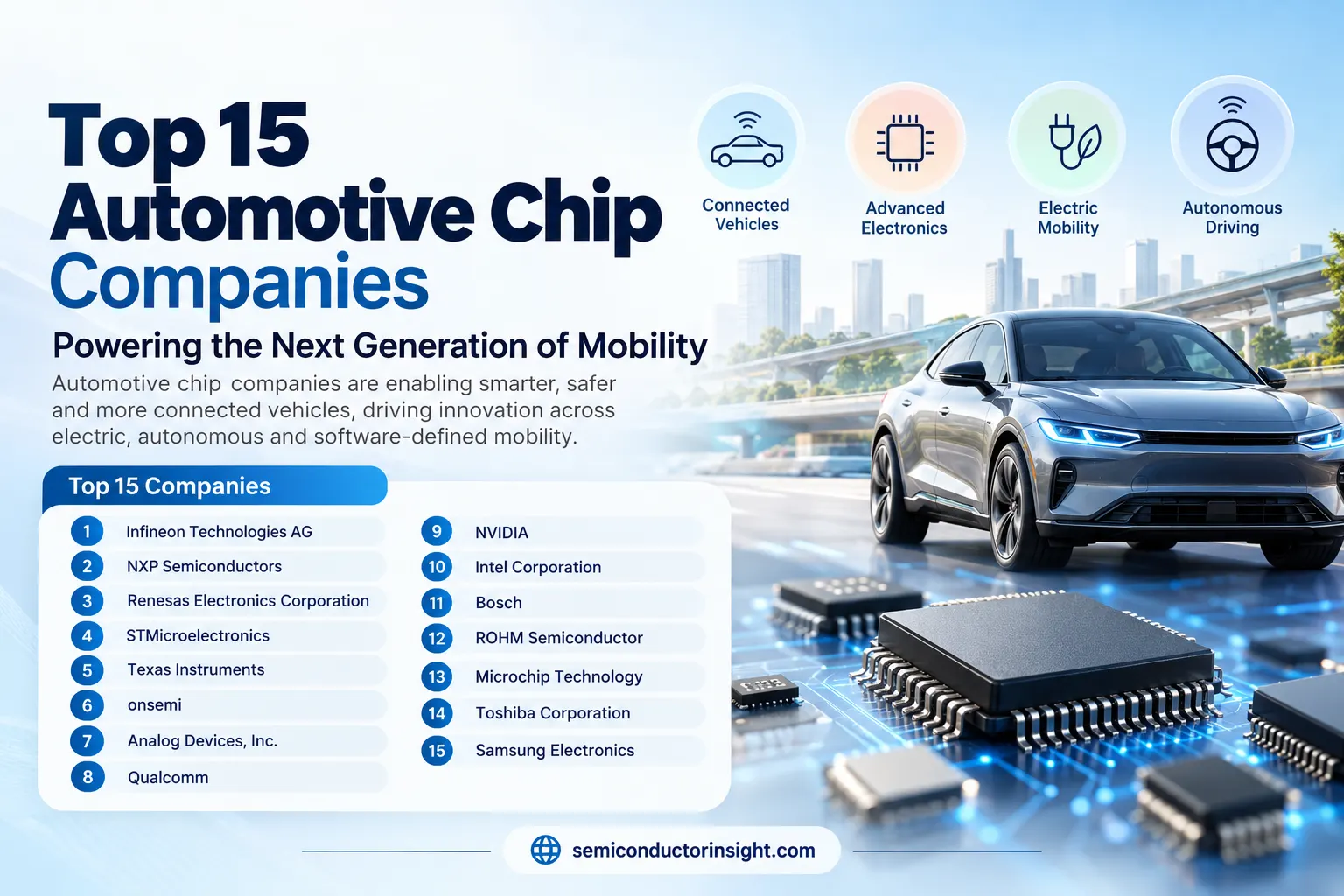
Top 15 Automotive Chip Companies Shaping the Future of the Automotive Semiconductor Industry
The automotive chip industry is becoming increasingly important as vehicles evolve into connected, software-driven, and electronically controlled systems. Modern automobiles rely on semiconductor components for engine management, advanced driver-assistance systems (ADAS), electric vehicle (EV) powertrains, battery management, infotainment, connectivity, and vehicle safety. As automakers invest in electrification and intelligent mobility, automotive chips are becoming essential to vehicle performance, efficiency, and reliability.
Unlike conventional consumer electronics, automotive semiconductor components must often operate under demanding conditions, including temperature fluctuations, vibration, electrical interference, and long product life cycles. These requirements have encouraged semiconductor manufacturers to develop specialized processors, power devices, sensors, microcontrollers, and communication chips for automotive applications.
The industry includes established semiconductor manufacturers, automotive electronics suppliers, AI computing companies, and specialized chip designers. The following overview examines 15 key automotive chip companies and their contributions to the wider automotive semiconductor ecosystem.
What Are Automotive Chips?
Automotive chips are semiconductor devices designed to control, monitor, process, or manage electrical and electronic functions within vehicles. They are used in everything from basic control systems to advanced computing platforms that support autonomous driving and connected vehicle services.
Several major categories contribute to the automotive semiconductor market:
- Microcontrollers (MCUs): Manage electronic control units, body electronics, motor control, and other embedded vehicle functions.
- Power semiconductors: Help control and convert electrical energy in electric drivetrains, charging systems, and power supplies.
- Sensors and analog chips: Measure physical conditions such as temperature, current, pressure, position, and motion.
- AI processors and automotive computing chips: Support perception, driver assistance, sensor fusion, and complex in-vehicle computing.
- Connectivity and networking chips: Enable vehicle communication, wireless connectivity, and data exchange between electronic systems.
- Memory and storage components: Support vehicle computers, infotainment platforms, and data-intensive applications.
The growing integration of these technologies is increasing the importance of semiconductor design, manufacturing quality, functional safety, and long-term supply reliability.
Top 15 Automotive Chip Companies
The companies below are presented as key participants in the automotive semiconductor ecosystem, not as a definitive ranking by automotive chip revenue or market share.
- Infineon Technologies AG
Infineon Technologies is a major semiconductor supplier serving automotive and industrial markets. Its automotive portfolio includes microcontrollers, power semiconductors, sensors, and security-related technologies.
Infineon’s products support applications such as electric vehicle powertrains, battery management, advanced driver-assistance systems, and vehicle electronic control units. Its expertise in power electronics makes the company particularly relevant as automakers develop more efficient electric and hybrid vehicles.
- NXP Semiconductors
NXP Semiconductors develops automotive processors, microcontrollers, networking solutions, radar technologies, and secure connectivity products. Its semiconductor platforms support vehicle access systems, in-vehicle networking, safety applications, and driver-assistance technologies.
As vehicles incorporate more electronic control units and connected functions, automotive networking and secure communication remain important areas for NXP. The company’s portfolio addresses several requirements associated with software-defined and connected vehicles.
- Renesas Electronics Corporation
Renesas Electronics supplies automotive microcontrollers, system-on-chip devices, analog components, and power-management solutions. Its products are used in engine control, body electronics, vehicle networking, and advanced automotive computing.
The company is relevant to the industry’s shift toward centralized and zonal vehicle architectures, in which multiple functions can be consolidated or coordinated through more capable electronic platforms. Its automotive semiconductor business also serves manufacturers developing hybrid and electric vehicles.
- STMicroelectronics
STMicroelectronics provides automotive microcontrollers, power semiconductors, sensors, and integrated circuits for vehicle electronics. Its technologies support applications including electric powertrains, battery systems, driver assistance, and vehicle control.
Silicon carbide (SiC) power devices are particularly relevant to electric vehicles because they can improve power-conversion efficiency in suitable applications. STMicroelectronics’ broader portfolio addresses both conventional automotive electronics and the growing requirements of vehicle electrification.
- Texas Instruments
Texas Instruments develops analog and embedded-processing semiconductors used across automotive electronics. Its products include power-management integrated circuits, signal-processing devices, interface components, and sensing-related solutions.
Automotive applications require accurate measurement and reliable management of electrical signals. Texas Instruments serves these requirements in systems such as battery monitoring, lighting, infotainment, power distribution, and driver-assistance electronics.
- onsemi
onsemi specializes in intelligent power and sensing technologies for automotive and industrial applications. Its automotive portfolio includes power-management devices, image sensors, and silicon carbide solutions.
These technologies are relevant to electric vehicle power conversion, charging infrastructure, battery systems, and camera-based driver-assistance functions. As vehicle electrification and electronic safety features expand, efficient power devices and reliable sensing components remain important areas of development.
- Analog Devices, Inc.
Analog Devices develops high-performance analog, mixed-signal, and digital signal-processing technologies. In automotive systems, these capabilities support battery management, precision measurement, signal conditioning, and vehicle connectivity.
Accurate monitoring of electrical and physical conditions is essential for electric vehicle operation and safety. Analog Devices contributes technologies that help convert real-world signals into usable information for vehicle control and monitoring systems.
- Qualcomm
Qualcomm develops semiconductor platforms and connectivity technologies for connected devices, automotive computing, and digital cockpit applications. Its automotive business includes solutions for infotainment, vehicle connectivity, and advanced driver-assistance computing.
As automakers seek to integrate navigation, communications, entertainment, and driver-assistance functions, high-performance computing and wireless connectivity are becoming more important. Qualcomm participates in this transition through automotive-focused semiconductor platforms and software-enabled technologies.
- NVIDIA
NVIDIA provides accelerated computing platforms used in automotive AI, simulation, and advanced driver-assistance development. Its automotive technologies support applications such as perception, sensor processing, in-vehicle computing, and autonomous-driving research.
The increasing use of AI in vehicles is creating demand for computing platforms capable of processing large amounts of sensor data. NVIDIA’s automotive ecosystem combines computing hardware and software tools for developers working on intelligent vehicle systems.
- Intel Corporation
Intel participates in automotive computing through its semiconductor technologies and its Mobileye business, which develops driver-assistance and autonomous-driving solutions. Mobileye’s portfolio includes vision-based systems, automotive processors, and technologies designed to support driving automation.
Advanced driver-assistance systems require dependable processing of camera and other sensor inputs. Semiconductor computing and software platforms are therefore important to the development of collision avoidance, lane assistance, and other safety-related functions.
- Bosch
Bosch is a major automotive technology and electronics supplier with semiconductor activities serving automotive applications. Its semiconductor-related portfolio includes sensors and specialized components used in vehicle safety, powertrain control, and electronic systems.
Bosch’s position across automotive engineering and electronics gives it a broad perspective on the integration of semiconductor components into production vehicles. Sensors are particularly important as vehicles rely more heavily on electronic monitoring and automated control.
- ROHM Semiconductor
ROHM Semiconductor develops power devices, analog integrated circuits, and other semiconductor components for automotive and industrial applications. Its automotive technologies support power conversion, motor control, and electronic systems.
The transition to electric mobility is increasing interest in semiconductors that can handle higher power levels efficiently. ROHM’s work in silicon carbide devices and power electronics is relevant to applications such as onboard charging and electric drivetrain systems.
- Microchip Technology
Microchip Technology provides microcontrollers, analog components, interface devices, and embedded-control solutions. Its products can be used in automotive body electronics, motor control, communication interfaces, and other embedded applications.
Automotive systems often require dependable control devices that can operate over long product life cycles. Microchip’s embedded-processing portfolio serves applications where integration, reliability, and design flexibility are important considerations.
- Toshiba Corporation
Toshiba develops semiconductor devices and electronic components, including power devices used in automotive and industrial applications. Power semiconductors help control current and voltage in systems such as motor drives, power supplies, and vehicle electronics.
As electric and hybrid vehicles increase the complexity of onboard power management, semiconductor devices that provide efficient switching and reliable operation remain important to vehicle design.
- Samsung Electronics
Samsung Electronics is a major semiconductor manufacturer with capabilities in memory, logic, and advanced semiconductor technologies. These capabilities are relevant to the wider automotive electronics supply chain, particularly as vehicles require more computing power and data storage.
Connected vehicles, digital cockpits, and advanced driver-assistance systems can increase demand for memory and other semiconductor components. Samsung’s relevance should be evaluated by specific automotive product categories and customer programs rather than assuming that all its semiconductor operations directly target automotive applications.
Key Trends Shaping the Automotive Chip Industry
Electrification and Power Semiconductor Innovation
Electric vehicles require semiconductor components to manage battery power, convert electrical energy, control motors, and support charging. Silicon carbide and other advanced power semiconductor technologies are receiving attention because of their potential efficiency advantages in suitable high-voltage applications.
Advanced Driver-Assistance Systems and AI Computing
Driver-assistance technologies rely on sensors, processors, and software to interpret information about the vehicle’s surroundings. As these systems become more sophisticated, demand is increasing for computing platforms that can support perception, sensor fusion, and real-time decision-making.
Software-Defined Vehicles
Automakers are moving toward architectures that consolidate computing resources and support more software-controlled vehicle functions. This shift is changing requirements for automotive processors, networking components, cybersecurity, and system integration.
Automotive Functional Safety and Reliability
Automotive semiconductors must meet stringent requirements for reliability and, where applicable, functional safety. Manufacturers must consider product qualification, lifecycle support, traceability, and the consequences of component failure when developing chips for safety-critical systems.
Supply Chain Resilience
Automotive production depends on dependable semiconductor availability. Manufacturers and automakers continue to pay attention to supplier diversification, manufacturing capacity, inventory planning, and longer-term supply agreements to reduce disruption risks.
Challenges Facing Automotive Chip Manufacturers
Despite the industry’s opportunities, automotive semiconductor companies face several challenges. Designing and qualifying automotive-grade chips can require extensive testing and long development cycles. New vehicle platforms must also integrate components from multiple suppliers while meeting demanding performance, safety, and cybersecurity requirements.
Rapid technological change presents another challenge. Companies must balance investment in new chip architectures with the need to support existing vehicles and established platforms. At the same time, competition in power electronics, automotive AI, and connectivity can put pressure on development costs and product differentiation.
Manufacturers that combine dependable product quality with strong engineering support and reliable supply capabilities are well positioned to address these requirements.
Future Outlook for the Automotive Semiconductor Industry
The automotive semiconductor industry is expected to remain strategically important as vehicles become more electrified, connected, and software-driven. Electric powertrains, digital cockpits, advanced driver assistance, and centralized computing architectures are creating demand for a diverse range of chips.
However, growth will not be uniform across all product categories. Power semiconductors, microcontrollers, sensors, connectivity devices, and AI processors serve different functions and face distinct technical and commercial requirements.
Long-term opportunities will depend on automaker investment, vehicle production trends, semiconductor innovation, regulatory requirements, and the speed at which new vehicle architectures reach mass production. Companies that can deliver reliable automotive-grade products and support complex system integration will remain important participants in this evolving industry.
Automotive chips are fundamental to the transformation of modern vehicles. From power management and embedded control to AI-driven safety features and connected infotainment, semiconductor technologies influence how vehicles operate, communicate, and use energy.
Infineon, NXP, Renesas, STMicroelectronics, Texas Instruments, onsemi, Qualcomm, NVIDIA, and other companies highlighted in this article serve different parts of the automotive semiconductor value chain. Their contributions demonstrate that the industry depends on a combination of processing, sensing, power electronics, connectivity, and manufacturing capabilities.
As electrification and intelligent mobility advance, automotive semiconductor innovation will remain an important factor in the development of safer, more efficient, and increasingly connected vehicles.
Get the Full Study with Detailed Forecasts: https://semiconductorinsight.com/report/automotive-chip-resistor-market/

Comments (0)