

Top 5 Regional Hotspots Putting Fire Equipment Power Monitoring System Market on a Smarter Safety Path
Fire protection is no longer only about detecting smoke or activating sprinklers. In modern buildings, the availability of electrical power to fire pumps, alarm panels, emergency systems, and suppression equipment and communication infrastructure can determine whether the protection system actually performs when required.
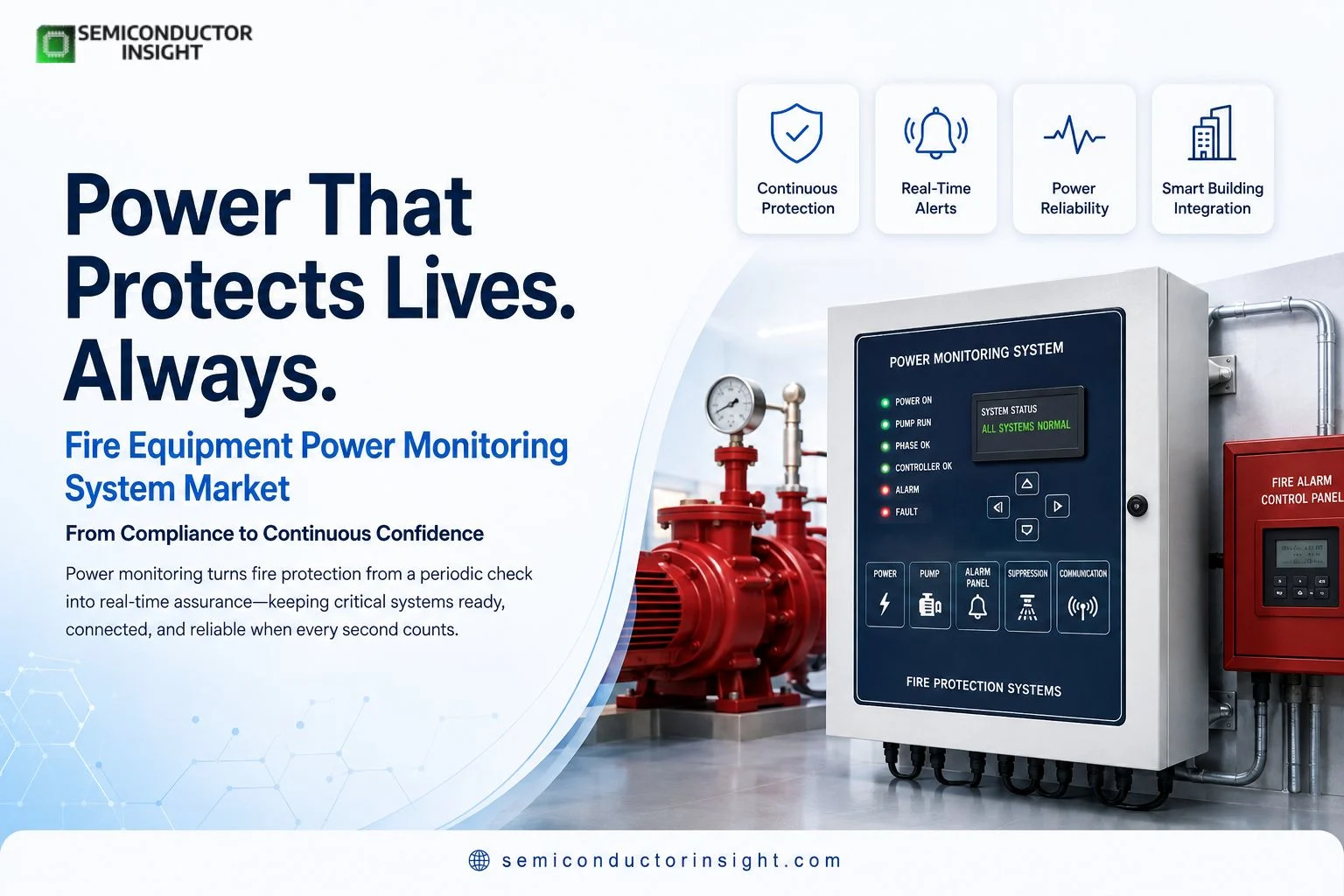
A Fire Equipment Power Monitoring System continuously checks critical electrical conditions such as power availability, phase loss, phase reversal, controller faults and equipment status, then communicates abnormal conditions to building operators or centralized monitoring platforms. NFPA guidance specifically identifies monitoring of fire-pump operation, controller status, loss of main power, phase reversal and phase loss as important fire-protection signals.
The relevance is becoming clearer as buildings become taller, more connected and increasingly dependent on digitally controlled safety equipment.
To find out more, feel free to browse our latest updated report: https://semiconductorinsight.com/report/fire-equipment-power-monitoring-system-marketsize-share-trends-market/
North America takes the reliability-first route
- North America remains one of the most technically mature environments for fire equipment power monitoring because fire protection is closely tied to inspection, testing, electrical reliability and code compliance.
- The United States recorded an estimated 38 million fires in 2024, including approximately 470,500 structure fires. Those structure fires accounted for 3,170 civilian deaths, 10,335 civilian injuries and $15.3 billion in direct property damage.
- That scale creates a substantial installed base of fire pumps, alarm panels, emergency power equipment and suppression systems that must remain operational.
- The technical ecosystem is also highly structured. NFPA 20’s 2025 edition covers stationary fire pumps, including electric-drive controllers and maintenance, while UL identifies fire-pump controllers as dedicated equipment responsible for controlling and monitoring fire-pump operation.
- 2026 opportunity: hospitals, airports, high-rise residential towers, warehouses, semiconductor facilities and data centers increasingly need continuous visibility rather than periodic manual inspection alone.
Europe is turning compliance data into live system intelligence
Europe presents a different opportunity. Instead of focusing purely on new construction, the region has a huge installed building base requiring modernization.
The European Commission reports that 85% of EU buildings were constructed before 2000, while 75% have poor energy performance. The annual renovation rate is only around 1%.
This creates an important opening for power-monitoring technologies during renovation projects. Fire panels, pumps, emergency generators and electrical distribution equipment can increasingly be connected to centralized building-management environments.
England alone recorded 600,185 incidents attended by fire and rescue services in the year ending December 2024, including 136,702 fires and 251,852 fire false alarms.
The European opportunity therefore lies strongly in retrofit, remote diagnostics and lifecycle monitoring, rather than simply adding new fire equipment.
Asia Pacific brings scale, density and high-risk applications
- Asia Pacific stands out because enormous urban populations are being accompanied by industrial expansion, high-rise construction, logistics facilities and technologically intensive manufacturing.
- Japan provides a particularly useful indicator. The country recorded 37,141 fires in 2024, equivalent to approximately 102 fires every day, while building fires represented 56.5% of total fires.
- More strikingly, Japan reported approximately 4.30 million fire-protection-target buildings and facilities as of March 2025.
- India adds another dimension. Fire services are primarily administered at the state level, and India’s Ministry of Home Affairs has highlighted modernization and upgrading of fire and emergency services as an ongoing national policy concern.
High-growth application chain:
Data centers → semiconductor fabs → hospitals → metros → high-rise housing → industrial plants → warehouses
- This makes Asia Pacific particularly important for compact sensors, connected controllers and centralized equipment-status monitoring.
Latin America is moving from response toward prevention
Latin America’s opportunity is increasingly connected with climate-related fire activity, expanding cities and the modernization of emergency-response infrastructure.
Brazil illustrates the scale of the operational requirement. In Paraná alone, the state fire service received 125,753 calls in 2024, including 21,839 general firefighting operations. Fire-related vegetation incidents reached 13,558, more than double the previous year’s level.
Meanwhile, Santa Catarina recorded 3,279 building fire occurrences in 2024, with 1,913 incidents formally investigated by its military fire service.
These numbers reinforce a shift toward prevention, equipment readiness and remote status visibility. Power monitoring can help facility managers identify failed controllers, disconnected equipment or abnormal electrical conditions before an emergency exposes the weakness.
Middle East & Africa is building the connected safety model
The Middle East is emerging as a particularly interesting technology-led market because large developments are being designed around centralized digital safety infrastructure.
- The UAE’s Hassantuk system connects building fire and life-safety systems to centralized alarm receiving infrastructure, enabling real-time transmission and verification of alarms.
- The UAE Ministry of Interior reports that more than 43,000 smart alarms had been installed in residential units and that the initiative had prevented more than 400 real fire incidents.
- Dubai’s smart-monitoring architecture is designed to monitor fire, life-safety and emergency alarms across private and government buildings, with the ability to scale to thousands of buildings simultaneously.
This is precisely where fire-equipment power monitoring fits: equipment status → fault detection → centralized alert → verification → emergency response.

Comments (0)