
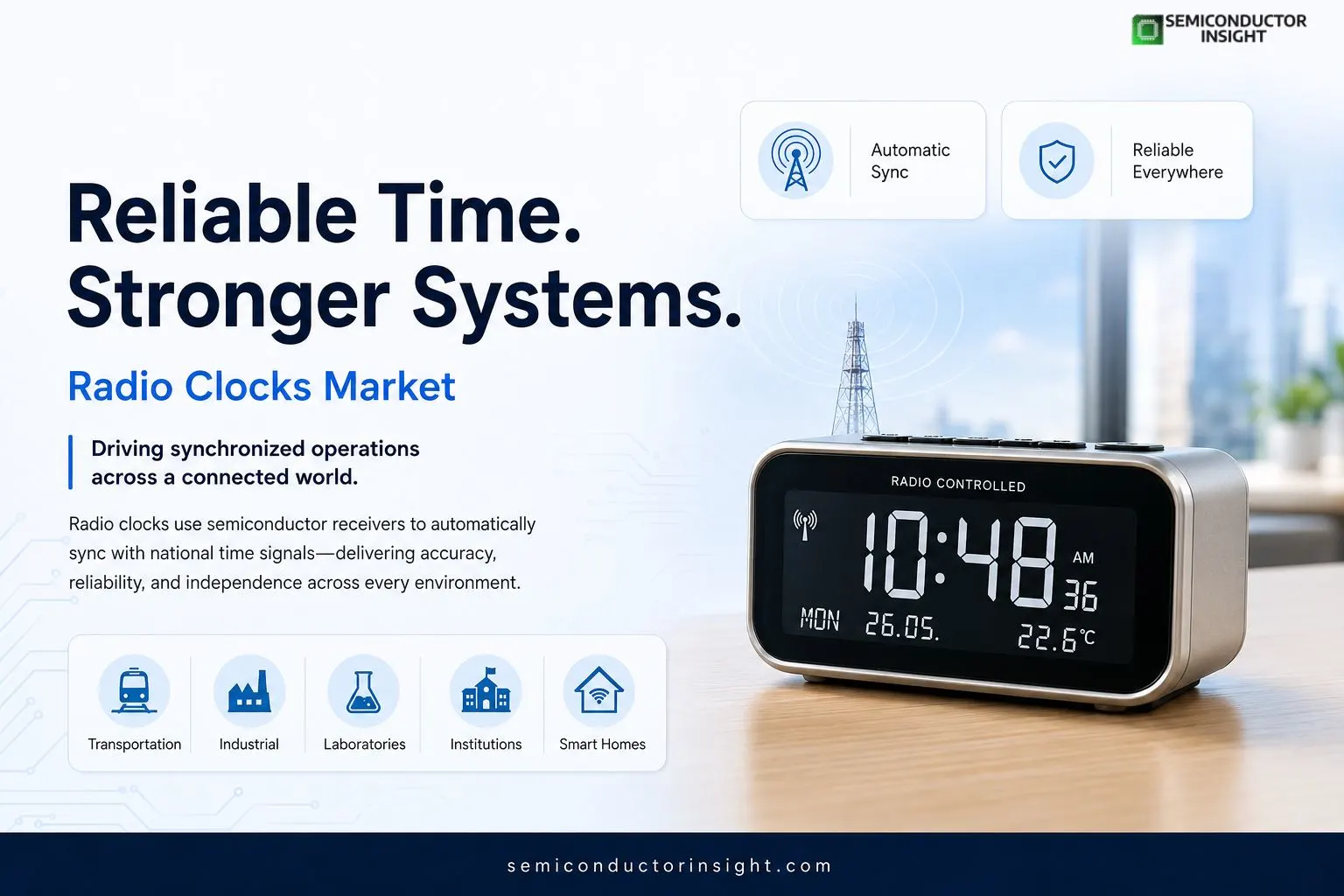
Top 5 Major Leading Regions Supporting Precision Time Synchronization in the Radio Clocks Market
Accurate timekeeping has become an essential component of modern infrastructure. While smartphones and internet-connected devices automatically synchronize time, radio clocks continue to serve industries and households where dependable, independent, and highly accurate timing is critical. Powered by semiconductor-based receivers and low-power integrated circuits, these clocks automatically receive long-wave radio signals from national time stations, ensuring consistent accuracy without manual adjustment.
The increasing demand for reliable synchronization across transportation systems, laboratories, manufacturing plants, educational institutions, and smart homes is giving new relevance to radio clock technology. Semiconductor innovations are also enabling compact receivers with lower power consumption and improved signal sensitivity.
Europe Remains the Global Technology Leader
Europe dominates the radio clocks market because of its well-established time signal infrastructure and long history of precision engineering. Germany’s DCF77 transmitter broadcasts an official time signal across much of Central and Western Europe, covering a radius of approximately 2,000 kilometers and serving millions of radio-controlled clocks every day.
Countries including Germany, Switzerland, France, the Netherlands, and Austria continue to use radio-controlled clocks in railway stations, industrial facilities, schools, and public buildings. The region also hosts several manufacturers specializing in precision timing electronics and semiconductor receiver modules.
North America Expands Industrial and Consumer Applications
- North America represents another major market supported by widespread adoption in commercial buildings, healthcare facilities, research laboratories, and residential smart home systems.
- The United States operates the WWVB radio time station in Colorado through the National Institute of Standards and Technology (NIST).
- The WWVB signal reaches nearly the entire continental United States and parts of Canada and Mexico. Every year, millions of radio-controlled clocks and watches synchronize automatically using this national timing reference.
- Growing interest in reliable backup timing systems continues supporting product innovation across consumer electronics.
Asia Pacific Builds Manufacturing Strength
Asia Pacific is becoming the fastest-growing production hub for semiconductor-enabled radio clocks. Japan, China, South Korea, and Taiwan manufacture large volumes of electronic timing components while continuously improving receiver sensitivity and energy efficiency.
Japan’s JJY time signal network operates two transmitter stations that collectively provide nationwide coverage. Meanwhile, China continues expanding domestic electronics production supported by one of the world’s largest semiconductor manufacturing ecosystems. The region also benefits from increasing demand for synchronized timing in factories adopting Industry 4.0 technologies.
Latin America Creates New Opportunities through Digital Infrastructure
- Latin America is steadily strengthening its position in the radio clocks market as governments and industries continue modernizing digital infrastructure and automation capabilities.
- Countries such as Brazil, Mexico, Argentina, and Chile are investing in smart manufacturing, intelligent transportation systems, logistics hubs, and public service modernization, all of which require accurate and synchronized timing.
- Semiconductor-enabled radio clocks are increasingly being installed in factories, educational institutions, warehouses, municipal buildings, and transportation facilities where consistent timekeeping supports operational coordination and workflow efficiency.
- Brazil alone has more than 5,500 municipalities, while Mexico operates over 50 major commercial airports, creating extensive opportunities for synchronized timing solutions across public infrastructure.
- Large manufacturing sectors, particularly automotive, food processing, and electronics production, are also expanding their adoption of synchronized clocks to coordinate production schedules, employee shifts, maintenance activities, and warehouse operations.
- As industrial digitalization progresses across the region, reliable timing devices continue to complement automated systems by maintaining consistent operational accuracy.
Although Network Time Protocol (NTP) and internet-based synchronization remain widely used, radio-controlled clocks provide an additional layer of reliability during internet disruptions or network maintenance. Their ability to automatically maintain accurate time without continuous internet connectivity makes them particularly valuable in manufacturing plants, healthcare facilities, research laboratories, and logistics centers where uninterrupted operations depend on precise scheduling and dependable time references.
Middle East and Africa Strengthen Institutional Adoption
The Middle East and Africa are emerging as promising markets for radio clocks as countries accelerate investments in smart infrastructure, digital public services, and advanced transportation networks.
Nations including the United Arab Emirates, Saudi Arabia, Qatar, and South Africa are integrating precision timing technologies into airports, hospitals, universities, government buildings, industrial facilities, and large commercial developments. These installations support synchronized operations, improve organizational efficiency, and help maintain accurate scheduling across multiple locations.
The region is witnessing rapid growth in infrastructure projects. Saudi Arabia’s Vision 2030 and the UAE’s smart city initiatives continue driving demand for intelligent building technologies that rely on dependable timing systems.

Comments (0)