

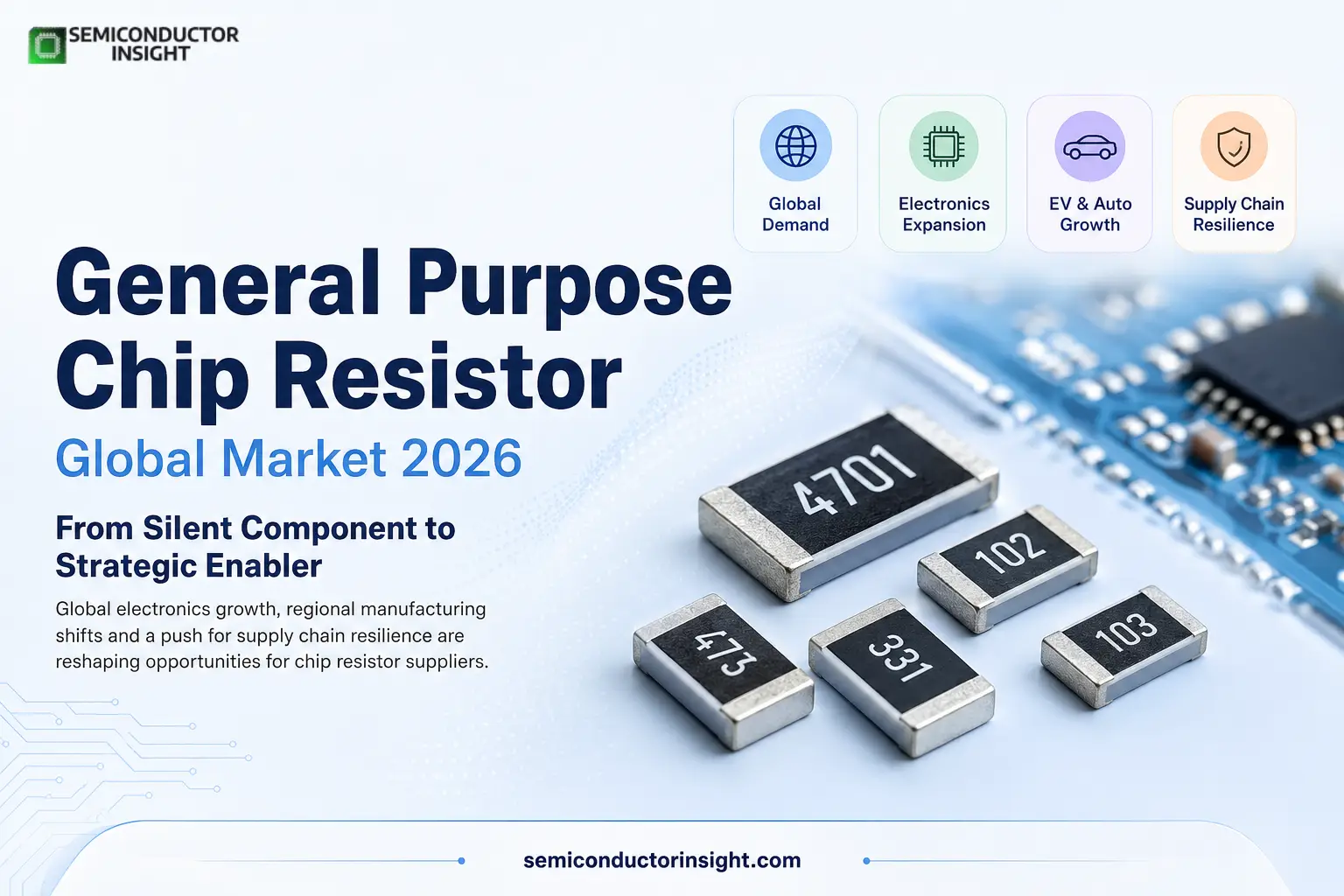
Top 5 Major Leading Regions for General Purpose Chip Resistor Market 2026 Where Billions of Electronic Devices Drive Component Demand
A tiny rectangular component can have an outsized role in modern electronics. General purpose chip resistors are used for current limiting, voltage division, signal conditioning and circuit protection across consumer electronics, vehicles, telecom equipment, industrial systems and countless other devices. Their importance is closely tied to where electronics are designed, assembled and increasingly localized.
The regional picture in 2026 is therefore less about one isolated component market and more about the changing geography of electronics manufacturing.
Asia Pacific Is Still the Volume Engine
Asia Pacific remains the most important production center because it combines large electronics manufacturing clusters with strong semiconductor, automotive and component supply chains. China produced 15.4 billion mobile phones and 484.3 billion integrated circuits in 2025, according to China’s Ministry of Industry and Information Technology. The same industry generated RMB 17.4 trillion in revenue, showing the enormous scale of the electronics ecosystem supporting passive components.
Japan, Taiwan, South Korea, China, Vietnam and India add further depth through smartphones, computers, automotive electronics, industrial equipment and telecommunications. Panasonic, for example, manufactures passive components including resistors in Japan and Indonesia, illustrating how production is increasingly distributed across Asian manufacturing locations.
The region also benefits from vehicle electrification. Nearly 22 million electric cars were produced globally in 2025, with China accounting for roughly 70% of global production. More electronic control units, battery systems and power-management circuits translate into additional opportunities for resistor suppliers.
Europe Is Turning Component Demand into Supply Chain Resilience
- Europe’s importance comes from the combination of automotive manufacturing, industrial automation, energy systems and semiconductor investment. The European Union produced almost 3.2 million electric cars in 2025, up around 30% from 2024. That expansion is particularly relevant for passive components used throughout vehicle electronics.
- The semiconductor ecosystem is also being rebuilt. The European Commission granted Integrated Production Facility and Open EU Foundry status to four semiconductor projects in 2025. One planned facility is expected to reach 480,000 wafers annually by 2029, while projects in Germany, Austria and Italy are strengthening automotive, analog, mixed-signal and silicon-carbide production.
- For chip resistors, this creates demand not only from finished electronics but also from the broader push toward locally sourced, traceable and qualification-ready components.
North America Is Rebuilding Its Electronics Footprint
North America’s opportunity is being reshaped by semiconductor localization and automotive electrification. The U.S. Department of Commerce reported that planned semiconductor and electronics investments had approached USD 450 billion, representing the largest wave of semiconductor manufacturing expansion in U.S. history.
Micron’s planned USD 200 billion semiconductor manufacturing and R&D investment across the United States is another major example, with the company expecting the projects to create approximately 90,000 jobs.
This expansion matters for general purpose chip resistors because fabs, advanced packaging facilities, industrial electronics plants, automotive systems and telecom infrastructure all depend on dense networks of passive components. Vishay’s 2026 launch of AEC-Q200-qualified thick-film chip resistors for automotive, industrial and telecommunications applications shows how suppliers are aligning products with these higher-reliability applications.
Latin America Is Becoming More Relevant Through Electronics Assembly
Latin America does not match Asia’s component manufacturing scale, but its importance is increasing through electronics assembly, automotive production, telecommunications and industrial equipment. Brazil’s Ministry of Development describes its electronics and semiconductor industrial base as covering component production, equipment, assembly, testing, research and systems serving telecommunications, industrial automation, healthcare, defense and digital infrastructure.
Brazil’s industrial base remains the largest opportunity in the region, while Mexico benefits from its close integration with North American automotive and electronics supply chains. The regional role is therefore increasingly connected to localization rather than sheer resistor production volume.
To find out more, feel free to browse our latest updated report: https://semiconductorinsight.com/report/general-purpose-chip-resistor-market/
Middle East and Africa Are Building Smaller but Strategic Electronics Clusters
The Middle East and Africa represent an emerging demand zone rather than a mature high-volume resistor manufacturing center. Telecom infrastructure, data centers, renewable-energy systems, automotive assembly and industrial automation are creating new electronics requirements.
The opportunity is particularly visible in systems that require large numbers of circuit-level components rather than semiconductor fabrication alone. As governments invest in digital infrastructure and localized manufacturing, distributors and electronics assemblers can become important channels for general purpose chip resistors.

Comments (0)