
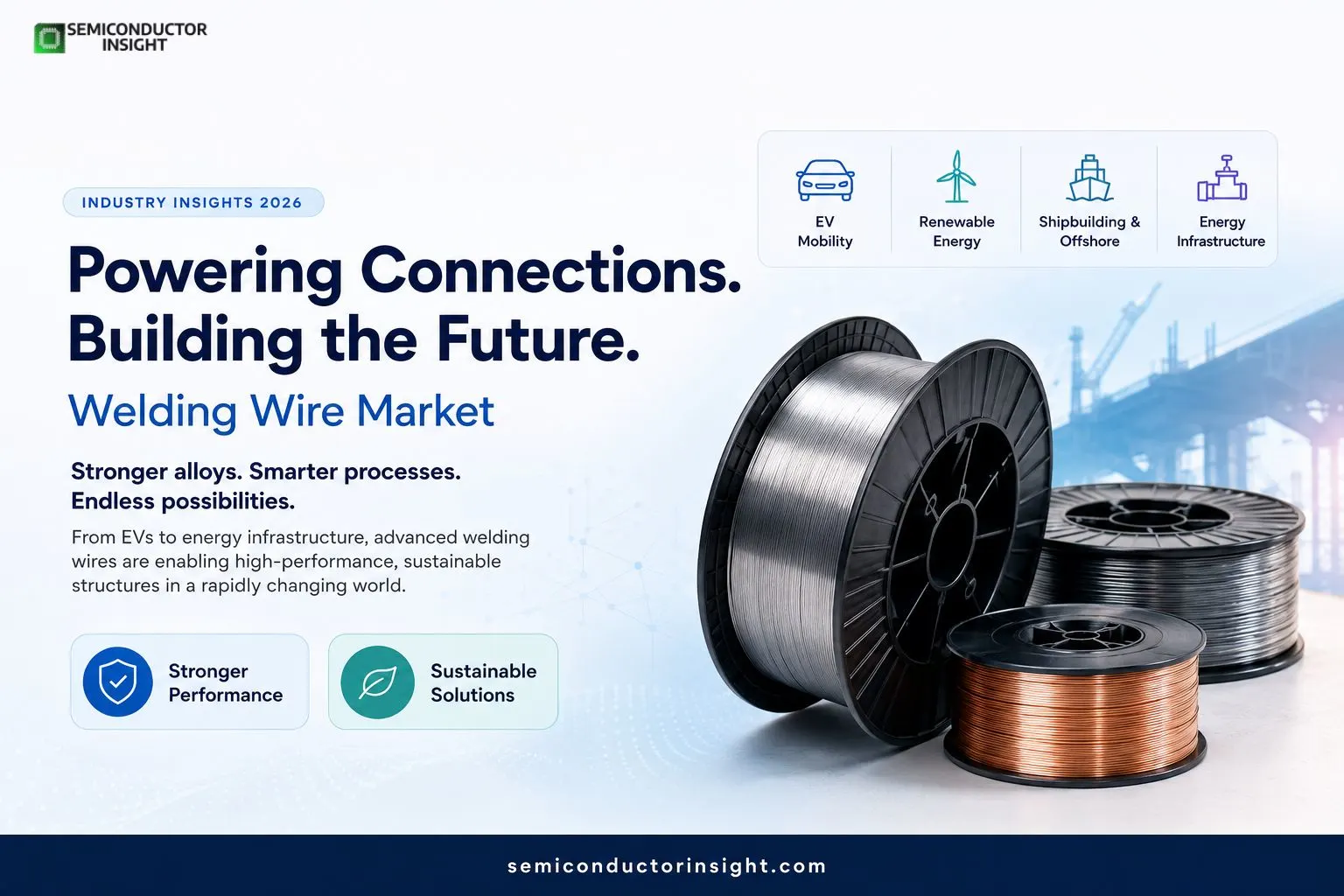
Top 10 Welding Wire Manufacturers Keeping Pipelines, Ships, and EV Batteries Together in 2026
Welding wire is one of those industrial products that almost nobody thinks about until something breaks. A few kilograms of the right alloy, wound onto a spool and fed through a welding torch, can mean the difference between an oil platform that withstands a North Sea storm and one that doesn’t. In 2026, the welding wire market is being pulled in several directions at once. The energy transition is demanding wires that can join advanced high-strength steels in electric vehicle bodies. Shipbuilders need wires that perform in arctic and tropical conditions alike. Pipeline projects, from carbon capture networks to hydrogen transport, require consumables that can handle new steel grades and service environments. And behind all of this, a handful of manufacturers-some centuries old, some newer specialists-are driving the innovation that keeps the world welded together.
The following ten companies are not ranked by revenue alone. They are chosen because each has a distinct influence on the market, whether through metallurgical expertise, geographic reach, or a focused commitment to a specific welding challenge. Together, they illustrate where the welding wire industry stands in 2026 and where it is heading.
- Lincoln Electric (United States)
Lincoln Electric, headquartered in Cleveland, Ohio, has been synonymous with welding since 1895. In 2026, it is the world’s largest welding consumables manufacturer by volume, with a product line that spans solid wires, flux-cored wires, and metal-cored wires for applications from robotic automotive welding to offshore pipeline construction. The company operates manufacturing plants in more than 20 countries and has been methodically expanding its automation and additive manufacturing divisions. Its welding wires are used in virtually every major automotive plant in North America, and its recent push into low-hydrogen, high-toughness wires for wind tower fabrication has aligned it with the renewable energy supply chain. In early 2026, Lincoln Electric opened a new flux-cored wire production line at its European hub in Poland, aimed at meeting rising demand from shipyards in the Baltic region.
- ESAB (United States/Sweden)
ESAB, now part of the broader ESAB Corporation, has a dual heritage that spans both American and Swedish industrial traditions. Its welding wire portfolio is among the most comprehensive in the industry, including copper-coated and non-copper-coated solid wires, metal-cored wires, and specialty alloys for nuclear, aerospace, and cryogenic applications. ESAB has invested heavily in digital integration, offering its “Digital Weld” platform that allows fabricators to track wire consumption, parameter adherence, and weld quality in real time. In 2026, the company launched a new series of low-spatter metal-cored wires specifically designed for robotic welding of electric vehicle battery trays, a growing niche that demands precise heat input and minimal post-weld cleanup.
- ITW Welding (Hobart/Miller) (United States)
Illinois Tool Works, through its Hobart and Miller brands, controls a substantial share of the North American welding wire market. Hobart filler metals are widely distributed through welding supply stores, making them a go-to choice for small fabricators, repair shops, and vocational schools. The company’s strength lies in accessibility: its wires are formulated to perform well across a range of machines and operator skill levels. In 2026, ITW expanded its line of Hobart FabCO flux-cored wires with new grades designed for seismic-rated structural steel, responding to updated building codes in earthquake-prone regions. The company’s ties to the Miller welding equipment brand also give it a unique ability to develop wire and machine combinations that are jointly optimised.
- voestalpine Böhler Welding (Austria)
Voestalpine’s Böhler Welding division is the European heavyweight in welding consumables, with a particularly strong position in stainless steel and nickel-alloy wires. Its products are specified in critical applications where corrosion resistance and mechanical properties at extreme temperatures matter: liquefied natural gas storage tanks, chemical reactors, and supercritical power plants. The company has been investing in environmentally friendly production, including copper-free solid wires that eliminate the environmental and health concerns associated with copper coating. In March 2026, Böhler introduced a new duplex stainless steel flux-cored wire designed specifically for hydrogen transportation pipelines, a niche that is expected to grow significantly as Europe builds its hydrogen backbone.
- Hyundai Welding (South Korea)
Hyundai Welding, part of the Hyundai Group, is one of the largest welding consumable manufacturers in Asia, with a dominant position in the Korean shipbuilding industry. Its solid wires and flux-cored wires are used extensively in the construction of LNG carriers, container vessels, and offshore platforms. The company has been expanding its international footprint, with distribution now reaching over 100 countries. In 2026, Hyundai Welding opened a new manufacturing facility in Vietnam aimed at serving the fast-growing Southeast Asian fabrication market, where demand for structural steel welding is being driven by infrastructure investment. The company has also been at the forefront of developing wires for high-manganese steel, a new class of cryogenic material that competes with nickel-alloy steel in LNG storage.
- Kiswel (South Korea)
Kiswel is another South Korean giant, slightly less diversified than Hyundai Welding but laser-focused on welding consumables. It claims one of the largest single-site welding wire factories in the world at its plant in Busan. Kiswel’s competitive advantage is its cost efficiency and its ability to supply enormous volumes of consistent-quality wire to shipyards, construction firms, and automotive suppliers. The company has been investing in seamless flux-cored wires that offer improved feedability and lower hydrogen content. In 2026, it secured a multi-year contract to supply welding wire for a series of offshore wind foundations being fabricated in Southeast Asia, a signal that its products are moving beyond traditional shipbuilding into the renewable energy supply chain.
- Kobe Steel (Kobelco) (Japan)
Kobelco’s welding business, operating under the Kobe Steel umbrella, has a reputation for technical excellence, particularly in the development of low-alloy high-strength wires for demanding applications. Japanese automotive manufacturers, known for their stringent quality requirements, are long-standing customers. Kobelco was a pioneer in the development of copper-free solid wires, branded as “DW” series, which reduce spatter and fume generation. In 2026, the company introduced a new series of high-efficiency twin-wire tandem welding consumables designed for the automated fabrication of large steel structures, such as bridge girders and ship blocks. This system doubles deposition rates, which is critical in industries facing skilled welder shortages.
- Tianjin Bridge Welding Materials Group (China)
No list of welding wire manufacturers would be complete without a representative from China, which produces and consumes more steel-and more welding consumables-than any other nation. Tianjin Bridge, often referred to as “Bridge Welding,” is one of the largest Chinese manufacturers, with an annual capacity measured in hundreds of thousands of tonnes. While historically focused on the domestic market, the company has been expanding exports under its “Bridge” and “Golden Bridge” brands. Its product range is vast, covering mild steel, low-alloy steel, and stainless steel wires. In 2026, Tianjin Bridge commissioned a new fully automated flux-cored wire production line aimed at improving consistency for export customers, particularly in Africa and South America, where its price-competitive wires are gaining market share in infrastructure projects.
- Ador Welding (India)
Ador Welding, headquartered in Mumbai, is India’s largest welding consumables manufacturer, with a product portfolio that includes solid wires, flux-cored wires, and submerged arc wires. The company has a strong presence in the Indian market, where it supplies fabricators in the power generation, shipbuilding, and construction sectors. Ador has been investing in research and development, including a partnership with the Indian Institute of Technology to develop wires for high-temperature applications in the defence sector. In 2026, it expanded its export footprint into the Middle East, capitalising on the region’s construction boom and the growing preference for Indian-manufactured industrial goods as an alternative to Chinese supply.
- Fronius International (Austria)
Fronius is primarily known for its welding power sources, but it also formulates and markets welding wires specifically engineered to work with its own systems. This is a deliberate strategy: by optimising wire and machine together, Fronius can deliver performance levels-particularly in terms of spatter reduction and arc stability-that are difficult to achieve with generic consumables. The company’s wires are often used in automotive and high-end fabrication where cosmetic weld appearance and repeatability are critical. In 2026, Fronius launched a new range of brazing wires for joining dissimilar materials, including aluminium to steel, a technique increasingly used in lightweight vehicle construction. The wires were developed in partnership with a European automotive OEM and are intended to be used exclusively with Fronius’s CMT (Cold Metal Transfer) welding process.
What the Top Ten Reveal About the Welding Wire Market in 2026
A few patterns emerge from this list. First, the market is simultaneously global and regional. Companies like Lincoln Electric and ESAB operate worldwide, but local champions-Kiswel in Korea, Tianjin Bridge in China, Ador in India-hold significant domestic shares and are increasingly exporting. Second, innovation is being driven by specific end-use demands: hydrogen pipelines, EV battery enclosures, offshore wind foundations, and autonomous robotic welding. The welding wire that worked for a structural beam a decade ago may not be suitable for a high-strength steel battery tray or a cryogenic LNG tank. Third, the shift toward copper-free and low-fume wires reflects both regulatory pressure and a growing awareness of welder health, particularly in enclosed environments.
Welding wire is not a glamorous product. It sits on a shelf, rust-free and waiting, until an electric arc turns it into a molten bridge between two pieces of steel. But without it, the energy transition stalls, ships stay in port, and bridges do not get built. The ten manufacturers profiled here are not just selling spools of metal; they are supplying the literal connections that hold modern infrastructure together. In 2026, their influence extends far beyond the welding booth, into the steel mills, assembly plants, and construction sites that define the built world.
Get the Full Study with Detailed Forecasts: https://semiconductorinsight.com/report/industrial-robot-market/

Comments (0)