

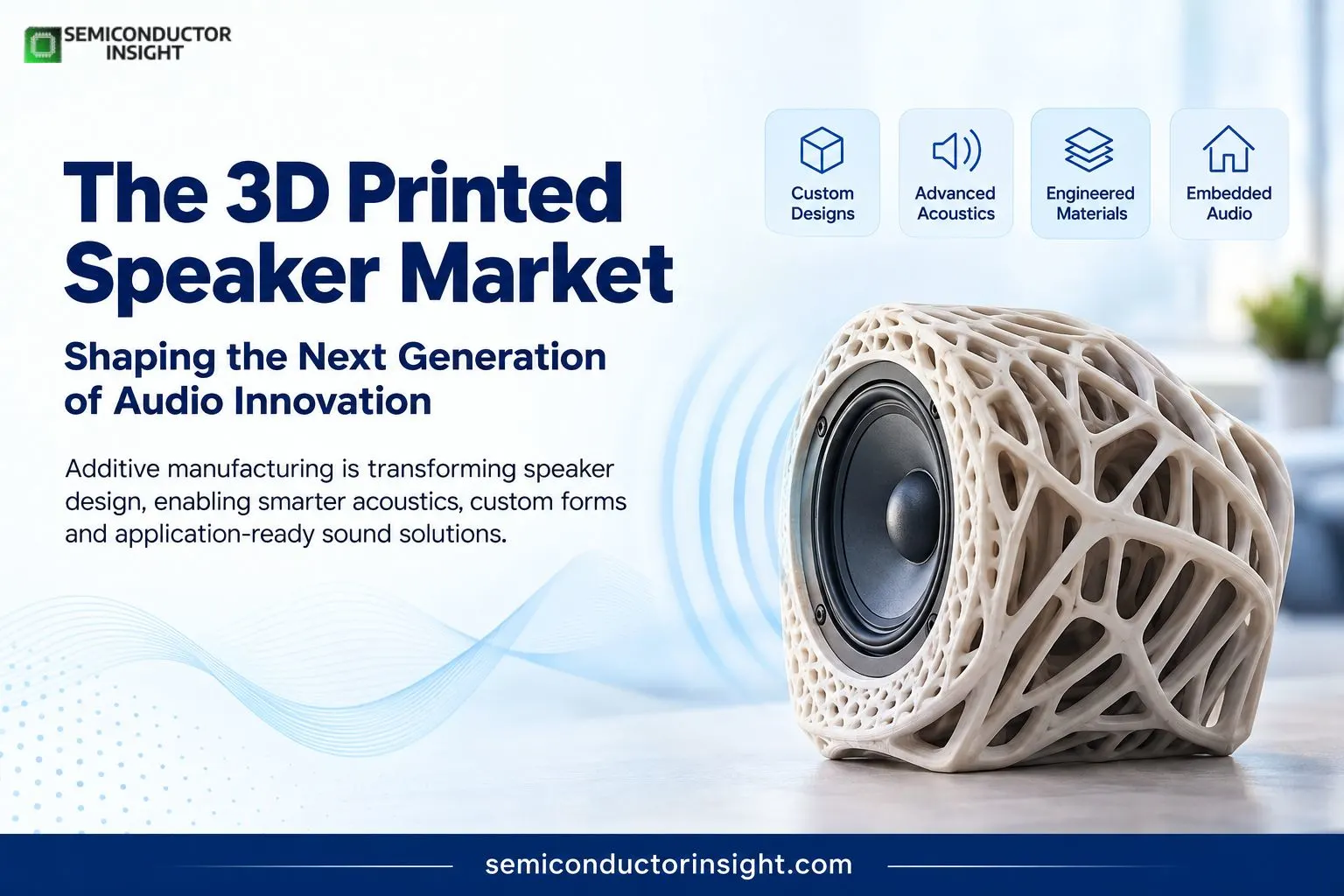
Top 10 Technical Classifications Shaping the 3D Printed Speaker Market in 2026 from Portable Audio to Embedded Sound
The 3D printed speaker is moving beyond the idea of a speaker cabinet made on a desktop printer. Additive manufacturing is allowing engineers to control internal cavities, wall thickness, infill, vibration paths and even acoustic surfaces at a level that conventional fabrication often makes difficult or expensive. The result is a developing category where industrial design, computational acoustics, materials science and electronics manufacturing intersect.
A useful way to understand this emerging market is through ten classifications that reveal where the technology is actually being applied.
The Speaker Itself Is Splitting Into Two Design Philosophies
- The first classification separates portable speakers from stationary speakers.
- Portable designs favour compact geometry, lightweight structures and rapid customization, while stationary or high-fidelity designs can exploit larger printed volumes and complicated internal pathways.
- A notable example is Node Audio’s HYLIXA loudspeaker, whose 3D-printed cabinet incorporated a 1.6-metre helical transmission line inside the enclosure.
- The design used selective laser sintering and glass-filled nylon to achieve a geometry that would be considerably more complicated to manufacture conventionally.
Where the Sound Is Going Matters as Much as How It Is Printed
The next three classifications are residential, commercial and industrial applications. Residential use is particularly interesting because additive manufacturing can turn a speaker into part of the interior rather than an object placed inside it. Custom wall panels, furniture-integrated sound systems and decorative enclosures become possible because the geometry is created digitally rather than constrained by standard moulds.
- Commercial installations can use customized acoustic structures for museums, retail environments and public spaces, while industrial applications open opportunities for specialized monitoring and machine-related audio systems.
This direction was highlighted by Penn State researchers in 2026, who developed a 3D-printed speaker cover capable of concentrating sound into a focal area slightly wider than one inch. The acoustic lens created a focused listening zone around four inches from the speaker, demonstrating how printed geometry can directly manipulate sound propagation.
Digital acoustic model → 3D geometry → Printed structure → Driver integration → Sound-field tuning → Application-specific audio
The End User Is Changing the Product Definition
The sixth and seventh classifications are consumer and professional users. Consumers are increasingly interested in customized shapes, colours and acoustic signatures, while professional users are more concerned with repeatability, structural rigidity, acoustic modelling and integration.
A 2025 research publication on 3D-printed loudspeaker enclosures tested 12 different configurations, combining three materials with three internal geometries. The study examined PLA, ABS and wood-composite structures alongside honeycomb, linear and Gyroid infills. The wood-composite configuration with 10% Gyroid infill produced approximately 4 dB lower main resonance amplitude than PLA with the same geometry, demonstrating how print material and internal architecture can materially influence acoustic behaviour.
You Can Freely Surf Our Latest Updated Report Here: https://semiconductorinsight.com/report/3d-printed-speaker-market/
Multi-Material Printing Opens a More Ambitious Route
- The eighth classification is multi-material composite construction, contrasted with single-material polymer structures and hybrid conductive systems.
- Instead of printing only the enclosure, future-oriented additive manufacturing can potentially combine structural, acoustic and electrical functions.
- This concept has roots in earlier Cornell research that demonstrated a working 3D-printed loudspeaker using separately deposited plastic, conductive and magnetic materials.
- The project showed the possibility of fabricating multiple functional components through additive processes rather than relying entirely on conventional assembly.
- Recent research into conductive-polymer additive manufacturing is expanding this idea further, with materials such as polyaniline, polypyrrole and PEDOT being investigated for printed electronic functions.
Invisible Audio Is Becoming a Design Target
The final classifications are embedded, standalone and vehicle-integrated form factors. Embedded speakers can be incorporated into walls, ceilings, furniture, dashboards or architectural surfaces, reducing the visual footprint of conventional audio hardware.
This is particularly important for automotive interiors, where speaker placement increasingly has to coexist with lightweight structures, displays, sensors and styling requirements. The same principle applies to residential architecture, where designers can create audio surfaces that look like part of the building rather than conventional electronic equipment.
The Geometry Is Becoming the Acoustic Component
One of the most important developments is the growing use of additive manufacturing for acoustic metamaterials and complex diaphragms. A 2025 study reported a 3D-printed flat-panel loudspeaker diaphragm designed to improve low-frequency performance, with experimental verification conducted below 200 Hz.
Another 2025 study investigated 3D-printed acoustic metamaterials using hollow star-shaped structures and slits, showing how additive manufacturing can create intricate sound-manipulating structures that are difficult to reproduce using conventional methods.
The broader significance is straightforward: 3D printing is no longer just making the speaker enclosure; it is increasingly becoming a method for designing the acoustic behaviour itself.
A New Audio Manufacturing Equation
The emerging 3D printed speaker ecosystem can therefore be viewed as:
Customization + computational acoustics + engineered materials + additive manufacturing + embedded electronics = application-specific sound
For the consumer, that can mean a speaker shaped around a room or personal aesthetic. For engineers, it means the freedom to experiment with internal structures, resonant chambers and sound-directing surfaces without redesigning an entire manufacturing line.
The 2026 research landscape suggests that the most interesting development is not simply printing speakers faster. It is the ability to print acoustic intent directly into the physical structure, turning geometry, material and electronics into one coordinated design problem.

Comments (0)