
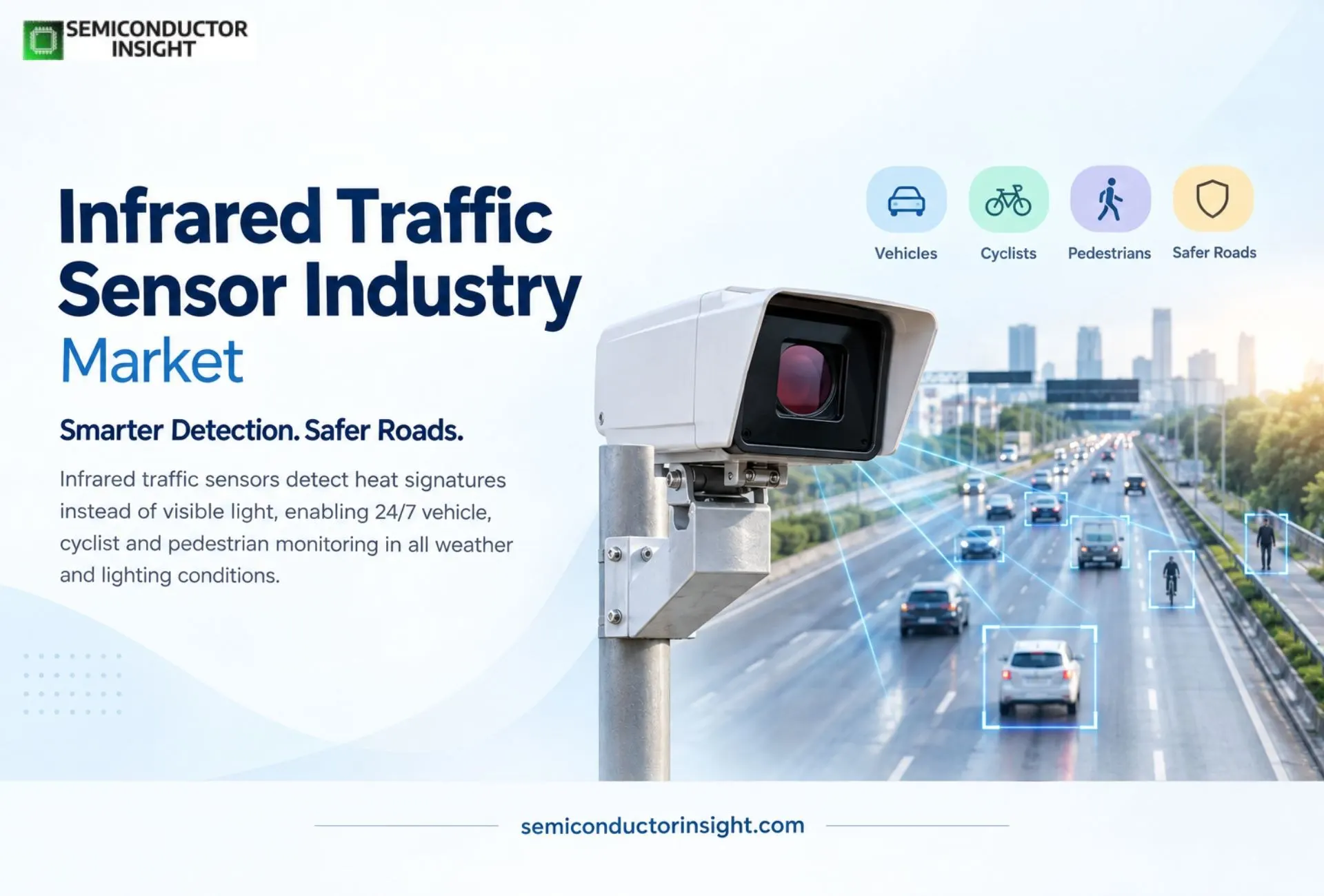
Top 10 Leading Manufacturers and Companies in the Global Infrared Traffic Sensor Industry 2026
Cities and highways never sleep, yet traditional cameras often fail when darkness, fog, glare, or heavy rain roll in. Infrared traffic sensors change that equation by reading heat signatures instead of relying on visible light. They detect, classify, and count vehicles, cyclists, and pedestrians around the clock without cutting pavement or waiting for perfect weather.
The technology now sits at the heart of smarter intersections, tunnel safety systems, and vulnerable-road-user protection programs worldwide. Below is a fresh look at the organizations driving this shift, each framed through the lens of real deployments, sensor performance, and recent advances that matter on the road.
Axis Communications brings bispectral intelligence to the roadside
Axis has pushed thermal and visual fusion into practical traffic environments with devices that combine high-resolution thermal sensors (often 640 × 480) and 4K visual streams in single housings. In 2025 and early 2026 the company introduced the AXIS Q6411-LE Bispectral PTZ and the Q2802-E, both built on the ARTPEC-9 chipset so object analytics can run on the edge detecting, classifying, tracking, and counting humans and vehicle types without constant server load.
These units deliver NETD sensitivity under 20 mK, 31× optical zoom on the visual side, and OptimizedIR reach beyond 150 meters even in total darkness. Axis works through a network of roughly 90,000 system-integration partners and employs about 5,500 people, enabling rapid rollout across logistics hubs, high-speed corridors, and perimeter-monitored roadways. The cameras’ Edge Vault cybersecurity and FIPS 140-3 Level 3 key storage address the long lifecycle demands of public infrastructure, while panoramic and modular thermal options give operators flexible coverage for multi-lane approaches and open junctions.
Bosch Security Systems layers AI video analytics onto traffic-grade platforms
Bosch equips fixed and PTZ cameras with Intelligent Video Analytics Pro Traffic, a deep-learning engine trained to separate pedestrians, bicycles, motorcycles, cars, trucks, and buses even when vehicles overlap in dense queues. The analytics ignore common disturbances such as headlight glare, shadows, and camera vibration while collecting volume, occupancy, and presence data that feed signal controllers. Devices carry NEMA TS 2 environmental certification and NTCIP compliance so they communicate directly with existing traffic-management systems.
Models such as the DINION and FLEXIDOME series offer multi-megapixel resolutions with integrated IR illumination and starlight sensitivity, supporting continuous operation in tunnels and at complex urban intersections. Bosch’s approach turns each camera into both a detector and a data source, reducing the need for separate inductive loops and delivering real-time alerts for wrong-way driving or congestion.
Teledyne FLIR anchors thermal detection at tens of thousands of intersections
FLIR’s TrafiSense and ThermiCam families have become reference points for non-intrusive thermal traffic sensing. Units such as TrafiSense AI and ThermiCam2 detect vehicles, bicyclists, and pedestrians in complete darkness, fog, and sun glare, then output presence, speed, heading, and classification data that integrate with controllers via virtual loops or dry contacts. The company has installed automatic incident-detection systems in more than 1,500 tunnels and traffic-control sensors at over 50,000 urban intersections worldwide.
Sensors use uncooled VOx microbolometers operating in the 7-14 µm long-wave band and can remain in service for a decade with minimal maintenance. In 2026 FLIR launched the Tura thermal camera module the first ASIL-B compliant long-wave sensor for automotive and ADAS applications featuring 640 × 512 resolution and the ability to support nighttime automatic emergency braking requirements. Additional modules such as Boson SX8 deliver 1280 × 1024 resolution for longer-range roadside and vehicle-mounted use.
To find out more, feel free to browse our latest updated report: https://semiconductorinsight.com/report/infrared-traffic-sensor-market/
Leonardo DRS extends rugged EO/IR capability into vehicle and infrastructure sensing
Leonardo DRS produces uncooled long-wave infrared detectors and complete vision systems that give operators clear views through dust, smoke, fog, and total darkness. The Driver’s Vision Enhancer Wide series stitches three 640 × 480, 17-micron sensors into a 107° × 30° field of view, allowing drivers to see both sides of the roadway and identify obstacles without leaving the vehicle.
These systems are field-upgradable and designed for continuous operation under extreme temperature swings. Cooled mid-wave arrays such as HexaBlu achieve 1280 × 960 resolution with 6 µm pixel pitch and typical NETD of 27 mK, supporting long-range surveillance of road corridors and border approaches. The company’s vertically integrated detector manufacturing in Dallas ensures consistent quality for programs that demand multi-year reliability on both military and civilian platforms.
Zhejiang Dali Technology supplies high-volume thermal modules for vehicle and roadside night vision
Dali Technology manufactures uncooled vanadium-oxide detectors and complete thermal cameras used in automotive night-vision systems and fixed monitoring. Vehicle-mounted units such as the EX-VIB series provide clear infrared imagery out to 300 meters roughly 1.5 times the reach of typical high-beam headlights and incorporate deep-learning algorithms that flag pedestrians and vehicles for early warning. Dual-spectrum PTZ models combine 640 × 512 thermal sensors with high-resolution visible cameras, supporting fire-point detection, intrusion alerts, and continuous surveillance of highways, airports, and industrial access roads. Frame rates reach 50 Hz and NETD values stay at or below 40 mK, enabling reliable performance in haze, dust, and night conditions. The company has scaled mass production of both a-Si and VOx detectors, feeding modules into passenger cars, commercial fleets, emergency vehicles, and fixed traffic installations.
Bullard focuses thermal imagers on rapid scene assessment and incident response
Bullard’s handheld and vehicle-mountable thermal imagers deliver high-frame-rate imagery for first responders who often operate at crash sites, tunnel incidents, or roadway fires. Models such as the QXT Pro and NXT Pro offer 640 × 480 resolution at 60 Hz with NETD sensitivity as low as 50 mK, while lighter units such as the TXS provide 320 × 240 imagery at 30 Hz in a package weighing under 0.75 kg including battery. X-Factor image-enhancement technology sharpens edges and maintains detail across wide temperature ranges, helping operators locate people, residual heat from vehicles, or skid marks even when the scene is filled with smoke or reflected glare. Battery run times extend to 6-8 hours, and five-year warranties cover both imagers and batteries. These tools support motor-vehicle incident size-up, water-rescue operations, and overhaul work where infrared visibility directly affects response speed and safety.
Fluke Corporation applies fixed and portable infrared sensing to infrastructure health and process monitoring
Fluke’s thermal imaging sensors and cameras monitor temperature patterns on road-related assets motors, pumps, bearings, and electrical panels that keep traffic systems running. The Fluke 3550 FC and similar fixed-mount sensors capture images at user-defined intervals from one to sixty minutes, feeding data into cloud platforms for trend analysis. Portable units such as the TC03A series deliver 384 × 288 resolution (upgradable to 768 × 576 SuperResolution) with NETD as fine as 45 mK and adjustable focus from 0.25 m to 20 m. Case studies on highway paving projects have used Fluke imagers to verify asphalt temperature uniformity across entire lanes, reducing the risk of premature road failure. The instruments support both preventive maintenance of traffic-signal cabinets and real-time checks during construction or emergency repairs.
General Dynamics brings multi-axis stabilized EO/IR platforms to long-range corridor monitoring
Through its electro-optical and infrared portfolio, General Dynamics supplies stabilized camera systems capable of continuous surveillance of highways, borders, and critical approaches. These multi-sensor packages combine cooled and uncooled infrared channels with visible and near-infrared imagers, delivering high-resolution thermal data over extended distances. Systems are engineered for airborne, ground, and maritime platforms and have been fielded in large numbers for intelligence, surveillance, and reconnaissance missions that include traffic-pattern observation and infrastructure protection. The emphasis on multi-axis stabilization keeps imagery steady even when the host vehicle or pole is subject to vibration, making the sensors suitable for permanent roadside installations as well as mobile command units.
Infrared Integrated Systems (Irisys) pioneered thermal array counting for people and vehicle flows
Irisys developed low-resolution thermal difference imagers and time-of-flight arrays that track movement without capturing identifiable images. Its Vector 4D and earlier people-counting sensors have been deployed in more than 500,000 units across retail, transport hubs, and public spaces, measuring entry-exit flows, queue lengths, and occupancy in real time. The same thermal-array principles support traffic applications where anonymous detection of pedestrians and vehicles is required at doorways, crosswalks, and transit platforms. Sensors operate with germanium optics and onboard processors that distinguish direction and speed while remaining robust to lighting changes. The technology’s privacy-preserving design and multi-year field life make it a practical choice for high-volume counting points that feed broader traffic-management databases.
Current Corporation contributes specialized infrared components and sensing expertise
Current Corporation focuses on niche infrared detection solutions that complement larger traffic-system integrators. Its sensors and modules address specific detection challenges presence sensing, short-range classification, or integration into existing controller cabinets where compact form factors and reliable thermal response are essential. By supplying building-block infrared capability rather than complete end-to-end systems, the company enables system designers to tailor solutions for unique intersection geometries, tunnel environments, or mixed pedestrian-vehicle zones. The approach supports the broader ecosystem of non-intrusive traffic sensing by filling gaps that full-platform vendors may leave open.

Comments (0)