
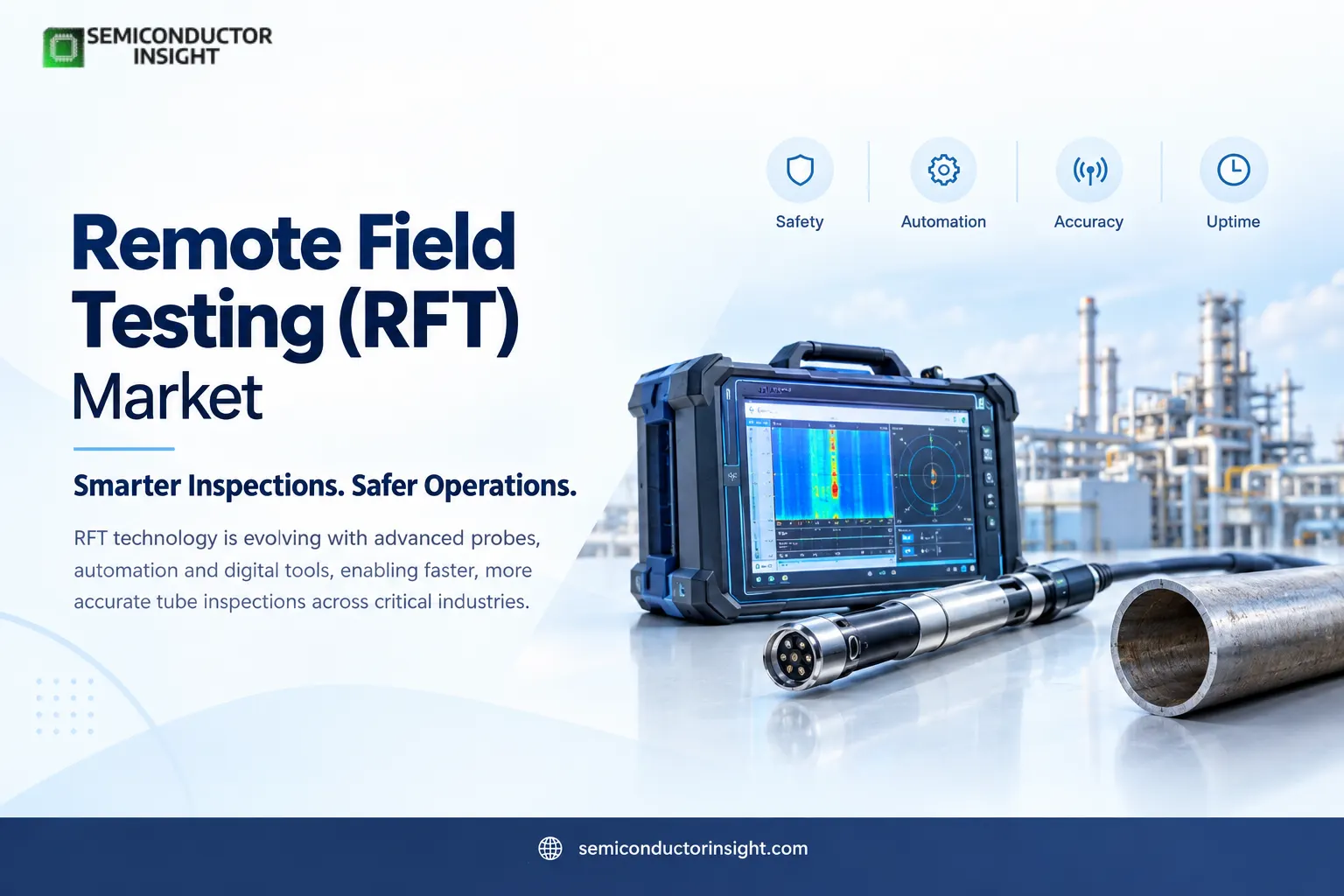
Top 10 Leading Companies Dominating the Global Remote Field Testing System Market in 2026
In power plants, petrochemical facilities, and heat exchanger networks, the integrity of ferromagnetic tubes determines operational safety and uptime. Remote Field Testing (RFT) stands out as the electromagnetic method that penetrates carbon steel and similar materials with equal sensitivity to internal and external wall loss, pitting, and erosion.
The following companies drive advancements in probes, instruments, software, and deployment that make high-volume, reliable RFT inspections practical across thousands of tubes in demanding environments.
General Electric’s Inspection Technologies Legacy continues to influence large-scale industrial tube assessment through systems historically developed under its measurement and control divisions (now often aligned with Waygate Technologies under Baker Hughes). These platforms support RFT configurations for boiler and heat-exchanger tubes, enabling detection of volumetric defects across extensive tube banks. In practice, operators deploy these solutions during planned outages to evaluate hundreds to thousands of tubes per unit, combining electromagnetic data with complementary ultrasonic validation. Recent integration efforts emphasize digital workflows that feed inspection results into broader asset-management platforms, reducing analysis time for complex tube sheets in power-generation and refining settings.
Olympus (now operating as Evident Scientific) has long supplied specialized remote-field probes engineered for ferromagnetic tubing. Their TRx-series designs place pickup coils at 2.5 to 3 times the tube outside diameter, ensuring the receiver captures only the remote field rather than the direct field. Probes feature circumferential coils that operate simultaneously in absolute and differential modes, thicker casings for durability in dirty or restricted tubes, and improved signal-to-noise ratios. These tools are routinely applied to heat exchangers, feedwater heaters, and boiler tubes, detecting erosion, corrosion, wear, and baffle cuts while supporting wall-thickness sizing. Field teams rely on the consistent performance across carbon-steel and ferritic stainless tubes in plants worldwide.
Eddyfi Technologies has pushed RFT speed and automation boundaries. In one documented nuclear-utility challenge involving a heat exchanger with more than 2,000 carbon-steel tubes, their Ectane 2 instrument paired with the Probot probe pusher and Magnifi software achieved scanning rates up to 508 mm per second—well above the previous 203 mm per second baseline—without measurable signal degradation. Over successive shifts the system completed thousands of straight-leg scans, demonstrating practical high-throughput capability. Complementary AI-assisted analysis tools introduced in recent conference presentations automate landmark detection (tube sheets, support plates) and signal normalization for ferromagnetic RFT data, accelerating post-inspection reporting for large tube bundles.
ETher NDE focuses on complete tube-inspection workflows that incorporate eddy-current and related electromagnetic methods suitable for both non-ferrous and ferromagnetic applications. Their ETi-300 instrument supports multi-frequency operation, two probe inputs, and extended battery life exceeding 12 hours, housed in rugged IP-rated enclosures. Software suites such as ETherMap and TMR Mapping convert raw signals into tube-sheet layouts and structured reports, allowing inspectors to plan and document examinations of condensers and heat exchangers containing thousands of tubes. The SteelCheck platform adds magnetic-flux-leakage capability for carbon-steel tubes, complementing traditional remote-field approaches when external fins or other geometries complicate conventional signals.
Don’t Forget to Surf Our Updated Report for More Detailed Analysis: https://semiconductorinsight.com/report/remote-field-testing-system-marketsize-share-trends-market/
Magnetic Analysis Corporation (MAC) brings nearly a century of electromagnetic testing experience to tube and pipe inspection lines. MultiMac instruments handle multi-channel eddy-current configurations, while newer MacFlux DC magnetic-flux-leakage systems expand coverage for OCTG and similar products. At the 2026 Tube and Wire exhibitions in Düsseldorf, MAC demonstrated integrated multi-modality lines combining eddy current, ultrasonic, and flux-leakage modalities under unified software. These systems inspect welded and seamless tubes at production speeds, detecting surface, subsurface, and wall-thickness variations that align with the defect types addressed by remote-field methods in service environments.
IBG NDT System Corporation specializes in digital eddy-current instruments and fully automated inline systems. With more than four decades of development, their eddyvisor and eddyliner platforms incorporate multi-frequency and harmonic-analysis techniques originally refined for component testing. While oriented toward production-line crack and structure inspection, the same electromagnetic principles and multi-channel architectures support tube-testing adaptations. Turnkey mechanical systems allow 100 percent inspection at line speeds, providing continuous quality data that parallels the high-volume requirements of remote-field campaigns in process-plant maintenance.
Ashtead Technology operates as a major rental and service provider of advanced NDT equipment across Europe and beyond. Their fleet includes eddy-current instruments, ultrasonic systems, and related tools that support remote-field and complementary tube-inspection campaigns. Rapid-response logistics enable technicians to obtain calibrated instruments for urgent outages, with pre-hire verification ensuring readiness. This model allows operators to scale inspection capacity for heat-exchanger campaigns without capital investment, covering applications from weld examination to corrosion mapping in both topside and subsea contexts.
Zetec (now integrated within the Eddyfi family) historically contributed multi-channel eddy-current and electromagnetic instruments widely used for tube inspection. Their platforms supported simultaneous frequency mixing and advanced signal processing that remain relevant for remote-field data acquisition and analysis. The combined portfolio continues to serve power-generation and petrochemical clients inspecting large populations of ferromagnetic tubes under strict code requirements.
Fidgeon supplies specialized probes and accessories that complement major instrument platforms. Their offerings support the precise coil geometries and durability needed for remote-field examinations of restricted or contaminated tubes, ensuring consistent fill-factor performance and signal quality across successive inspections.
Complementary innovators such as specialized probe and system developers further refine remote-field hardware for unique geometries, including small-bore pipelines and finned tubes. Together these organizations sustain a practical ecosystem: high-speed scanning of thousands of tubes, equal sensitivity to internal and external defects, automated analysis tools, and flexible deployment options that keep critical heat-transfer equipment in service safely and efficiently.

Comments (0)