
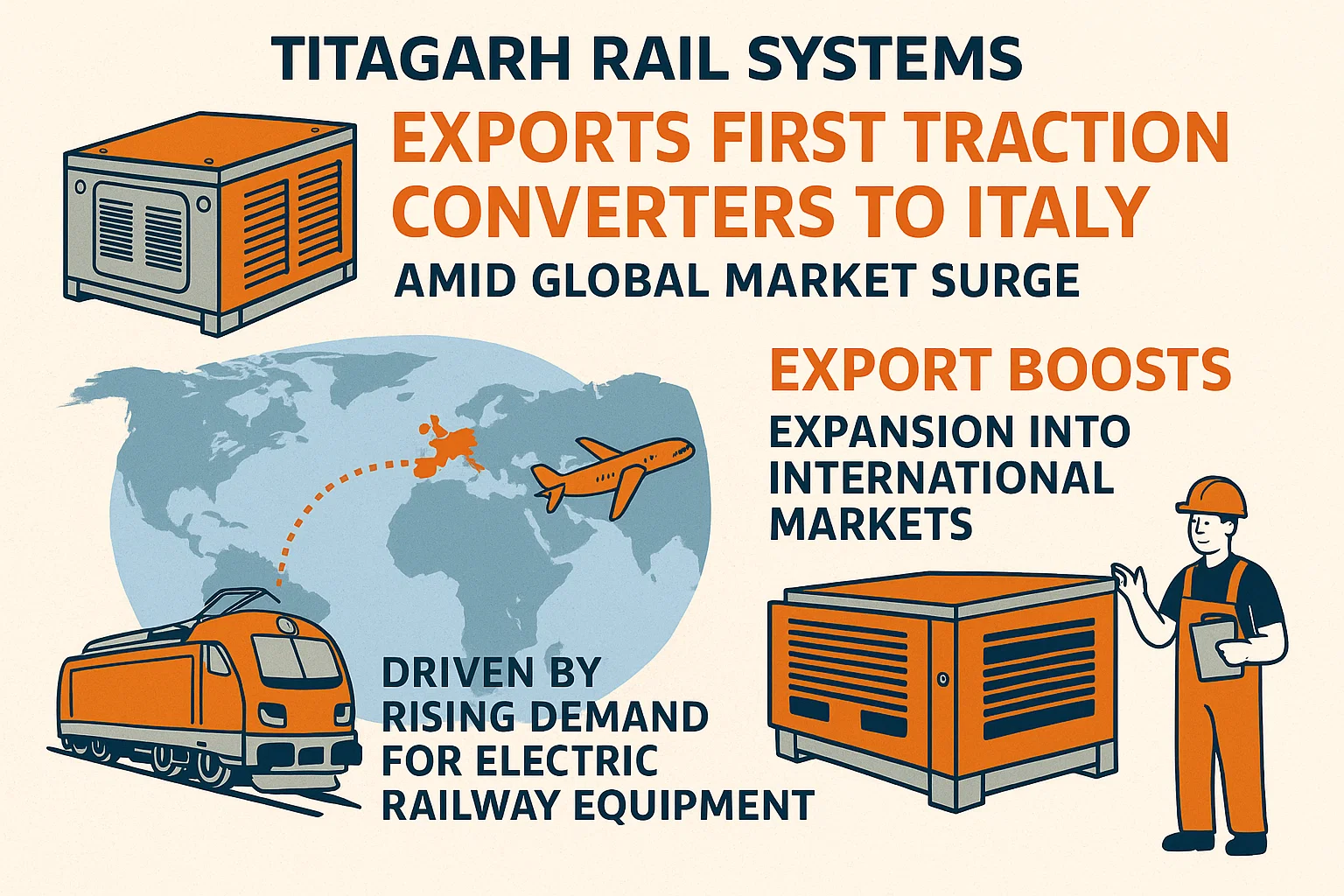
Titagarh Rail Systems Exports First Traction Converters to Italy Amid Global Market Surge
In July 2024, Titagarh Rail Systems Ltd (TRSL) achieved a major milestone by exporting its first batch of eight traction converters to its European arm, Titagarh Firema S.p.A. in Italy. This shipment is part of a €7.18 million order to supply converters for 38 EMU trainsets designated for Regione Lazio in central Italy.
Why This Matters:
- Marks India’s entry into the global converter export market.
- Signifies the growing technical self-reliance of Indian rail component manufacturers.
- Boosts India’s ‘Make in India for the World’
Production Insights:
- Current production: ~25 converters/month
- Target capacity: 50 converters/month
- Technology used: IGBT-based systems tailored for EMU and MEMU units
This event signals a turning point in global traction converter supply chains. Instead of depending solely on traditional suppliers in Europe and Japan, global rail projects are now looking toward cost-competitive yet high-quality options from emerging markets.
Access Your Free Sample Report- Rolling Stock Traction Converter Market
2. Modernization Wave: IGBT Retrofits and Smart Converters
Across Europe and North America, electrified rail networks are undergoing significant modernization efforts. A central focus of these projects is upgrading old GTO (Gate Turn-Off) thyristor-based converters to modern IGBT (Insulated Gate Bipolar Transistor) units.
Featured Case Study: ABB’s Swiss Overhaul
ABB, one of the leaders in power electronics, partnered with Swiss Federal Railways (SBB) to upgrade 119 locomotives with high-efficiency IGBT converters.
Outcomes:
- Energy savings of up to 20%
- Reduced heat dissipation
- Improved service life
- Enhanced performance during regenerative braking
This type of upgrade not only improves the vehicle’s performance but also contributes to decarbonization goals by reducing the overall carbon footprint per trip.
3. Hydrogen & Battery Hybrids: Converters Powering Clean Transit
Hydrogen and battery-electric trains are no longer experimental— they’re becoming mainstream in regions lacking full electrification.
Example: Stadler Rail’s FLIRT H₂
Slated for commercial service in California and parts of Germany, the FLIRT H₂ hydrogen train is equipped with:
- ABB traction converters
- DC/DC converters
- Onboard Energy Storage Systems (ESS)
The train can run up to 460 kilometers per day emission-free. The converter here plays a crucial role not just in motor control, but in:
- Balancing power from fuel cells and ESS
- Managing peak load efficiency
- Reducing noise and vibration
This innovation highlights how traction converters now serve as intelligent energy managers in alternative propulsion systems.
Emerging Technologies & R&D Trends
Beyond the current wave of modernization and hybrid integrations, next-gen traction converters are focusing on efficiency, miniaturization, and durability.
1. Silicon Carbide (SiC) Semiconductors
- Compared to IGBT, SiC offers:
- Higher efficiency
- Lower switching losses
- Smaller heat sinks
2. Three-Level Converters
KSC Drive Systems in Russia is developing three-level inverter topologies for EMUs. Benefits include:
- Smoother waveforms
- Reduced motor insulation stress
- Lower acoustic noise
- Enhanced reliability
3. Predictive Maintenance Integration
Converters with real-time health diagnostics and AI-based fault prediction are being piloted. These will reduce unplanned downtimes and maintenance costs significantly.
Download Sample Report PDF- Rolling Stock Traction Converter Market
Regional Landscape
Asia-Pacific: Fastest Growing Region
- India’s Titagarh and BHEL, China’s CRRC, and Japan’s Toshiba are scaling up production.
- Urban rail networks are expanding in Delhi, Bangkok, Jakarta, and Manila.
- Retrofitting older fleets with modern converters is a big focus.
Europe: Technological Pioneer
- Push for full rail decarbonization by 2040.
- Countries like Germany, Austria, and Switzerland are upgrading to hybrid fleets.
- EU grants encourage conversion from diesel to electric/dual-mode vehicles.
North America: Retrofit & Hybrid Focus
- BNSF and Amtrak investing in battery-electric test fleets.
- California’s Clean Transit Initiative backs hydrogen rail pilots.
Traction Converters in the Value Chain
| Stakeholder | Role in Ecosystem |
| OEMs (Alstom, Siemens) | Integrate converters into trains |
| Component Suppliers (ABB, Mitsubishi) | Build and supply converter systems |
| Railway Operators (DB, SNCF, IR) | Specify converter features in tenders |
| Local Manufacturers | Drive localization and cost reduction |
| Governments & Policies | Provide funding and regulatory support |
Challenges Ahead
Even with innovation and market expansion, challenges remain:
Supply Chain Complexity
- High-spec components like IGBT modules and control boards face global sourcing issues.
- Geopolitical tensions may disrupt cross-border tech sharing (e.g., EU-India-Russia).
Regulatory Compliance
- Must meet strict EMC and safety norms.
- Adapting to changing electrification standards (15kV, 25kV, 750V DC, etc.)
Energy Density vs. Heat Dissipation
- Higher efficiency converters tend to produce concentrated heat.
- Innovative cooling systems are essential (liquid cooling, heat pipe tech).
Click Here To Download Full Sample Report- Rolling Stock Traction Converter Market
Strategic Recommendations for Industry Players
For Manufacturers:
- Invest in SiC-based R&D
- Partner for hybrid/battery integrations
- Expand local testing labs to reduce certification delays
For Operators:
- Prioritize modular upgrade paths for legacy trains
- Focus on converter lifecycle costs, not just upfront price
- Implement predictive maintenance platforms
For Policymakers:
- Provide grants/subsidies for fleet upgrades
- Promote technology transfer programs
- Create a global certification protocol to streamline exports
A High-Voltage Future
The Rolling Stock Traction Converter market, once a niche in the railway supply chain, is now a linchpin of electrified mobility. As nations push for lower emissions, better energy use, and smart urban mobility, traction converters are emerging as the central nervous system of modern rail.
From India’s first traction converter exports to Stadler’s hydrogen marvels and Russia’s three-level inverters, the industry is riding a wave of technological and geopolitical realignment. With a CAGR of 5.1% through 2032, and a forecast value of US$ 1.12 billion, the traction converter segment is powering more than just trains—it’s energizing the future of sustainable transport.

Comments (0)