
Timing Reliability at the Core of the Thru-Hole Clock Oscillator Market
Clock oscillators are the heartbeat of electronic systems, defining the timing accuracy that governs data flow, synchronization, and processing stability. Within this broader category, thru-hole clock oscillators continue to hold strategic importance in semiconductor-driven systems where mechanical robustness, thermal endurance, and long operational life are critical.
Through-hole oscillators, in contrast to surface-mount devices (SMDs), are placed using leads that are inserted through printed circuit boards. This construction provides enhanced physical stability, making them preferred in industrial controls, defence electronics, power systems, and legacy infrastructure where replacement cycles extend over decades rather than years.
Core Technology Overview and Functional Role
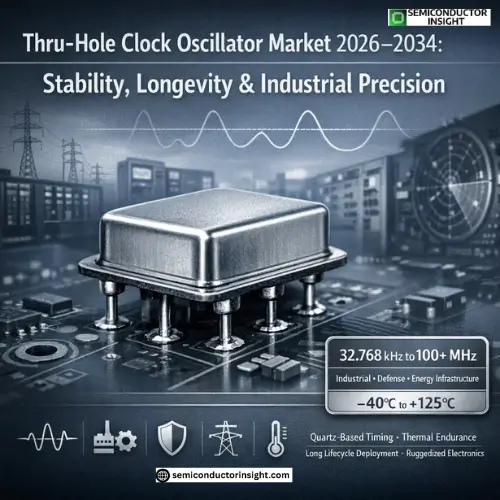
A thru-hole clock oscillator integrates a quartz crystal resonator, active semiconductor circuitry, and output buffering into a sealed package. The oscillator converts the crystal’s mechanical resonance into a stable electrical frequency that drives system timing.
Key functional advantages include:
- Strong resistance to vibration and mechanical shock
- Superior thermal performance in harsh environments
- Reliable solder joints for high-current and high-temperature operations
These characteristics align well with systems where failure tolerance is minimal and uptime is mission-critical.
Frequency Ranges and Performance Characteristics
The market spans a wide frequency spectrum, typically ranging from 32.768 kHz (used in real-time clocks) to 100 MHz and above for control and communication systems. Lower-frequency oscillators dominate industrial automation and metering, while higher-frequency units support embedded processors and communication interfaces.
Performance differentiation often centers on:
- Frequency stability over temperature
- Aging characteristics over extended operational life
- Output formats such as CMOS, TTL, and clipped sine wave
Thru-hole designs are especially valued in applications requiring long-term frequency consistency, even if absolute miniaturization is not a priority.
End-Use Segmentation across Semiconductor Applications
- Industrial Automation and Control Systems
Programmable logic controllers (PLCs), motor drives, and factory control units rely on thru-hole oscillators for consistent timing under heat, dust, and vibration. Many industrial OEMs maintain legacy board designs where thru-hole components remain standardized.
- Defence and Aerospace Electronics
Radar systems, communication modules, and navigation electronics often specify thru-hole oscillators due to their mechanical integrity and predictable long-term performance. In these sectors, design validation cycles can exceed 10-15 years, reinforcing demand for proven component formats.
- Power Infrastructure and Energy Systems
Grid monitoring equipment, inverters, and protection relays use thru-hole oscillators to ensure stable clock signals in high-voltage and high-temperature environments.
- Medical and Test Equipment
Diagnostic instruments and laboratory analysers favor thru-hole oscillators for serviceability, accuracy, and reliability across extended usage cycles.
You Can Freely Surf Our Latest Updated Report Here:
https://semiconductorinsight.com/report/thru-hole-clock-oscillator-market/
Packaging Types and Design Preferences
Thru-hole oscillators are commonly available in metal can and ceramic packages, offering effective shielding against electromagnetic interference. These packages also improve thermal dissipation, which is essential in densely populated industrial boards.
Design engineers often select thru-hole formats when:
- Boards are manually assembled or wave-soldered
- Mechanical anchoring is prioritized over space efficiency
- System upgrades must maintain backward compatibility
Market Drivers and Current Industry Conditions
Despite the global shift toward miniaturization, several structural factors sustain this market:
- Continued operation of legacy industrial and defense systems
- Increased focus on infrastructure resilience and modernization
- Growing demand for ruggedized electronics in energy and transportation
Recent supply chain disruptions have also encouraged OEMs to retain proven thru-hole designs rather than requalify newer components, reinforcing near-term demand stability.
Innovation Trends and Engineering Developments
While the physical format remains unchanged, innovation is occurring at the material and circuit level. Advances include:
- Improved crystal cut techniques for enhanced stability
- Lower power consumption semiconductor drivers
- Expanded operating temperature ranges
These improvements allow thru-hole oscillators to remain technically competitive while meeting modern reliability standards.
Thru-hole clock oscillator market is not driven by rapid growth but by consistency, trust, and long-term deployment. As industries invest in upgrading infrastructure without replacing entire systems, demand for compatible and reliable timing components will persist.
For semiconductor suppliers, this market represents a stable, margin-resilient segment anchored in engineering reliability rather than volume competition. For system integrators and OEMs, thru-hole oscillators remain a cornerstone of dependable timing architecture.

Comments (0)