
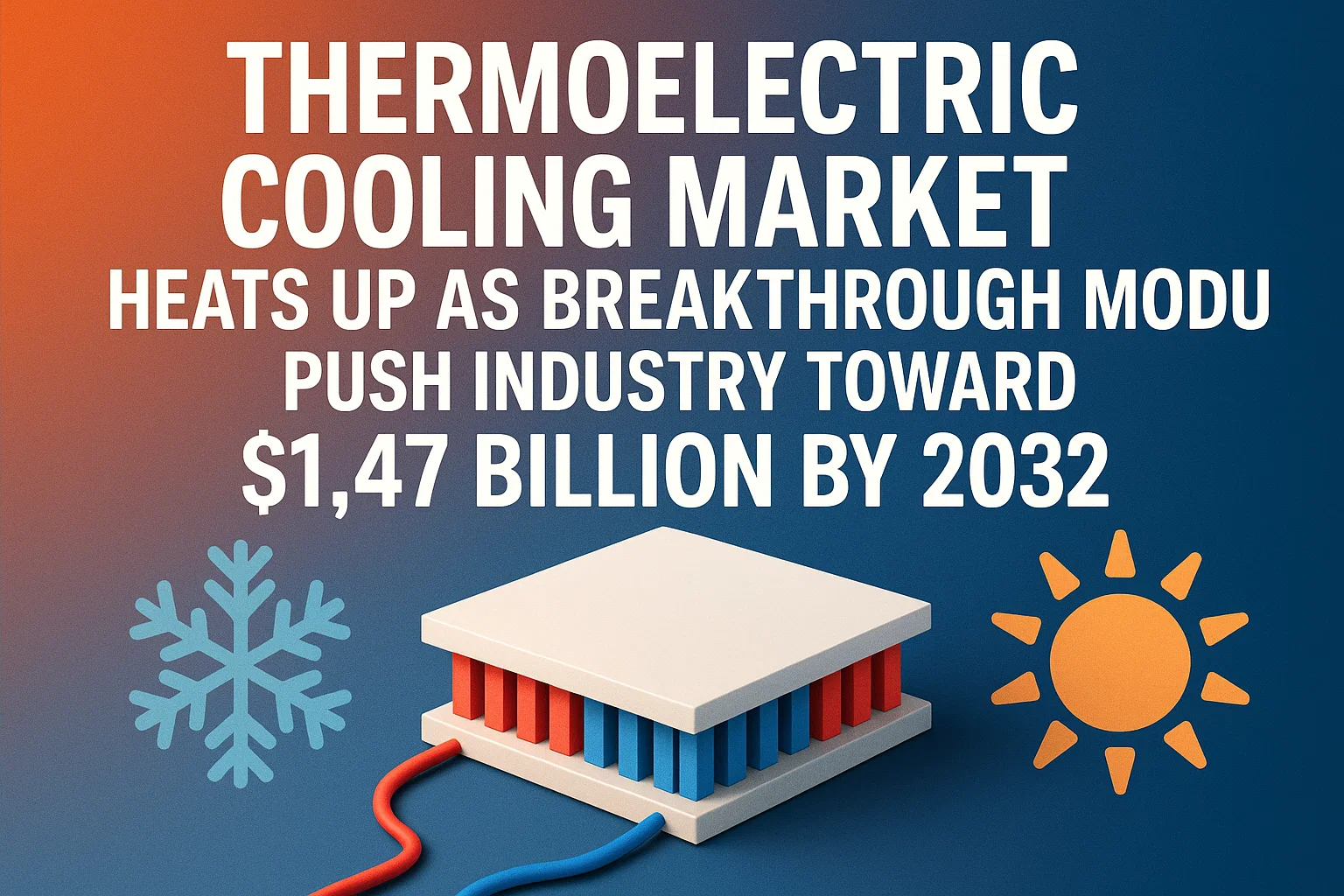
Thermoelectric Cooling Market Heats Up as Breakthrough Modules Push Industry Toward $1.47 Billion by 2032
Thermoelectric or Peltier cooling has long lived in the shadow of compressors and vapor-cycle refrigerators: humble, compact, reliable, but limited by efficiency. That narrative is changing fast. Over the past few years, engineering teams, materials scientists, and systems integrators have begun to cram surprising performance out of this solid-state effect. Thin films, single-crystal growth, smarter controls, and system-level thinking are pushing Peltier devices into markets once considered unreachable for solid-state cooling.
This article digs into the recent developments that matter, explains why they’re important in plain language, and connects the dots to the market forecast: the Peltier Cooling Modules market was valued at USD 795 million in 2024 and is expected to grow to USD 1,475 million by 2032 (CAGR 9.5%).
Access Your Free Sample Report- Peltier Cooling Modules Market
What exactly is a Peltier (thermoelectric) module quick refresher
A Peltier module is a solid-state heat pump: when you run current through specially arranged semiconductor legs, heat moves from one side of the module to the other. No moving parts, no refrigerant, compact form factor, instant response. They’re used today for small-scale applications laser diode cooling, scientific detectors, portable coolers, and niche consumer devices but historically suffered from low energy efficiency compared with compressor systems.
Two metrics matter most:
- ΔTmax (maximum temperature difference) how large a temperature gap the module can sustain between hot and cold sides.
- Qmax (heat pumping capacity at a given ΔT) how much heat the module can remove at a chosen ΔT.
Improvements in both metrics translate into new applications. Recent work has made strides on both counts.
The headline breakthroughs you need to know about
-
Thin-film and nano-engineered thermoelectrics big efficiency gains
Researchers and large labs have reported new thin-film thermoelectric devices that dramatically change the performance-to-mass story of Peltier cooling. By moving away from bulk, polycrystalline legs to engineered thin films and improved semiconductor stacks, these devices reduce parasitic losses and increase the effective figure of merit (zT) of the thermoelectric material.
Practically, thin-film approaches cut the amount of active material needed and allow for integration into hybrid systems. That results in higher cooling efficiency per unit volume and makes thermoelectric cooling more attractive where weight, space, or environmental impact (no refrigerants) matter.
-
Single-crystal growth and better Qmax
On the module manufacturing side, improvements like single-crystal growth of thermoelectric legs have pushed heat absorption (Qmax) up by meaningful percentages compared to traditional designs. These advances mean modules can move more heat for the same footprint a critical enabler for automotive and industrial use where heat loads can be large.
-
Higher ΔT and stacked modules for extreme cooling
Product lines have expanded to include single-stage modules that reach higher temperature differentials and stacked multi-stage modules that deliver extreme cooling performance in thin stacks. That opens doors to applications that require large ΔT values without bulky compressors: specialized medical devices, laboratory instruments, and compact refrigeration in constrained spaces.
-
Compact, thin, and higher heat flux units
A trend toward ultra-compact, thin modules with improved heat flux density helps in miniaturized systems such as optics, laser diodes, and sensors. Small form-factor devices with high power density are now feasible, which supports growth in electronics cooling and precision instrumentation.
-
Smarter control machine learning and hotspot management
New research demonstrates that intelligent control algorithms including ML-based allocation of current across TEC arrays can significantly improve temperature uniformity and energy efficiency in multi-module arrays. Instead of driving all modules identically, adaptive control distributes power optimally to address hotspots, reduce power consumption, and extend module life.
-
System-level optimization is finally getting attention
Several studies show that module improvements are necessary but not sufficient: interface thermal resistances, heat-exchanger design, and airflow management are often the weak links. Optimized air-to-air thermoelectric heat pumps and hybrid configurations (thermoelectric + mechanical compressor) show the greatest promise when engineers treat the module as part of an integrated thermal system rather than a drop-in component.
Why these advances are meaningful real world impact
- Hybrid refrigeration becomes practical. Instead of replacing compressors, Peltier modules can augment traditional systems. For instance, a compressor can bear the steady baseline load while Peltiers handle transient spikes, quick cooldowns, and localized hotspots. That approach reduces refrigerant usage and can improve overall COP (coefficient of performance) by matching the strengths of each technology.
- Design freedom for electronics and optics. Thin, high-heat-flux modules allow designers to put cooling right where it’s needed under a detector, next to a laser diode, or beneath a power package. The ability to integrate cooling directly at hotspots reduces thermal gradients and can boost performance and reliability.
- Cleaner, quieter, and more reliable solutions. No refrigerant leaks, no compressors, and fewer moving parts mean silent operation and potentially longer mean time between failures (MTBF) important for medical devices, vehicles, and sensitive scientific instrumentation.
- New markets open up. As ΔT and Qmax improve, Peltier modules become viable for automotive HVAC augmentation, battery thermal management, small refrigeration appliances, telecom cooling, and even some data center edge solutions.
Market snapshot and drivers of the forecast (USD 795M → USD 1,475M by 2032 at 9.5% CAGR)
The market figures you provided set a clear growth narrative: from USD 795 million in 2024 to USD 1,475 million by 2032, implying a compound annual growth rate of 9.5%. That projection aligns with the technical trends above and is supported by multiple demand drivers:
Primary demand drivers
- Automotive electrification: As electric vehicles proliferate, battery thermal management becomes mission-critical. Thermoelectric modules offer localized cooling and heating, rapid response, and compact form factors useful for battery modules, seat climate control, and power electronics.
- Consumer and portable refrigeration: For specialized portable fridges, vaccine carriers, and field medical kits, the appeal of small, refrigerant-free cooling is strong.
- Optics, photonics, and sensors: Many lasers, photodetectors, and analytical instruments require precise temperature control for stability and sensitivity. Miniaturized TECs fit perfectly here.
- Telecom and edge computing: Telecom shelters, remote RF amplifiers, and edge data boxes need localized thermal solutions that can tolerate harsh environments where compressors are impractical.
- Medical devices and laboratory equipment: Active temperature stabilization of samples, reagents, and sensors is a recurring need in diagnostics and lab automation.
- Environmental and regulatory pressures: Phase-out or tighter regulation of certain refrigerants and a general push toward low-GWP solutions create a tailwind for solid-state alternatives in niche refrigeration applications.
Download Sample Report PDF- Peltier Cooling Modules Market
Supply-side enablers
- Manufacturing improvements: Advances such as single-crystal growth and thin-film fabrication techniques improve module performance and may reduce per-unit material costs at scale.
- Localized manufacturing and reshoring: Companies shifting production closer to target markets reduce lead times and improve responsiveness to OEM demands.
- Smart controls and system integration expertise: Better thermal modeling and embedded control software make it easier to extract real-world value from modules.
Restraints and headwinds
- Fundamental efficiency limitations: Even with material and design improvements, thermoelectrics still lag vapor-compression in raw COP for many bulk refrigeration needs. That means Peltiers will be complementary rather than a wholesale replacement in many segments.
- Cost: High-end thermoelectric materials (including telluride-based compounds) can be costly. Until manufacturing scales or material costs decline, price sensitivity will limit adoption in cost-conscious markets.
- Thermal interface and system design complexity: Poor interfaces and poorly designed heat exchangers can erase module gains. Many companies underestimate system-level engineering required for good results.
- Competition from alternative technologies: Heat pipes, microchannel liquid cooling, vapor chamber solutions, and novel refrigerants continue to evolve and remain strong competitors.
Application breakdown where growth will be concentrated
Automotive
- Battery and power electronics: localized TECs for hot-spot mitigation and temperature ramp management.
- Cabin comfort: Peltier-based seat cooling/heating and small personal climate zones (supplementing HVAC).
- Why it will grow: Automakers want compact, efficient thermal solutions; solid-state advantages in response time and integration make TECs attractive.
Consumer appliances & portable refrigeration
- Mini-fridges, wine coolers, and medical transport boxes.
- Why it will grow: No refrigerant, low maintenance, and the ability to operate at odd orientations or in mobile settings.
Electronics and photonics
- Laser diodes, photodetectors, scientific cameras, and telecom optics.
- Why it will grow: Precise temperature control improves performance and longevity; miniaturized modules are a fit.
Medical & lab equipment
- Point-of-care devices, reagent chillers, and portable PCR transport.
- Why it will grow: Sterility and reliability, combined with compactness and quiet operation.
Industrial & aerospace
- Cooling for sensors, avionics, and small instrumentation.
- Why it will grow: Low maintenance and reliability in extreme environments.
Technical and commercial challenges to watch
- Material sustainability and supply risk. Some high-performance thermoelectric materials contain scarce or toxic elements. Alternatives that use abundant, environmentally benign elements are needed for broad sustainability.
- Integration pitfalls. The best module on paper can underperform if thermal interfaces, mounting pressure, or heat-sink design are neglected. System testing and thermal modeling must be part of product roadmaps.
- Cost per watt vs. compressor systems. For larger refrigeration loads, compressors remain more cost-effective. Peltiers must therefore focus on niches where their unique attributes (size, orientation tolerance, precision) matter.
- Thermal cycling and reliability. Repeated thermal cycling, mechanical stresses, and moisture ingress can reduce lifetime. Improved packaging and humidity/corrosion protection are essential for automotive and outdoor applications.
- Control electronics and software. Intelligent drivers improve efficiency but add complexity. Industry adoption favors robust, easy-to-integrate control modules and standard interfaces.
Strategic recommendations for manufacturers, OEMs, and investors
For module manufacturers
- Prioritize system partnerships. Work with heat-sink and OEM system designers to deliver complete cooling solutions rather than bare modules. Co-design bundles reduce integration risk for customers.
- Invest in packaging and corrosion protection. Especially for automotive and outdoor markets, durable environmental protection is a differentiator.
- Scale thin-film production carefully. Thin films promise efficiency but require new manufacturing tooling. Focus initial volumes on high-margin segments (medical, scientific) to amortize tooling costs.
For OEMs (device integrators)
- Conduct full system thermal audits. Don’t treat a Peltier module as a drop-in model and test interfaces, airflow, and parasitic resistances across the full operating envelope.
- Leverage hybrid architectures. Where possible, pair Peltiers with mechanical systems to improve transient behavior, reduce peak compressor usage, and deliver a better user experience.
For investors
- Look for companies with systems expertise. Suppliers that can deliver module + heat-sink + control software are more likely to win contracts.
- Bet on materials and manufacturing scale. Firms solving material cost or making step changes in manufacturing economics could disproportionately benefit as adoption scales.
- Watch regulatory trends. Policies that restrict high-GWP refrigerants or encourage energy-efficient designs can accelerate demand in niche refrigeration markets.
Near-term roadmap and what to expect by 2030
By 2030 we should expect:
- Wider adoption in EV thermal subsystems, particularly for targeted use cases (battery cell module cooling and seat climate systems).
- More hybrid refrigeration appliances that use thermoelectrics for fast response and compressors for steady-state.
- Commercial thin-film modules in high-value instrumentation, where improved efficiency and size reductions justify higher costs.
- Robust toolchains for control and integration, with off-the-shelf driver modules and thermal management software becoming common.
- Steady but limited penetration in mainstream household refrigeration solid-state alone won’t replace compressors for bulk cooling but will appear in auxiliary features and niche form factors.
Practical design checklist for integrating Peltier modules
- Start with heat flow numbers. Determine real heat load at the desired cold-side temperature, not just ambient numbers.
- Design low-resistance thermal interfaces. Use high-quality TIMs (thermal interface materials), controlled mounting pressure, and minimal interface layers.
- Match module Q-ΔT curve to operating point. Don’t overspec module ΔT if it sacrifices Q beyond your heat load.
- Plan for condensation control. If the cold side drops below ambient dew point, add moisture management and electrical protection.
- Use adaptive control. Implement algorithms to vary current as loads change this saves power and extends module life.
- Test in the field. Validate across the full temperature and humidity range expected in real operations.
Click Here To Download Full Sample Report- Peltier Cooling Modules Market
Environmental and sustainability considerations
- No refrigerants a big plus for many small and mobile applications. Eliminating refrigerants reduces leakage risk and simplifies regulations.
- Material concerns remain. Some high-performance thermoelectric alloys include scarce elements. Industry must balance performance with sustainable, abundant materials over the longer term.
- Energy efficiency tradeoffs. Even with improvements, Peltiers don’t always beat vapor-compression for bulk refrigeration. Life-cycle analysis should consider energy use over the product lifetime, not just initial installation.
Thermoelectric cooling is transitioning from a niche, convenience technology to a strategic tool in the thermal engineer’s toolkit. The combination of material science breakthroughs, better module designs, and smarter control is unlocking applications that were previously off limits. The projected market growth from USD 795 million in 2024 to USD 1,475 million by 2032 (9.5% CAGR) is compelling but also nuanced: growth will be uneven, concentrated in segments that value the unique attributes of solid-state cooling.

Comments (0)