
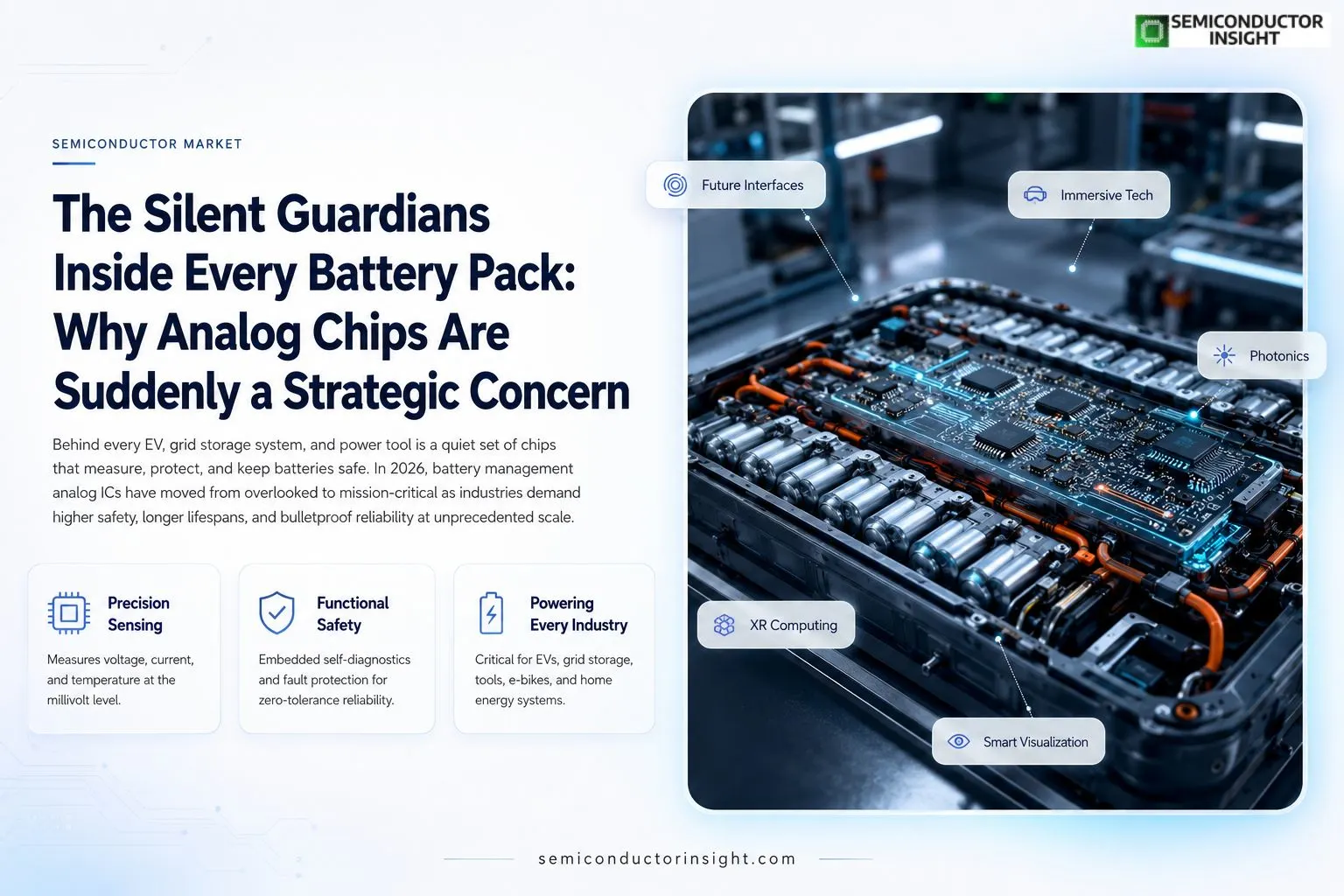
The Silent Guardians Inside Every Battery Pack: Why Analog Chips Are Suddenly a Strategic Concern in 2026
Behind the sleek dashboard of a new electric car, beneath the floor pan where thousands of cylindrical cells sit clamped together, there is a quiet set of chips that never makes it into marketing brochures. They do not run infotainment screens or crunch neural‑network calculations. Their job is far more primitive and, as it turns out, far more critical. They measure voltage, current, and temperature at each cell with excruciating precision, balance the charge across the pack, and slam the system shut if something starts to go wrong. These are the battery management analog integrated circuits, and in 2026 they have become one of the automotive and energy storage industries’ most tightly watched components.
For years, the semiconductor world treated battery management chips as a mature, somewhat boring category. You needed them, sure, but they were not glamorous. They were full of amplifiers, comparators, and data converters built on older process nodes that rarely made headlines. What has changed is the sheer scale of the battery market bearing down on them. Every electric vehicle contains at least one battery management system, often several. Every grid‑scale storage installation contains dozens. Every cordless power tool, every e‑bike, every home backup unit relies on a chip that can keep a string of lithium‑ion cells from drifting into dangerous territory. The volume is staggering, and the reliability requirements are unforgiving.
The shift from digital to analog anxiety
Battery management systems have always been a mix of analog sensing and digital processing. The digital side – the microcontrollers that run state‑of‑charge algorithms and talk to the vehicle’s main computer – gets most of the engineering attention. But the analog front end is where the physics meets the silicon. A cell’s voltage must be measured to within a few millivolts while the pack is under heavy load, with electromagnetic noise screaming through the wiring harness. Temperature sensors must be sampled constantly across dozens of points. A single failed measurement can cause the system to miscalculate the battery’s health, trigger a false alarm, or, in the worst case, miss an overvoltage condition that leads to a thermal runaway.
In 2026, the tolerance for such failures is effectively zero. Functional safety standards like ISO 26262 now apply to battery management chips at the highest integrity levels, especially in vehicles with hands‑off driving capabilities where a battery failure at highway speed is unthinkable. This has pushed analog chip designers to embed extensive self‑diagnostics, redundant measurement paths, and fault‑injection testing right into the silicon. A chip that was once considered a commodity is now being treated as a safety‑critical component, and that changes everything from the design cycle to the price tag.
A 2026 product launch that tells the story
In February this year, Texas Instruments, one of the world’s largest analog semiconductor companies, released a new battery monitor IC that it described as its most accurate and functionally safe to date. The chip, designed to sit directly on cell modules, can measure voltage with an error of less than 1.5 millivolts over the full automotive temperature range, a spec that would have been considered laboratory‑grade a decade ago. More importantly, it includes built‑in hardware that continuously checks the analog signal chain for latent faults – a requirement that is fast becoming a baseline expectation in the industry.
A Reuters story from April 2026 reported that a major German automaker had selected this chip family for its next‑generation electric platform, citing the need for “inherently safe measurement from the cell to the microcontroller.” That wording matters because it reflects a shift in procurement logic. Carmakers are no longer just asking for accurate chips; they are demanding chips that can prove, in real time, that they have not silently broken.
The energy storage boom multiplies demand
Electric vehicles may be the most visible application, but they are not the only one pulling on analog battery management ICs. Stationary energy storage has become a genuine volume market. In March 2026, the U.S. Energy Information Administration reported that utility‑scale battery installations in the United States had already surpassed 25 gigawatts, more than triple the capacity operating just three years earlier. Each of those installations needs a battery management system, and each system needs analog front‑end chips capable of monitoring hundreds or thousands of cells arranged in long series strings.
The requirements here are slightly different from automotive. A grid battery does not have to survive a crash test, but it does have to run for decades with minimal maintenance, often in remote locations where a service visit is expensive. Analog chips for these applications are being specified for drift performance over twenty‑year lifespans, a challenging requirement for semiconductor devices that are constantly exposed to voltage stress and temperature cycling. Manufacturers that can demonstrate long‑term reliability data are winning contracts, and new qualification standards are being drafted to standardize how such longevity is proven.
The supply chain hangover that reshaped inventory strategies
The semiconductor shortage of 2021–2023 is a fading memory for most chip categories, but its ghost still lingers in the battery management market. During the crunch, automakers discovered just how dependent they were on a handful of analog chip suppliers, and many of them panicked. Waiting times for battery monitor ICs stretched beyond 52 weeks, and production lines sat idle because a three‑dollar chip could not be sourced.
By 2026, the industry has adjusted in ways that are likely to be permanent. Several large automotive tier‑one suppliers have moved to dual‑source qualification for their analog battery management chips, meaning they design their boards to accept pin‑compatible parts from two different manufacturers. This is expensive and time‑consuming – analog chips are rarely drop‑in replacements – but the supply assurance is now seen as worth the engineering cost. A trade publication, Electronic Design, noted in May 2026 that dual‑sourcing requests for battery analog ICs had increased by over 40 percent since 2023, a shift that is reshaping how chipmakers compete.
At the same time, new analog semiconductor capacity is coming online. A joint venture between a European chipmaker and an Indian manufacturing group broke ground on a new 200‑millimetre analog wafer fab near Bangalore in January 2026, with battery management ICs explicitly named as a target product line. The project, covered by local business press, is part of India’s broader push to build a domestic semiconductor ecosystem, and it highlights how battery management chips are being drawn into national industrial strategies.
The humble op‑amp that refuses to be replaced
For all the innovation in digital battery algorithms, the actual measurement still comes down to a handful of analog building blocks: operational amplifiers, analog‑to‑digital converters, precision voltage references, and multiplexers that scan across cell channels. These circuits have been around for decades, but the demands of modern lithium‑ion packs are pushing them to new extremes. A 400‑volt or 800‑volt automotive battery string requires the analog chip to withstand high common‑mode voltages while still resolving microvolt differences between cells. That is not easy, and it forces design teams to use specialized high‑voltage semiconductor processes that are only available at a limited number of fabs.
This is one reason why the market has not seen the kind of disruptive startup entry that has transformed digital semiconductors. Analog chip design requires years of tacit knowledge and close collaboration with process engineers. The dominant players – Texas Instruments, Analog Devices, STMicroelectronics, Renesas, NXP – have accumulated a deep moat not just in intellectual property but in the sheer craft of making precise measurements in electrically hostile environments. In 2026, that moat looks as wide as ever.
Where the market is heading
The battery management analog IC market is not a trillion‑dollar story. It is a quietly expanding layer of the electrification wave, growing in lockstep with the number of battery packs shipped each year. As cell chemistries evolve – solid‑state batteries, sodium‑ion, lithium‑iron‑phosphate – the analog chips will need to adapt to different voltage ranges and impedance characteristics. As packs get larger and voltages rise, the isolation and safety demands will only intensify. And as regulators in Europe, North America, and Asia impose stricter battery lifecycle tracking, the analog front end will become the primary source of truth for the data that feeds digital battery passports.
None of this will make the evening news. You will never see a commercial for a cell‑monitoring chip. But the next time you see an electric car glide silently past or a rooftop solar battery charging on a sunny afternoon, it is worth remembering that somewhere deep inside those packs, a cluster of analog circuits is watching every cell, every second, without complaint and without fail. That silent vigilance is what makes the entire electrified future possible.
Check Out Our Latest Analysis Report: https://semiconductorinsight.com/report/battery-management-analog-ic-market/

Comments (0)