
Terrestrial Trunked Radio TETRA Market Enabling Trusted Communication for Public Safety and Enterprise Sectors
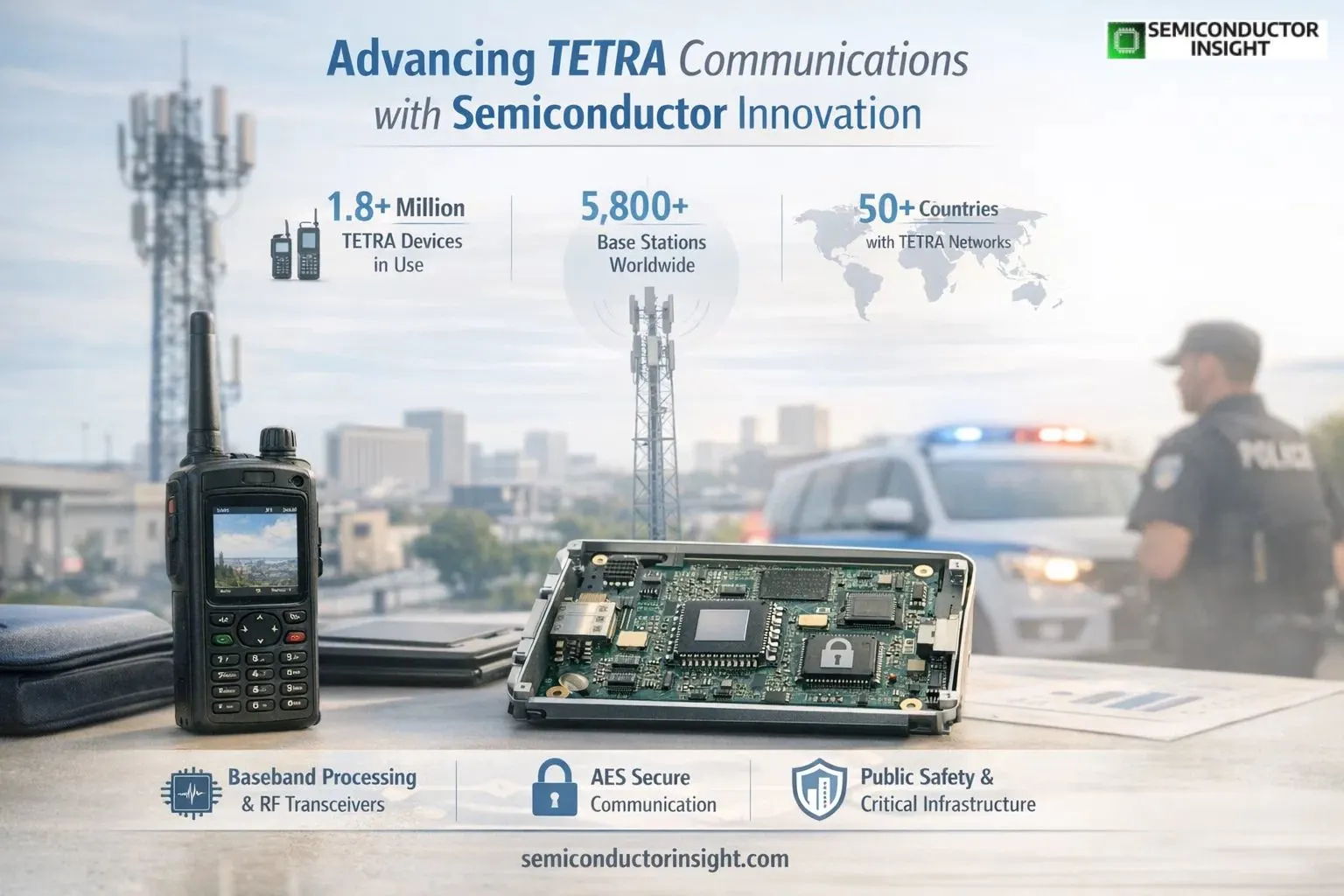
Terrestrial Trunked Radio (TETRA) has evolved into one of the most reliable communication standards for mission-critical environments, deeply intertwined with semiconductor advancements. TETRA networks use dedicated frequency, specialized baseband processors, RF chips, and encryption modules to provide uninterrupted communication, unlike traditional cellular systems.
Globally, over 1.8 million TETRA terminals are currently operational, supporting sectors such as emergency services, transportation, and utilities. Additionally, more than 5,800 base stations have been deployed worldwide, forming dense communication grids across urban and remote regions.
The semiconductor layer plays a crucial role here enabling signal processing, spectrum efficiency, and secure data transmission through embedded chipsets.
Advanced Chipsets Enabling Next Wave
At its core, TETRA communication is enabled by a combination of specialized semiconductor components designed for reliability and low-latency communication.
Key chip level architecture includes:
- Baseband processors for digital signal modulation and decoding
- RF transceivers operating in UHF frequency bands (typically 380-470 MHz)
- Power-efficient microcontrollers for portable devices
- Encryption chips supporting AES-based secure communication (adopted in nearly 48% of new devices)
- DSP (Digital Signal Processing) units for voice clarity and noise suppression
TETRA semiconductors, on the other hand, focus on endurance, a long lifespan (usually 10 to 15 years), and performance in harsh environments.
Network Density and Usage Pattern Mapping
Global Deployment Footprint
Base Stations Installed | █████████████████████
Active Radio Units | ███████████████████████████
Countries with TETRA Networks | ███████████
Supporting data:
- TETRA networks operational in 50+ countries
- Over 2 million devices deployed globally
- Public safety accounts for more than 55% of usage demand
This distribution highlights how semiconductor-enabled communication systems are scaling across critical infrastructure globally.
Smart Indicators Supporting Market Decisions
- Portable devices contribute to nearly 60% of total deployments, reflecting mobility-driven demand
- Hardware components dominate with ~70% share, emphasizing semiconductor dependency
- Trunked Mode Operation (TMO) supports over 65% of communication traffic, optimizing spectrum efficiency
- Around 70% of public safety agencies rely on TETRA portable radios for real-time coordination
- Nearly 30% of recent upgrades focus on IP-based and hybrid TETRA-LTE systems
Integration with Next-Gen Semiconductor Technologies
The evolution of TETRA is now intersecting with advanced semiconductor innovations:
- Integration with LTE chipsets for hybrid communication systems
- AI-enabled signal processors for predictive network management
- Low-power semiconductor design improving battery life in handheld radios
- System-on-Chip (SoC) architectures reducing hardware complexity
- Edge computing modules embedded in base stations for real-time analytics
This convergence is transforming TETRA from a voice-centric system into a data-capable communication infrastructure.
Some unique Professional Mobile Radio (PMR) services of TETRA are:
- Fast call setup for a large area and all-informed net group calls
- Independent of the network, Direct Mode Operation (DMO) enables back to back conversations between radio terminals.
- High-level audio encryption to satisfy public safety organisations security requirements
- A feature that allows emergency calls to be made even when the system is busy
- PABX and PSTN telephone communications using full duplex voice
Semiconductor Supply Chain Linkages
The TETRA ecosystem relies heavily on semiconductor supply chains, encompassing RF chip manufacturers, embedded system designers, memory and storage component suppliers, power management IC providers, and secure chipset developers. Disruptions in semiconductor production directly affect TETRA device availability and deployment schedules, rendering this market particularly vulnerable to global chip supply fluctuations.
At Last before Ending, Don’t Forget to Browse Our Recent Exclusive Report for Detailed Insights: https://semiconductorinsight.com/report/global-terrestrial-trunked-radio-tetra-market/
Terrestrial Trunked Radio market stands at a unique intersection of communication infrastructure and semiconductor engineering. While it may not match the scale of consumer telecom, its importance in mission-critical operations makes it indispensable.
What distinguishes this market is not just its application but the depth of semiconductor innovation embedded within every device, network node, and transmission layer. As global infrastructure becomes more security-driven and resilient, TETRA systems will continue to rely on advanced chip technologies to deliver reliability where failure is not an option.

Comments (0)