
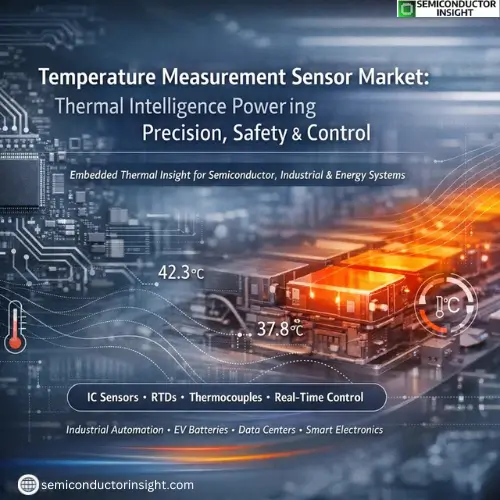
Temperature Measurement Sensor Market Growth Strengthens Precision Monitoring, Expands Industrial Share, and Shapes Future Forecast
Temperature, in many ways, is the universal indicator of operational health. From industrial machinery to semiconductor processors, from automotive powertrains to biomedical devices, how heat is measured and how precisely defines performance, safety, and reliability. Temperature measurement sensor market lies at the intersection of material science, signal processing, and real-time control systems, and its growth mirrors the expanding need for accurate thermal insight across systems that must operate within stringent tolerances.
While this market encompasses a broad range of technologies from thermocouples and resistance temperature detectors (RTDs) to semiconductor-based IC sensors, recent demand is increasingly influenced by semiconductor innovation, digital integration, and smart control architectures.
Why Temperature Sensors Matter More Than Ever?
Every electronic system generates heat and in high-density circuits, even small thermal deviations can compromise performance or shorten life. In modern applications, temperature measurement sensors are not optional add-ons; they are built into the control loops that manage power, performance, and safety.
In many sectors, thermal insights account for:
- Up to a significant majority of real-time control decisions in automation systems
- A major proportion of failure prevention protocols in industrial machinery
- Integral data streams for battery management systems (BMS) in electric vehicles
Statistical data from industry surveys indicate that a large percentage of system faults trace back to thermal events, reinforcing why temperature sensors are embedded from the design phase through deployment and maintenance.
For instance, in July 2025: Sensirion has launched the SHT40-AD1P-R2 and SHT41-AD1P-R2 digital humidity and temperature sensors, now available through their global distribution network. Designed for harsh situations, these sensors guarantee great accuracy and dependability and are fitted with a removable protective cover to ensure durability during handling and deployment.
For instance, in October 2025: Metis Engineering, a pioneer in advanced CAN-based sensor technology, today announced the launch of its new 8-Channel Isolated Thermocouple to CAN module, designed to meet the demanding temperature monitoring requirements of industrial, automotive, and research applications. The new gadget represents a major breakthrough in thermocouple technology since each channel is isolated to 1000 VDC. With an accuracy of ±0.5 °C between 0 and 85 °C and ±1 °C between -40 and 125 °C, the module offers unmatched precision and performs dependably even in the most difficult conditions.
Semiconductors at the Core of Modern Thermal Sensing
Temperature measurement sensors today are substantially different from their analog predecessors. While traditional thermocouples remain valuable for extreme environments, semiconductor-based temperature sensors offer distinct advantages in precision, calibration stability, integration capability, and digital interfacing.
These devices typically incorporate:
- On-chip temperature-to-digital conversion
- Calibration data stored in non-volatile memory
- Standardized digital protocols like I2C, SPI, or SMBus
- Compact form factors suitable for embedded systems
This evolution toward embedded thermal intelligence has allowed designers to deploy temperature sensing not just at system boundaries, but deeply inside processors, power modules, and mixed-signal environments.
Applications Powering Market Expansion
The temperature measurement sensor market spans a wide range of end uses, each with its own technical and performance expectations.
Industrial Automation and Smart Factories
Temperature monitoring is central to industrial equipment reliability. As manufacturing lines become automated, sensors provide feedback that prevents overheating of motors, drives, and actuators.
In production environments where downtime can cost significant revenue, predictive maintenance programs rely on thermal trend data as one of the earliest indicators of system degradation.
Automotive and Electric Mobility
Modern vehicles contain dozens of temperature sensors. They monitor engine systems, transmissions, climate control, and battery packs. In electrified powertrains, thermal management is often the single most critical factor determining range, cycle life, and safety.
Industry reports suggest that a notable proportion of EV system design cycles include temperature sensor specifications as a core requirement, reflecting their essential role in battery management systems and power electronics.
To Know More about the Report, You Can Freely Browse Our Latest Updated Report:
https://semiconductorinsight.com/report/temperature-measurement-sensor-market/
Consumer Electronics and Data Centers
Smartphones, laptops, and servers all contain semiconductor temperature sensors that throttle performance, protect ICs, and optimize power consumption. In data centers, rack-level thermal insight is used not only for safety but for energy efficiency optimization, reducing cooling costs while maintaining uptime.
Material Science and Sensor Chemistry
Temperature sensors operate on different physical principles, each rooted in material behavior:
- Thermistors rely on predictable resistance changes with temperature
- RTDs use metal resistance change, often platinum, for high precision
- Thermocouples generate voltage based on junction temperature differences
- Semiconductor IC sensors integrate temperature-dependent band-gap references with digital circuitry
In semiconductor sensors, the chemical and physical properties of silicon allow tighter tolerance control, better reproducibility, and mass manufacturability. Calibration compensation at the wafer level ensures that sensor outputs remain accurate over time with a feature that has transformed how temperature data is trusted in automated systems.
Technology Innovations and Current Market Shifts
Innovation in this market is not merely about smaller sensors; it is about smarter thermal sensing. Noteworthy trends include:
- Sensor fusion combining temperature data with humidity, pressure, or vibration signals to produce richer diagnostics
- Edge processing executing thermal anomaly detection algorithms on the sensor module itself
- Wireless and IoT integration enabling remote monitoring in smart buildings and industrial platforms
- Miniaturized multi-zone thermal arrays allowing detailed thermal maps within compact electronics
These advancements have amplified the role of temperature measurement sensors from isolated indicators to system health compasses feeding digital twin models and real-time operational analytics.

Comments (0)