
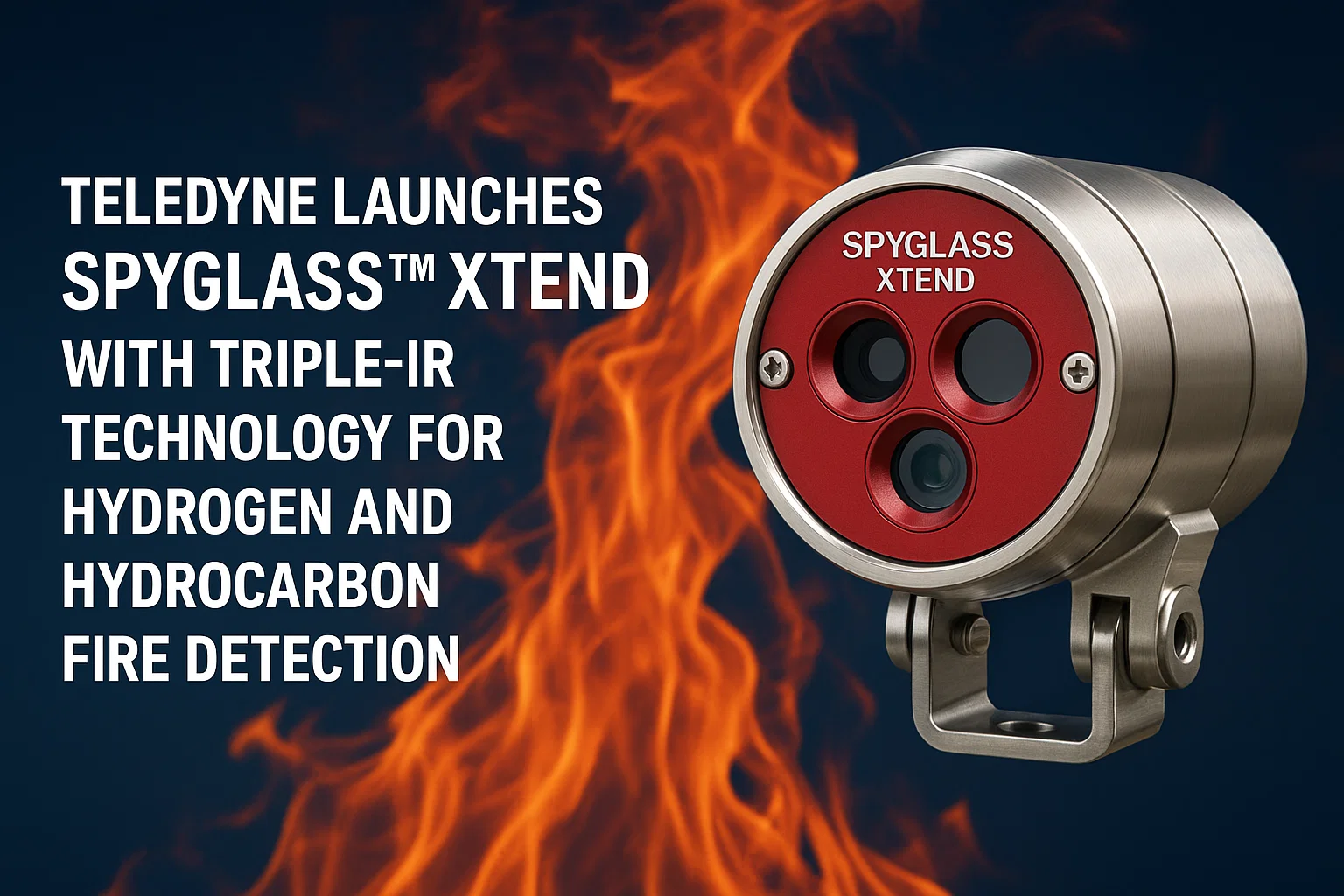
Teledyne Launches Spyglass™ Xtend with Triple-IR Technology for Hydrogen and Hydrocarbon Fire Detection
Industrial fire safety has always been a cornerstone of plant operations, energy production, and hazardous facility management. As industries expand into hydrogen energy, lithium-ion battery storage, and advanced data centers, the demand for accurate, reliable, and fast flame detection systems has grown rapidly. One of the most trusted technologies in this space is the Infrared (IR) Flame Sensor. These detectors provide reliable fire monitoring by analyzing the IR radiation emitted by flames, making them indispensable in high-risk industries such as oil & gas, chemical processing, mining, aerospace, and power generation.
The global Infrared Flame Sensor Market was valued at US$ 123 million in 2024 and is projected to grow to US$ 201 million by 2032, expanding at a steady CAGR of 7.2% between 2025 and 2032. This growth trajectory is fueled by both regulatory mandates and technological innovations that are reshaping how fire safety systems function.
Access Your Free Sample Report- Infrared Flame Sensor Market
Why Infrared Flame Sensors Matter More Than Ever
Infrared flame sensors work by detecting IR emissions from flames and differentiating them from background IR radiation. Their advantages include:
- Fast response times (as little as 2–5 seconds for advanced models).
- High immunity to false alarms caused by sunlight, welding arcs, or lightning.
- Ability to detect invisible flames such as hydrogen fires.
- Durability in harsh industrial conditions with heated optics and weather-resistant housings.
As industries evolve, particularly with the shift toward clean energy, traditional flame detection systems (like UV-only sensors) are no longer sufficient. Hydrogen fires, for example, emit a nearly invisible flame, which requires specialized IR and multi-spectrum flame detectors to detect them quickly and accurately.
Recent Developments Driving Market Growth
1. Teledyne’s Spyglass™ Xtend – Expanding to Hydrogen and Hydrocarbons
In February 2025, Teledyne Gas and Flame Detection introduced the Spyglass™ Xtend, a groundbreaking flame detector designed for both hydrogen and hydrocarbon fire detection.
Key highlights include:
- Triple-infrared (IR3) technology for enhanced accuracy.
- Resistance to false alarms from sunlight, reflections, and even harsh weather.
- Heated optics that prevent condensation and frost.
- Optional HD video output for live monitoring and event recording.
- Compliance with leading certifications: SIL 2, ATEX, IECEx, and usFMc.
The integration of video-based monitoring in flame detection is a major step forward. Not only does it improve visibility during an incident, but it also aids forensic investigations after an event.
2. Viking’s VSF303H – Built for the Hydrogen Economy
In June 2024, Viking Group launched the FM-approved VSF303H, a flame detector tailored for hydrogen applications.
Key features:
- Capable of detecting hydrogen flames at 40 meters.
- Ultra-fast response time of 2–5 seconds.
- Multi-IR sensors with digital signal processing for enhanced accuracy.
- Heated optics to handle harsh weather environments.
- Available in both aluminum and stainless-steel housings for diverse industrial environments.
With the hydrogen economy expanding rapidly—especially in Europe and Asia-Pacific—the Viking VSF303H positions itself as a key safety technology for hydrogen production plants, refueling stations, and storage facilities.
3. MSA Safety’s FL5000 – First Flame Detector with Bluetooth®
One of the most significant innovations came in June 2024 when MSA Safety unveiled the FL5000 Multi-Spectrum Flame Detector at the NFPA Conference & Expo.
Why it matters:
- First Bluetooth-enabled flame detector, enabling wireless setup and diagnostics.
- Uses multiple IR detectors analyzed through artificial neural networks (ANNs).
- Reduces false positives from sources like lightning, welding, or sunlight.
- Provides seamless integration into plant automation and safety systems.
Bluetooth integration reflects a broader trend in industrial IoT (IIoT), where even safety devices are becoming connected. Remote configuration and predictive diagnostics not only improve safety but also reduce maintenance costs.
4. Industry Shift Toward Multi-Spectrum and AI-Based Systems
While individual product launches are impressive, the larger industry trend is equally important. As of mid-2025, reports indicate that:
- Infrared detectors held 41.8% of the market share in 2024.
- Multi-spectrum IR detectors are projected to lead growth with a 2% CAGR through 2030.
- Companies are increasingly embedding AI algorithms and signal processing to minimize false alarms while maintaining ultra-fast detection speeds.
AI-based flame detection not only boosts reliability but also addresses the long-standing challenge of false alarms, which can cause costly operational shutdowns.
Download Sample Report PDF- Infrared Flame Sensor Market
5. Advances in Optical Flame Detection Methods
In 2024, industry experts highlighted how optical flame detection methods are being refined through:
- UV/IR combinations that balance speed and accuracy.
- Signal processing enhancements that filter out non-fire IR sources.
- Machine learning models that continuously improve detector intelligence.
These advances reflect a steady shift toward smart flame detection systems, aligning with broader smart factory and Industry 4.0 initiatives.
Market Size and Forecast (2025–2032)
The global Infrared Flame Sensor Market is set to expand steadily due to regulatory pressures, hydrogen energy projects, and IoT-driven advancements.
- 2024 Market Value: US$ 123 million
- 2025 Market Value: ~US$ 132 million
- 2032 Market Value: US$ 201 million
- CAGR (2025–2032):2%
Drivers of Growth
- Hydrogen Economy Expansion – Need for specialized IR sensors that detect invisible hydrogen flames.
- Industrial IoT (IIoT) – Integration of smart diagnostics, wireless connectivity, and AI.
- Stricter Safety Regulations – Mandates like ATEX Zone-0 requiring SIL-2 compliant systems.
- High-Risk Industries – Demand from oil & gas, chemical processing, power generation, and mining.
Challenges
- High upfront costs of advanced multi-spectrum sensors.
- Maintenance in harsh environments, especially offshore platforms.
- Technical expertise requirements for integration into safety networks.
Applications Across Industries
- Oil & Gas Facilities – Critical for detecting hydrocarbon and hydrogen fires in refineries and offshore platforms.
- Chemical Processing – Provides safety in volatile production environments.
- Mining Operations – Enhances safety against methane explosions.
- Power Generation – Especially vital in hydrogen-powered plants and battery storage facilities.
- Aerospace & Defense – Used in hangars, testing facilities, and fuel depots.
- Warehousing & Logistics – Increasing demand in lithium-ion battery warehouses.
Regional Insights
- North America – Strong adoption driven by regulations and oil & gas presence.
- Europe – Hydrogen-focused safety investments pushing demand for advanced detectors.
- Asia-Pacific – Rapid industrialization, clean energy projects, and data center expansions.
- Middle East & Africa – High-risk oil & gas operations ensuring steady demand.
Click Here To Download Full Sample Report- Infrared Flame Sensor Market
Future Outlook: 2025–2032
The future of infrared flame sensors is being shaped by three critical factors:
- Hydrogen Safety Standards – As hydrogen becomes mainstream, specialized IR flame detectors will become mandatory in facilities worldwide.
- Connected Safety Devices – Bluetooth, IoT, and AI integration will drive adoption, making sensors smarter and easier to maintain.
- Regulatory Convergence – Global standards for flame detection will likely tighten, requiring compliance across regions.
By 2032, multi-spectrum IR sensors with AI-driven algorithms will dominate the market, while video-assisted flame detection will become standard in high-value installations.
The Infrared Flame Sensor Market is on a clear upward path, projected to grow from US$ 123 million in 2024 to US$ 201 million by 2032 at a CAGR of 7.2%. With Teledyne, Viking, and MSA Safety leading the charge in innovation, industries are embracing next-gen flame detection technologies that combine multi-spectrum IR, AI, IoT connectivity, and advanced optics.

Comments (0)