
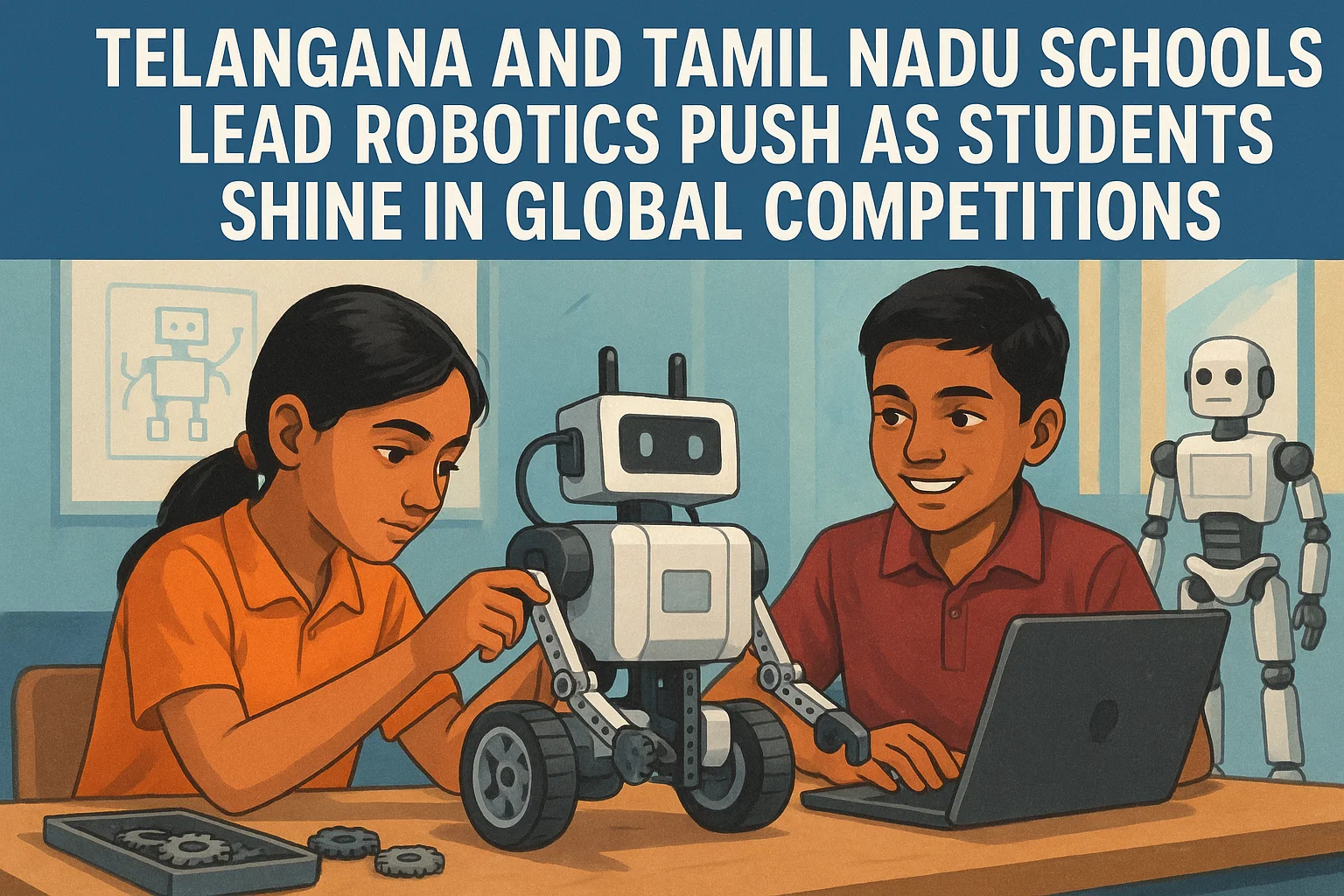
Telangana and Tamil Nadu Schools Lead Robotics Push as Students Shine in Global Competitions
Education today is undergoing a rapid transformation, driven by digitalization, robotics, and artificial intelligence (AI). Among the most exciting innovations reshaping the classroom are reconfigurable educational wheeled robots flexible, modular, and programmable platforms that give students hands-on exposure to robotics, coding, and problem-solving. Unlike static robotic kits, these reconfigurable systems allow learners to rebuild, reprogram, and adapt robots for different functions, making them a powerful tool for STEM education (Science, Technology, Engineering, and Mathematics).
The global reconfigurable educational wheeled robots market is growing rapidly, fueled by rising adoption in schools, competitions, research, and extracurricular learning. According to industry insights, the market was valued at US$ 278 million in 2024 and is projected to reach US$ 512 million by 2032, reflecting a CAGR of 9.1% during 2025–2032. This strong growth reflects increasing demand for robotics-based learning, government initiatives to embed coding and robotics in school curricula, and innovations in AI-driven robot designs.
Access Your Free Sample Report- Reconfigurable Educational Wheeled Robots Market
The Rising Importance of Reconfigurable Educational Robots
1. Why Reconfigurable Robots?
Reconfigurable robots are modular, flexible, and customizable students can change the hardware structure, add or remove wheels, sensors, or controllers, and modify the software to create new functions. For example, a wheeled robot can be transformed from a line-following car into a maze-solving autonomous vehicle or even into a parking assistant prototype.
This adaptability helps students:
- Learn by doing: Experiment with mechanics, electronics, and coding.
- Develop problem-solving skills: Reconfigure designs to overcome challenges.
- Explore AI and IoT integration: Apply modern technologies like computer vision, path planning, and wireless communication.
- Prepare for real-world innovation: Build prototypes that mimic autonomous cars, delivery bots, or industrial mobile robots.
2. The Link with STEM and AI Education
Global governments and schools recognize that robotics education is not just about machines it’s about future-proofing the workforce. Reconfigurable robots are being used to teach not only basic mechanics and coding but also AI concepts like pathfinding, machine vision, and decision-making.
For example:
- A student project might use a reconfigurable wheeled robot to simulate autonomous valet parking, similar to the ValetDroid prototype that won the World Robotics Olympiad India Nationals 2025.
- Others might design robots for search-and-rescue simulations, combining mobility with sensor-based adaptability.
Such projects highlight how educational robots are preparing students for careers in AI, robotics, and automation industries.
Recent Developments in the Educational Robotics Space
The reconfigurable educational wheeled robots industry has gained momentum with newsworthy developments across India and globally. Let’s look at some of the most impactful updates:
1. Telangana Introduces Robotics and AI in Schools
The Telangana state government in India has rolled out an ambitious plan to integrate coding, robotics, and AI into the curriculum. Activity-based learning modules are being introduced in government schools, exposing students to hands-on robotics kits. Wheeled robots often modular and reconfigurable are expected to form the backbone of this program.
This is significant because:
- It makes robotics education more inclusive, reaching rural and urban schools alike.
- It provides a scalable platform for students to learn AI concepts using affordable robotics kits.
- It aligns with global education reforms, where robotics is no longer extracurricular but part of core learning.
2. AI and Coding Classes Expand in Tamil Nadu (Madurai)
Under the TNSPARK initiative, 72 government schools in Madurai have introduced AI and coding classes for middle school students (Classes VI–IX). The program leverages Blockly, Scratch, and Python programming, allowing students to control robots via visual programming or coding.
Reconfigurable wheeled robots are particularly suitable here because:
- They allow students to apply classroom learning by building real prototypes.
- They integrate smoothly with beginner-friendly programming platforms.
- They can be reused in different classroom projects, making them cost-effective.
Download Sample Report PDF- Reconfigurable Educational Wheeled Robots Market
3. Student Innovation at Robotics Olympiad
Two teenage innovators from Vadodara, India, developed ValetDroid, an AI-powered parking valet robot. This project won the World Robotics Olympiad India Nationals 2025, demonstrating how students are leveraging reconfigurable robotics platforms to solve real-world problems.
This achievement is crucial for the industry because it highlights:
- How reconfigurable wheeled robots can act as incubators for start-up level innovations.
- The role of competitions like WRO, FIRST Robotics, and RoboCup in popularizing robotics education.
- The growing ability of students to combine AI algorithms with mobile robot platforms.
Market Insights: Growth of Reconfigurable Educational Wheeled Robots
1. Market Size and Forecast
- 2024 Market Value: US$ 278 million
- 2032 Market Projection: US$ 512 million
- CAGR (2025–2032):1%
This strong growth reflects rising demand for robotics-based education, increased government funding, and advances in modular robotics design.
2. Key Growth Drivers
- Government Initiatives: National education policies in India, China, South Korea, and the EU emphasize robotics and coding literacy.
- STEM Competitions: Events like World Robotics Olympiad and FIRST LEGO League encourage schools to invest in modular robotics kits.
- University Programs: Colleges worldwide use reconfigurable robots for engineering and AI courses.
- EdTech Partnerships: Companies like LEGO Education, Makeblock, and Arduino are partnering with schools to deliver robotics labs.
3. Regional Trends
- Asia-Pacific (APAC): Fastest growth due to government-backed school programs in India, China, Japan, and South Korea.
- North America: Strong adoption through STEM initiatives and widespread availability of educational robotics kits.
- Europe: High integration in curricula, particularly in Germany, UK, and Nordic countries.
Academic and Research Innovations in Reconfigurable Robotics
Beyond news headlines, academic research has been driving technical breakthroughs in reconfigurable educational robotics:
- TARA Robotic Arm: A low-cost (~$200) 3D-printed robotic arm designed for educational reproducibility.
- TiniScript Language: A simplified programming language that enables real-time wireless robot control, perfect for collaborative classrooms.
- RoboBlimp: A bio-inspired aerial robot used in middle-school STEM workshops, showing how reconfigurability can expand beyond wheeled robots.
- Omni Differential Drive (ODD): A novel drive system allowing robots to reconfigure wheel spacing for omnidirectional movement.
Such innovations signal the next wave of reconfigurable robots, where cost reduction, modularity, and AI integration will dominate.
Challenges Facing the Industry
Despite promising growth, the industry faces hurdles:
- Infrastructure Gaps: Many schools in developing countries lack labs, smart classrooms, or trained faculty to deploy robotics education.
- Cost Barriers: While low-cost options exist, fully reconfigurable robotics kits remain expensive for widespread adoption.
- Teacher Training: Educators need specialized training in robotics, coding, and AI to effectively use these tools.
- Standardization: Lack of uniform curricula in robotics across countries limits scalability.
Click Here To Download Full Sample Report- Reconfigurable Educational Wheeled Robots Market
Future Outlook (2025–2032)
The reconfigurable educational wheeled robots market is set for transformational growth over the next decade. Trends that will define its trajectory include:
- AI-Enabled Educational Robots: More kits will include AI modules, allowing students to train robots in object detection, pathfinding, and voice commands.
- IoT Integration: Robots connected to the internet for remote programming and collaboration will expand virtual learning.
- Sustainability in Design: Use of 3D-printed, recyclable materials for robot kits will lower costs and improve accessibility.
- Cross-Disciplinary Learning: Robots will not only teach STEM but also integrate with arts, humanities, and environmental studies.
- Global Competitions: Rising participation in competitions will drive innovation and market adoption.
The global reconfigurable educational wheeled robots market is at an inflection point. With a projected CAGR of 9.1% (2025–2032) and growth from US$ 278 million in 2024 to US$ 512 million in 2032, the industry is set to play a transformative role in STEM education worldwide.

Comments (0)