
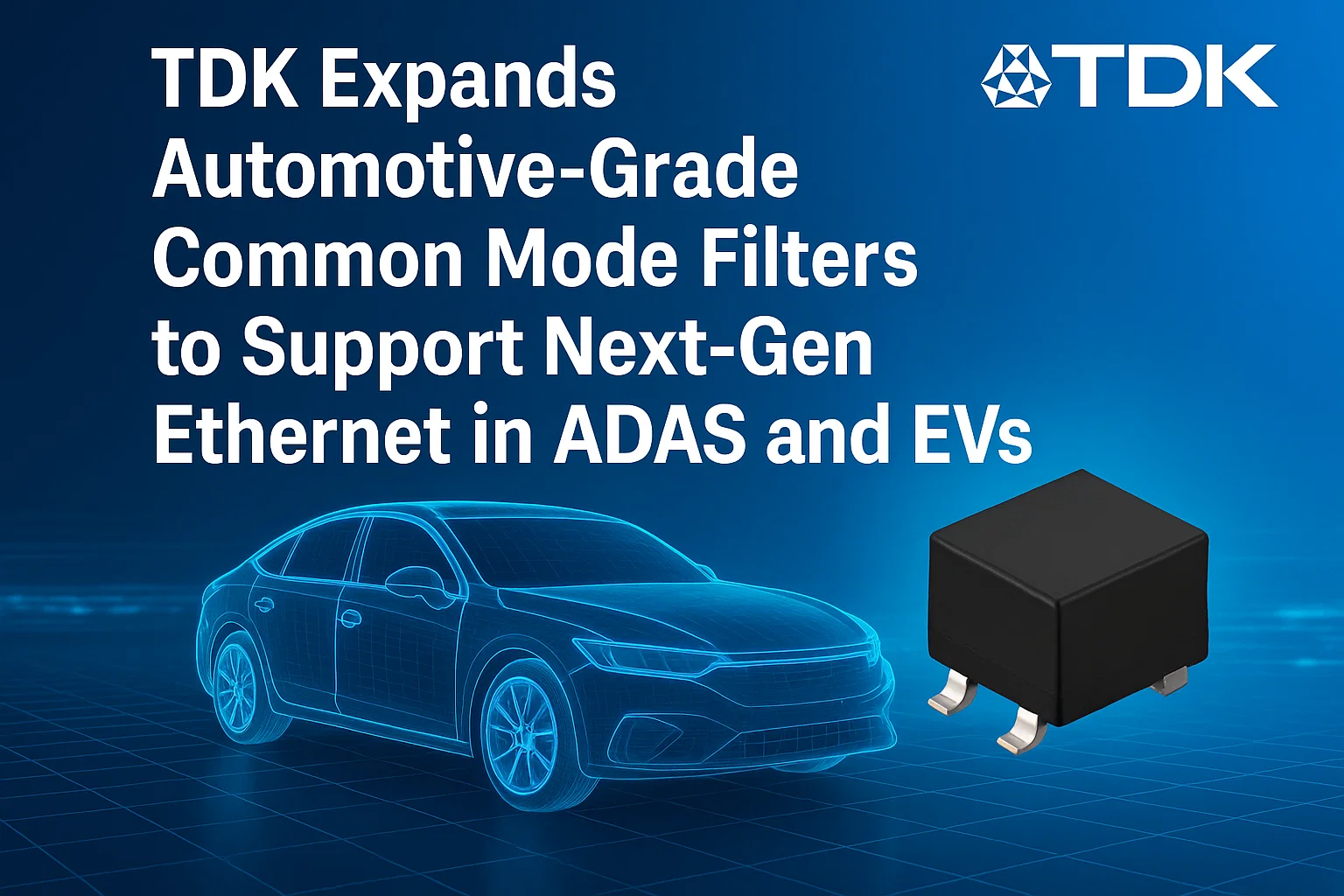
TDK Expands Automotive-Grade Common Mode Filters to Support Next-Gen Ethernet in ADAS and EVs
The electronics industry is evolving at a breakneck pace, and nowhere is this more evident than in the way devices handle signal integrity and protection. From smartphones to electric vehicles (EVs), engineers are expected to design products that deliver higher data speeds, compact form factors, and reliable operation in increasingly harsh environments.
At the heart of this effort lies a deceptively small but indispensable component: the common mode filter with integrated ESD (Electrostatic Discharge) protection. Once considered a niche solution, these filters are now central to the design of high-speed communication interfaces, automotive Ethernet networks, and next-generation consumer devices.
Recent developments from leading players like Murata Manufacturing, TDK Corporation, Würth Elektronik, and Texas Instruments illustrate how innovation in this field is shaping the future of electronics. At the same time, the market for these solutions is expanding rapidly. In 2024, the common mode filter with ESD protection market was valued at US$ 634 million and is projected to reach US$ 1.15 billion by 2032, registering a CAGR of 8.9% between 2025 and 2032.
Access Your Free Sample Report- Common Mode Filter with ESD Protection Market
Understanding Common Mode Filters with ESD Protection
What Are They?
A common mode filter is a passive component used to suppress electromagnetic interference (EMI) and common mode noise in differential signal lines. By preventing unwanted high-frequency noise from propagating, these filters improve signal integrity in high-speed digital circuits.
When ESD protection is integrated, the device gains an additional layer of defense against voltage spikes caused by static electricity or surge events. This dual functionality makes them indispensable for applications where data speed and robustness must coexist.
Why Are They Needed Now More Than Ever?
- High-Speed Interfaces – Standards like USB4, Thunderbolt 4, HDMI 2.1, and PCIe Gen 5/6 push data rates beyond 20–40 Gbps, where even small amounts of noise or ESD can cause system failure.
- Automotive Ethernet – Modern vehicles rely on 1000BASE-T1 and 2.5GBASE-T1 Ethernet for ADAS (Advanced Driver Assistance Systems), infotainment, and EV powertrain communications. Filters with integrated ESD ensure compliance with automotive-grade standards.
- IoT and 5G Devices – With compact designs, space constraints mean engineers favor integrated solutions instead of separate filters and protection components.
Recent Developments: A Closer Look at Industry Leaders
1. Murata Manufacturing: Compact Filters for High-Speed Interfaces
Murata, a global leader in passive components, has been at the forefront of developing miniaturized common mode filters. Their latest offerings target USB4 and Thunderbolt 4 applications, capable of handling 20–40 Gbps differential signals without degrading performance.
Key highlights:
- Ultra-compact footprint – Enables integration into slim laptops, tablets, and smartphones.
- Enhanced ESD robustness – Protects delicate ICs against system-level ESD strikes (IEC 61000-4-2 compliance).
- Focus on signal integrity – Optimized insertion loss and return loss parameters to support next-gen high-speed data protocols.
Insight: Murata’s work underscores a larger industry trend — designing components that balance high-frequency performance with system-level protection, making them indispensable for the latest consumer devices.
2. TDK Corporation: Automotive-Grade Reliability
TDK has reinforced its presence in the automotive sector with expansions to its ACT1210 and MPZ series of common mode filters. These devices are purpose-built for automotive Ethernet and comply with AEC-Q200 reliability standards.
Key highlights:
- Support for 1000BASE-T1 and 2.5GBASE-T1
- Designed for ADAS and infotainment systems, where uninterrupted data transmission is critical.
- Automotive-grade ESD robustness ensures long-term reliability in harsh environments.
Insight: As vehicles transform into “computers on wheels,” the requirement for EMI and ESD protection skyrockets. TDK’s filters enable automakers to meet both safety and performance standards in data-heavy automotive networks.
Download Sample Report PDF- Common Mode Filter with ESD Protection Market
3. Würth Elektronik: High-Frequency Chokes with ESD
Würth Elektronik recently launched the WE-CNSW HF common mode chokes with integrated ESD protection. These are tailored for GHz-range applications like Wi-Fi 6/6E and 5G modules, where RF performance is critical.
Key highlights:
- Optimized for IoT, smartphones, and wireless modules.
- High suppression in the GHz frequency range without degrading RF signal quality.
- Integrated ESD ensures device safety in compact PCB designs.
Insight: Würth’s innovation reflects the growing need for miniaturized, high-frequency components in IoT and wireless applications. As billions of devices connect to 5G and Wi-Fi 6 networks, interference and ESD protection are non-negotiable.
4. Texas Instruments: Design Integration Support
Texas Instruments (TI) may not manufacture common mode filters directly, but it plays a crucial role in the ecosystem. TI provides reference designs and ESD suppressor ICs that complement third-party filters, particularly for USB Type-C and HDMI applications.
Key highlights:
- Helps designers integrate TI ESD diodes with common mode filters for optimal system protection.
- Focus on reducing BOM size and PCB space in portable electronics.
- Bridges the gap between signal integrity and protection circuitry.
Insight: TI’s approach shows how collaboration between ESD ICs and filter manufacturers can deliver comprehensive solutions that meet modern design challenges.
Market Growth and Outlook
Current Market Landscape
The global common mode filter with ESD protection market reached US$ 634 million in 2024. With accelerating adoption across automotive, consumer electronics, and industrial IoT, the market is expected to grow robustly.
- Forecast: By 2032, the market is projected to reach US$ 1.15 billion.
- CAGR: 8.9% (2025–2032).
Key Growth Drivers
- High-Speed Data Interfaces – Adoption of USB4, HDMI 2.1, PCIe Gen 5 in consumer electronics.
- Automotive Ethernet Expansion – EVs and ADAS systems need reliable, interference-free communication.
- 5G & IoT Growth – Billions of connected devices increase demand for robust EMI/ESD solutions.
- Integration Trend – Shift towards multi-functional, space-saving components.
Challenges
- Signal integrity at ultra-high frequencies (40 Gbps+).
- Balancing size with performance in miniaturized devices.
- Supply chain pressures in the passive component sector.
Applications Across Industries
1. Consumer Electronics
- Smartphones, laptops, tablets.
- High-speed interfaces: USB-C, HDMI, Thunderbolt.
- ESD protection critical for durability.
2. Automotive
- Ethernet for ADAS and infotainment.
- EV battery management communication.
- Automotive-grade reliability standards.
3. IoT and Wireless
- Wi-Fi 6/6E, 5G, BLE modules.
- Compact wearables and smart devices.
- Noise suppression in GHz frequencies.
4. Industrial & Medical Devices
- Robotics and factory automation.
- Medical imaging systems where interference-free signals are crucial.
Click Here To Download Full Sample Report- Common Mode Filter with ESD Protection Market
The Future of Common Mode Filters with ESD
Looking ahead, several trends will define the future of these components:
- Higher Data Rate Readiness – Filters designed for 80 Gbps and beyond.
- Co-Packaged Solutions – Integration with surge protection, TVS diodes, or even signal conditioning.
- Automotive Dominance – As EVs scale, automotive Ethernet and protection requirements will outpace other sectors.
- Sustainability & Miniaturization – Eco-friendly materials and ultra-compact footprints will be prioritized.
From Murata’s high-speed USB4 filters to TDK’s automotive Ethernet solutions, and Würth’s 5G-ready chokes, the common mode filter with ESD protection is no longer just a supporting player in electronics design — it’s a central enabler of reliability and performance.
With the market projected to nearly double from US$ 634 million in 2024 to US$ 1.15 billion by 2032, the trajectory is clear: the demand for integrated EMI/ESD protection is set to skyrocket.
For engineers, manufacturers, and system designers, the message is equally clear: investing in advanced filtering and protection technology today will define the competitiveness and durability of tomorrow’s electronics.

Comments (0)