
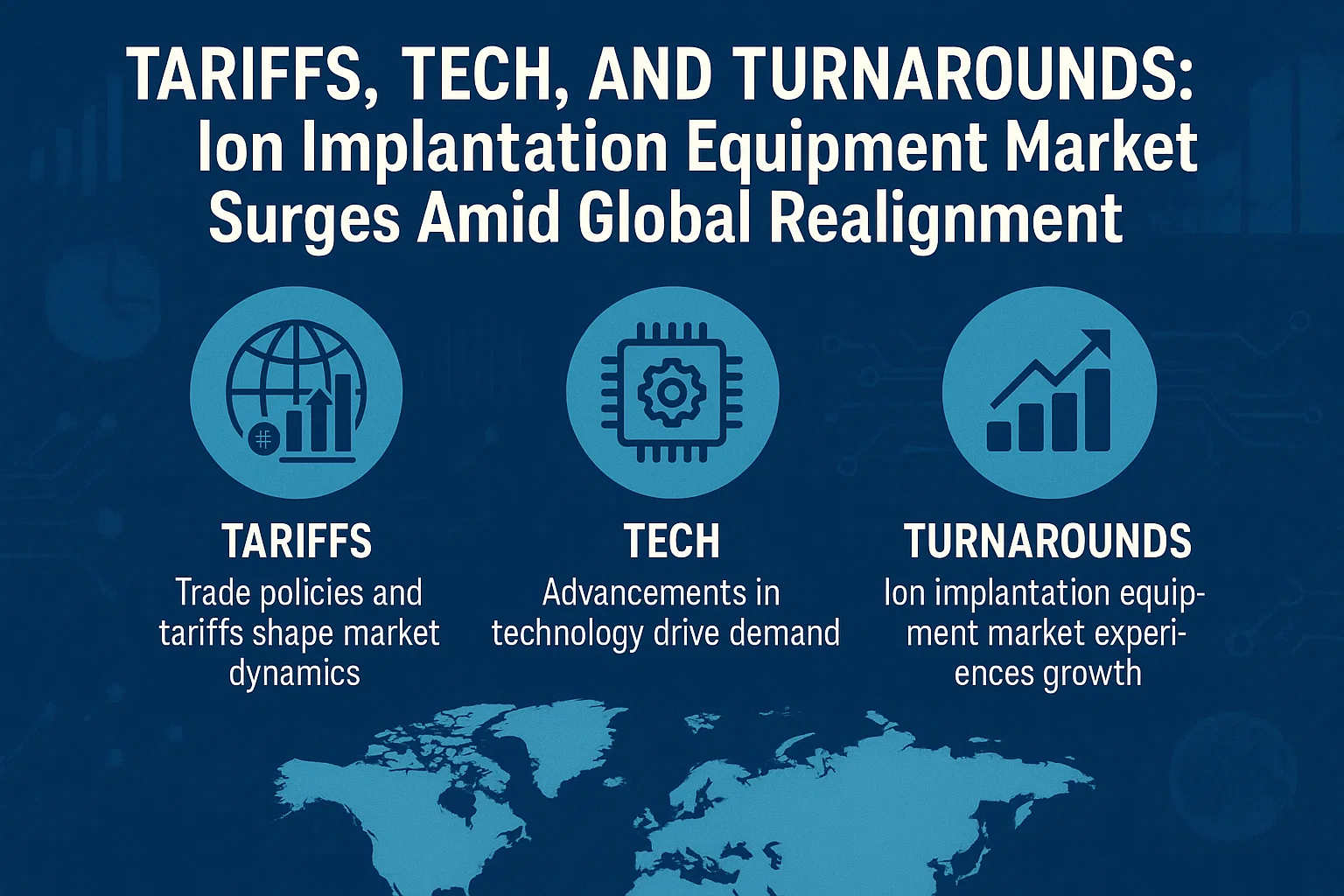
Tariffs, Tech, and Turnarounds: Ion Implantation Equipment Market Surges Amid Global Realignment
The global semiconductor industry is in the midst of a transformative evolution, and a pivotal enabler of this shift is ion implantation technology. Specifically, the market for wafer used ion implantation equipment has shown remarkable momentum. Valued at approximately US$ 3.94 billion in 2024, this market is projected to soar to US$ 6.83 billion by 2032, growing at a CAGR of 8.2% from 2025 to 2032.
This growth trajectory is being shaped not just by rising demand for semiconductors, but also by several recent developments and macroeconomic shifts that are driving new purchasing, refurbishment, and localization trends.
Access Your Free Sample Report- Wafer Used Ion Implantation Equipment Market
- Trade Tariffs and Geopolitical Realignments: Reshaping Supply Chains
In 2025, the United States imposed new tariffs on imported semiconductor equipment, including ion implantation systems. The intent was to boost domestic manufacturing under the broader framework of the CHIPS Act. However, the immediate impact has been a significant increase in landed costs and procurement delays for fabs relying on imported tools.
To mitigate this, chipmakers are now:
- Delaying or staggering system orders.
- Prioritizing suppliers with in-region assembly or support.
- Exploring hybrid models that combine new systems with refurbished or retrofitted components.
These tariffs have also fostered joint development initiatives between equipment OEMs and fabs. By collaborating early in the design phase, both parties are mitigating risk and accelerating time-to-market despite external policy headwinds.
- Supply Chain Disruptions and Component Scarcity
Even as geopolitical policies drive procurement changes, supply chain constraints are further complicating the picture. Shortages of critical raw materials—like tungsten, rare earth metals, and SiC components—have extended lead times for high-energy ion implantation tools.
Key bottlenecks include:
- Ion source parts: Increased wear due to high throughput has outpaced component availability.
- Specialized magnets and RF subsystems: Limited manufacturers and geopolitical controls have added 2-3 weeks to the average delivery timeline.
These issues are compelling fabs to keep backup inventories, diversify suppliers, and in some cases, recondition older tools instead of waiting for new shipments.
- Government Incentives Driving Localization
Across major economies, government-backed subsidies are playing a critical role in reshaping the ion implantation ecosystem.
United States:
The CHIPS and Science Act continues to channel billions into domestic chip production, prioritizing infrastructure, equipment subsidies, and skilled labor. Firms receiving grants are increasingly required to procure from U.S.-based or allied suppliers.
European Union:
The EU Chips Act emphasizes research and innovation, leading to joint ventures between European OEMs and fabs in Germany, France, and the Netherlands. Ion implantation equipment vendors are now opening local service hubs to comply with these incentives.
China:
The launch of Big Fund III in 2024 is enabling aggressive equipment self-sufficiency goals. Chinese players are ramping up localized design of mid-energy implanters while retrofitting legacy tools sourced from Japan and the U.S.
India:
The government’s PLI scheme has invited both new fabs and refurbished tool suppliers. Localized dopant gas partnerships and phased import norms are incentivizing in-country retrofitting and pilot installations.
These regional policies are not only reshaping where tools are built, but also how they are maintained and upgraded.
Download Sample Report PDF- Wafer Used Ion Implantation Equipment Market
- Growth in the Secondary and Refurbished Equipment Market
With escalating costs and lead times, the secondary market for ion implantation tools has become a vital part of the semiconductor ecosystem.
Key trends include:
- Retrofit kits and part upgrades now account for nearly 40% of the aftermarket demand.
- Fabs are retrofitting older systems to meet modern requirements for uniformity, dose control, and automation.
- Refurbished systems are often bundled with localized support contracts, which can be 20-30% cheaper than OEM agreements.
Notably, companies specializing in used equipment—especially in Taiwan, South Korea, and Israel—have seen double-digit revenue growth, driven by mature-node fabs producing for the automotive and industrial IoT segments.
- Sustainability and Energy Efficiency as Core Drivers
As global attention turns to sustainability, the ion implantation segment is not immune. Regulatory mandates—especially from the EU—are pushing fabs and OEMs to reduce the environmental footprint of semiconductor manufacturing.
Recent innovations include:
- Energy-efficient ion sources: New designs reduce energy consumption while extending lifecycle and reducing downtime.
- Hydrogen-based beamline cooling: Helps reduce per-implant CO₂ emissions.
- Advanced dopant gas mixtures: Introduced by companies like Linde, these gases offer higher throughput and less residue, thus reducing the maintenance cycle.
OEMs are also embedding predictive maintenance software in refurbished tools to avoid overuse and minimize waste.
- Regional Analysis: Where the Growth Is Coming From
North America
Driven by CHIPS Act funding and a renewed focus on domestic manufacturing, North America remains a high-value market for both new and used ion implantation tools.
Asia-Pacific
Still the largest consumer, the region’s mature fabs in South Korea, Taiwan, and Japan are leaning heavily on refurbished systems to meet niche, low-node demand. Meanwhile, China is investing in home-grown implanter R&D.
Europe
The EU’s environmental and innovation-led strategy is increasing demand for sustainable tools, often sourced from trusted OEMs and localized vendors.
Middle East & India
Emerging demand, supported by government incentives, is driving interest in flexible deployment models, often combining refurbished systems with locally sourced upgrades.
- Market Forecast and Strategic Outlook
Looking ahead, the wafer used ion implantation equipment market is expected to grow from US$ 3.94 billion in 2024 to US$ 6.83 billion by 2032, at a CAGR of 8.2%.
Growth will be fueled by:
- Smart device proliferation and advanced packaging techniques.
- The expansion of mature-node applications (e.g., automotive, power electronics).
- Increased demand for sustainable, modular, and serviceable equipment.
- A vibrant secondary market that bridges affordability and technological requirements.
Click Here To Download Full Sample Report- Wafer Used Ion Implantation Equipment Market
The wafer used ion implantation equipment market is undergoing profound changes that extend far beyond conventional supply and demand curves. Geopolitics, policy, technology, and sustainability are combining to reshape everything—from procurement and service models to the very materials used in beamlines.
For OEMs, refurbishers, and fabs alike, success in this landscape will depend on agility, collaboration, and long-term vision. Whether through embracing retrofit solutions, entering joint R&D projects, or investing in greener technologies, the players in this sector are not just adapting—they are actively defining the future of semiconductor manufacturing.
As the industry moves deeper into the AI, automotive, and green-tech revolutions, ion implantation remains not just relevant—but essential. And the strategic shifts unfolding today will determine who leads tomorrow.

Comments (0)