

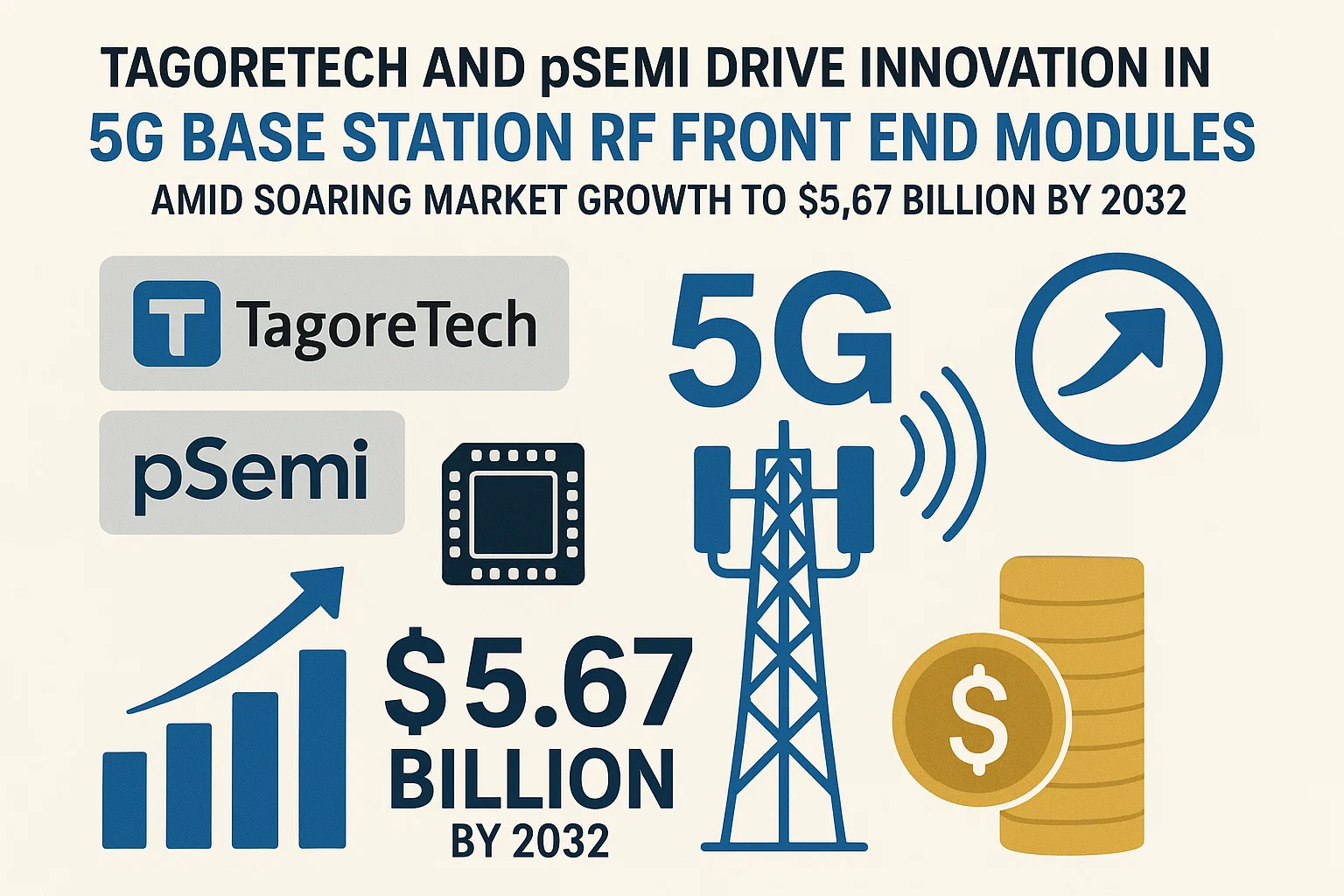
TagoreTech and pSemi Drive Innovation in 5G Base Station RF Front End Modules Amid Soaring Market Growth to $5.67 Billion by 2032
As the global push for 5G connectivity intensifies, the demand for high-performance, energy-efficient, and compact radio frequency (RF) front end modules (FEMs) has never been more critical. These FEMs serve as vital components in the signal chain of 5G base stations, enabling signal amplification, filtering, and frequency conversion essential for both transmission and reception of data. The 5G Base Station RF Front End Module market is evolving rapidly, spurred by technological innovations, strategic collaborations, and increased deployment of 5G networks, particularly in Asia-Pacific and North America.
According to recent industry analysis, the 5G Base Station RF Front End Module Market was valued at USD 2.34 billion in 2024 and is expected to reach USD 5.67 billion by 2032, growing at a CAGR of 11.7% during the forecast period of 2025 to 2032. This growth is underpinned by several pivotal developments and shifts in the market.
Access Your Free Sample Report- 5G Base Station RF Front End Module Market
Understanding the Role of RF Front End Modules in 5G Base Stations
Before diving into the market developments, it’s important to understand the function of RF front end modules within a 5G base station.
An RF FEM typically comprises components such as power amplifiers (PAs), low-noise amplifiers (LNAs), switches, filters, and duplexers. These elements manage the transmission and reception of RF signals, ensuring signal integrity and enabling efficient data communication between mobile devices and the base station.
In 5G networks—especially those operating in the mmWave spectrum—FEMs must handle higher frequencies, broader bandwidths, and increased power density while maintaining energy efficiency and thermal performance. This makes innovation in materials (like GaN and GaAs) and integration techniques (like beamforming and AiMs) critical to advancing 5G infrastructure.
Recent Developments Reshaping the 5G RF Front End Module Market
- TagoreTech Launches TSL8028N Receiver FEM
In June 2025, TagoreTech announced the launch of the TSL8028N, a compact, high-power RF receiver front-end module designed specifically for 5G Time Division Duplex (TDD) base stations and small cell deployments. This module combines Gallium Nitride (GaN) and Gallium Arsenide (GaAs) technologies to achieve exceptional performance in a miniature footprint.
Key Features:
- 33 dB gain with a low noise figure of 1.2 dB
- Excellent TX-RX isolation
- Fast switching times (<2 µs)
- Integrated into a 5 mm × 5 mm QFN package
The module’s small size and high performance make it ideal for urban and indoor 5G deployments, where space and power efficiency are crucial. TagoreTech’s innovation reflects the trend of miniaturization and integration in FEMs, aiming to support network densification with compact, high-performance components.
- pSemi Expands Its mmWave Beamforming Portfolio
pSemi Corporation, a leader in high-performance RFICs and a Murata company, has extended its product offerings in the mmWave spectrum (24 GHz–40 GHz) with new beamforming front-end ICs and up/down converters that cater to 5G infrastructure developers.
Key Innovations:
- Scalable beamforming RF front-end architecture
- Compatibility with key mmWave bands (n257, n258, n260)
- Integration with digital control interfaces for dynamic reconfiguration
These additions address the growing need for flexibility and scalability in 5G base station design, especially in macro cells and outdoor mmWave deployments. pSemi’s modular approach allows for easier implementation across different site configurations while reducing the overall BOM (bill of materials) and system complexity.
- pSemi and Murata’s Antenna-Integrated Module (AiM) Collaboration
Another groundbreaking development came through the collaboration between pSemi and Murata, which resulted in a highly integrated antenna-in-module (AiM) solution. The AiM incorporates multi-channel beamforming RFICs, enabling advanced phased-array functionality in a tightly packaged form.
Advantages:
- Combines transmitter and LNA in a single compact unit
- Reduces form factor for high-density antenna arrays
- Enhances signal integrity and energy efficiency
The introduction of AiMs is a pivotal step toward simplified deployment and cost-effective scaling of mmWave infrastructure. By integrating antennas with the RF FEM, manufacturers can minimize interconnect losses and boost signal gain directly at the source.
Download Sample Report PDF- 5G Base Station RF Front End Module Market
Market Dynamics and Growth Drivers
- Proliferation of 5G Base Stations
The backbone of any 5G network is its base station infrastructure. As operators race to expand their networks, the demand for compact and power-efficient FEMs continues to soar. Countries like China, South Korea, the U.S., and India are investing heavily in 5G rollouts, especially in urban centers.
- In China alone, the government aims to deploy over 3 million 5G base stations by 2026.
- North America is emphasizing Open RAN infrastructure, which opens new opportunities for third-party RF FEM vendors.
- Rise of mmWave Deployments
The use of millimeter wave (mmWave) bands allows for significantly higher data rates and bandwidth. However, operating at these frequencies introduces challenges in RF performance and signal propagation. Thus, advanced beamforming and low-noise modules are crucial.
- The integration of beamforming ICs like those from pSemi allows for directional signal targeting, improving efficiency and user experience.
- mmWave base stations require more compact, thermally robust FEMs that can be installed in small cells, rooftops, and even street furniture.
- Technological Advancements in Materials
The shift from traditional silicon to compound semiconductors such as GaN (Gallium Nitride) and GaAs (Gallium Arsenide) is transforming the FEM landscape.
- GaN offers superior power density, efficiency, and thermal conductivity—ideal for high-power base station PAs.
- GaAs is widely used in LNAs for its low noise and high gain characteristics.
This material evolution is enabling more robust, thermally stable, and efficient front-end modules to meet the stringent requirements of 5G infrastructure.
- Focus on Integration and Miniaturization
As telecom operators look to reduce deployment costs and complexity, integration of FEMs into smaller footprints is gaining traction. This includes:
- AiMs (Antenna-in-Modules)
- System-in-Package (SiP) FEMs
- Dual-band and Tri-band FEMs
Miniaturized modules not only save board space but also improve reliability and reduce losses, which are particularly critical at higher frequencies.
Competitive Landscape and Strategic Collaborations
The 5G RF FEM space is fiercely competitive, with key players investing in R&D, partnerships, and global expansion.
Key Players Include:
- TagoreTech
- pSemi (Murata)
- Qorvo
- Skyworks Solutions
- Broadcom
- Analog Devices
- NXP Semiconductors
Notable Collaborations:
- Murata-pSemi AiM Alliance: Combines Murata’s packaging and antenna design with pSemi’s IC integration.
- Qorvo & Rakuten Symphony: Promoting Open RAN with pre-integrated RF front-end solutions.
- Analog Devices & Marvell: Working on integrated transceiver platforms with embedded RF FEMs.
Regional Insights
Asia-Pacific
- China, Japan, and South Korea are the leaders in both 5G deployment and RF FEM manufacturing.
- China’s domestic RF semiconductor ecosystem is accelerating to reduce dependency on foreign suppliers.
North America
- Strong focus on Open RAN and private 5G networks
- Home to leading FEM design companies (Skyworks, Qorvo, pSemi)
Europe
- Emphasis on energy-efficient and sustainable 5G deployments
- Investments from operators like Vodafone and Ericsson in GaN-based FEM technology
Challenges and Opportunities
Challenges:
- Thermal management in high-density mmWave modules
- Interference and signal integrity in crowded RF environments
- Regulatory and spectrum allocation inconsistencies across regions
- High production costs for GaN/GaAs-based FEMs
Opportunities:
- Open RAN is democratizing the FEM ecosystem, opening doors for startups and niche players.
- Private 5G networks in manufacturing, logistics, and healthcare require custom FEM solutions.
- AI-based tuning and adaptive beamforming will unlock new levels of efficiency and performance in FEMs.
Click Here To Download Full Sample Report- 5G Base Station RF Front End Module Market
Future Outlook: What Lies Ahead?
As 5G networks evolve toward 6G and beyond, the expectations from RF FEMs will continue to increase. The focus will shift toward:
- Sub-THz frequencies and higher-bandwidth modules
- Artificial intelligence for real-time signal optimization
- Photonic front-ends and hybrid optical-RF systems
By 2032, RF front-end modules will become more intelligent, self-healing, and adaptive to user mobility and environmental conditions.
The 5G Base Station RF Front End Module market is witnessing a transformative phase, fueled by rapid technological progress, growing network demands, and the need for compact, high-efficiency solutions. With the market expected to grow from USD 2.34 billion in 2024 to USD 5.67 billion by 2032, the industry is ripe with opportunity.
Pioneers like TagoreTech and pSemi are redefining the benchmarks for performance and integration, while collaborations and regional investments are accelerating innovation across the board. As 5G networks become ubiquitous and mmWave deployments expand, RF front end modules will remain at the heart of next-generation wireless infrastructure.
The journey ahead is one of continuous evolution—fueled by innovation, collaboration, and the global pursuit of hyper-connectivity.

Comments (0)