
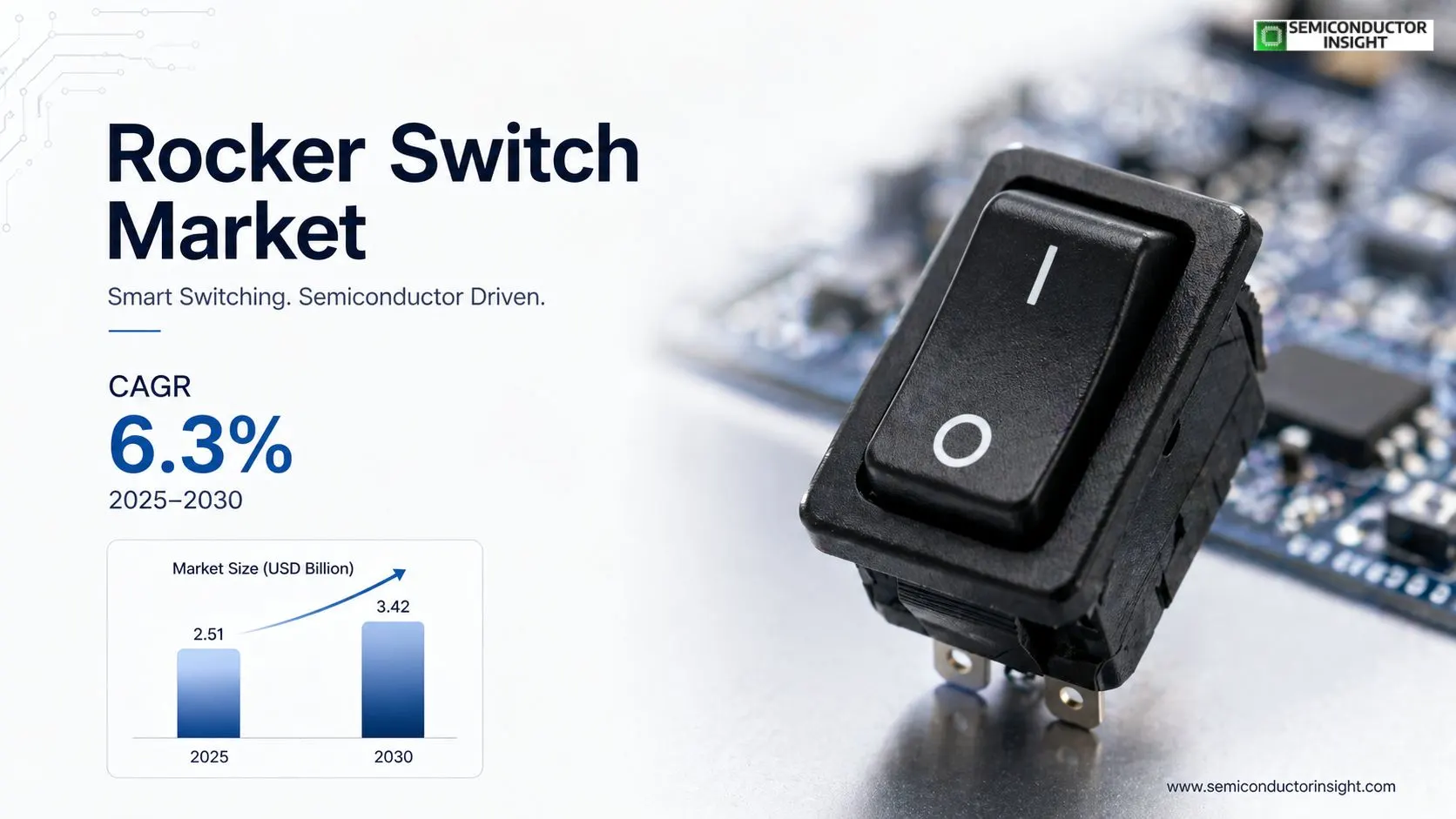
Switching Intelligence with Rocker Switch Market in a Semiconductor Driven World
The rocker switch, often perceived as a simple electromechanical component, plays a pivotal role in modern electronics. From industrial machinery to consumer appliances, its integration has evolved alongside semiconductor innovation. In contrast to conventional toggle systems, rocker switches are more reliable and have an ergonomic shape, which makes them essential in situations where precise circuitry and consistent user engagement coexist.
Globally, annual production of rocker switches exceeds 3.5 billion units, driven by demand across automotive, consumer electronics, and industrial sectors. In 2024, the automotive industry alone accounted for nearly 780 million units, reflecting the growing electrification of vehicles and the increasing number of control interfaces per vehicle.
Key Technical Distinctions
- Actuation Force: To work, these switches usually need an actuation force of between and to make a comforting, stiff, and tactile click.
- Electrical Life: High-quality rocker switches can last for a long time mechanically (up to 100,000 cycles) but not as long electrically (usually 10,000 to 50,000 cycles).
- Flexible Connectors: They can be used with several types of terminations, such as quick-connect blade terminals or, soldering lugs, or pins for mounting on a PCB.
Where Mechanics Meet Silicon
The transformation of rocker switches is closely tied to semiconductor advancements. Modern switches are no longer purely mechanical; they often integrate microcontrollers, LEDs, and sensing ICs to enable smarter functionality. Capacitive touch overlays and embedded chips allow switches to communicate with broader electronic systems, reducing mechanical wear and enhancing lifespan.
In industrial automation systems, rocker switches are now paired with semiconductor-based debounce circuits, ensuring signal integrity. This is critical in environments where electrical noise can disrupt operations. The integration of CMOS-based control chips has reduced power consumption in switch modules to less than 5 milliwatts per unit, enabling energy-efficient designs in battery-operated devices.
For More Detailed Insights You Can Surf Our Latest Related Report Here: https://semiconductorinsight.com/report/single-pole-rocker-switch-market/
Material Science and Semiconductor Synergy
The materials used in rocker switches have also evolved. High-performance thermoplastics and conductive polymers are now combined with semiconductor-grade coatings to improve durability and conductivity. Silver alloy contacts, often used in conjunction with semiconductor drivers, support current loads ranging from 5A to 20A, depending on application requirements.
Recent developments in gallium nitride (GaN) and silicon carbide (SiC) technologies are influencing switch design indirectly. As power electronics become more efficient, the demand for switches capable of handling higher voltages up to 250V AC in residential systems has increased. This has led to innovations in insulation materials and contact design.
Embedded Intelligence in Everyday Applications
Rocker switch market is witnessing a shift toward intelligent interfaces. In smart home ecosystems, switches are now integrated with wireless semiconductor modules such as Wi-Fi and Zigbee chips. This allows users to control lighting, appliances, and HVAC systems remotely.
Key application trends include:
- Smart appliances using rocker switches with embedded microcontrollers for adaptive control
- Automotive dashboards integrating illuminated rocker switches with LED drivers
- Industrial panels utilizing switches with semiconductor-based fault detection
- Medical devices employing sealed rocker switches with low-leakage semiconductor circuits
In 2025, over 42% of newly manufactured smart appliances globally incorporated semiconductor-enhanced rocker switches, highlighting the growing convergence of hardware and digital control.
Manufacturing Precision and Semiconductor Alignment
The production of rocker switches has become increasingly aligned with semiconductor manufacturing standards. Cleanroom environments are now used for high-precision switch components, especially those intended for medical and aerospace applications. Tolerances have tightened to within ±0.05 mm, ensuring compatibility with densely packed circuit boards.
Surface-mount technology (SMT) has enabled rocker switches to be directly integrated onto printed circuit boards (PCBs), reducing assembly time and improving reliability. This trend mirrors semiconductor packaging techniques, where miniaturization and integration are key.
Current Market Pulse and Real-World Instances
Recent global supply chain disruptions have impacted both semiconductor chips and electromechanical components, including rocker switches. However, manufacturers have adapted by localizing production and investing in automation. For instance, several electronics manufacturers in East Asia have increased switch production capacity by 18% year-over-year to meet rising demand.
In the electric vehicle sector, rocker switches are being redesigned to support haptic feedback and ambient lighting, powered by integrated semiconductor drivers. This enhances user experience while maintaining functional reliability.
Additionally, the rise of renewable energy systems has created new demand. Solar inverters and battery storage units often rely on rocker switches for manual override controls, with units designed to handle DC voltages exceeding 48V.
Design Thinking in the Semiconductor Era
The rocker switch is no longer a passive component; it is an active participant in the electronic ecosystem. Designers now approach switch development with a semiconductor-first mindset, considering signal processing, power efficiency, and system integration from the outset.
This shift is evident in the increasing number of patents related to smart switch modules, many of which combine mechanical actuation with semiconductor logic. The result is a new generation of interfaces that are not only functional but also adaptive and intelligent.
In a world increasingly defined by silicon, the rocker switch continues to evolve quietly enabling the seamless interaction between humans and machines.

Comments (0)