
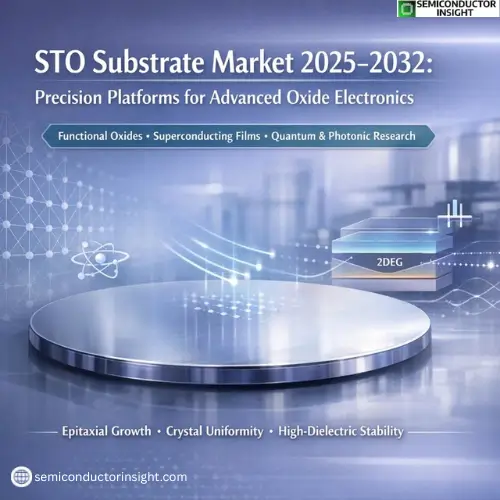
STO Substrate Market: Powering the Next Generation of Oxide Electronics
In advanced semiconductor research and emerging electronic architectures, material choice often defines the boundary between experimental success and commercial scalability. Strontium titanate (STO) substrates occupy a unique position in this landscape. While they do not compete with silicon in volume, they have become indispensable wherever functional oxides, superconducting films, and complex heterostructures are involved.
STO substrate market operates quietly beneath headline semiconductor segments, yet its influence continues to expand as next-generation electronics push beyond conventional material limits.
What Makes STO Substrates Technically Significant?
STO substrates are single-crystal materials primarily used as lattice-matched platforms for growing oxide thin films. Their appeal lies in a rare combination of structural uniformity, thermal stability, and dielectric behavior that supports precise epitaxial growth.
Unlike commodity substrates, STO is selected for what it enables rather than what it replaces. Researchers and device engineers rely on it to explore phenomena such as two-dimensional electron gases, ferroelectric switching, and oxide-based superconductivity. In practical terms, this means STO substrates act as foundational building blocks for devices that still sit at the frontier of semiconductor innovation.
Demand Is Shaped by Research Intensity, Not Volume Manufacturing
STO substrate market behaves differently from mainstream wafer markets. Demand is driven by research momentum, pilot-scale fabrication, and specialized device development, rather than mass consumer electronics.
Universities, national laboratories, and corporate R&D centers represent a substantial portion of demand. At the same time, industrial users involved in oxide electronics, RF components, and advanced sensors are steadily increasing their procurement as concepts move closer to applied deployment.
This creates a market where order volumes are modest, but specifications are strict and switching costs are high.
Don’t Forget to Surf Our Updated Report for More Detailed Analysis:
https://semiconductorinsight.com/report/sto-substrate-market/
Where STO Substrates Are Being Used Today?
STO substrates are deeply embedded in several advanced application areas. In oxide electronics, they serve as platforms for high-mobility transistor structures and multifunctional electronic layers. Superconducting research relies heavily on STO due to its compatibility with complex oxide films.
In photonics and optoelectronics, STO substrates support experimental waveguides and tunable optical components. They are also increasingly used in sensor research, where dielectric properties and surface stability are critical.
Rather than serving one dominant sector, STO substrates enable multiple high-value niches simultaneously, insulating the market from short-term demand shocks.
Manufacturing Precision Defines Market Leadership
Producing STO substrates is a technically demanding process. Crystal growth, orientation control, surface polishing, and defect minimization require deep materials expertise and tightly controlled production environments.
Small deviations in lattice quality or surface roughness can directly impact thin-film performance. As a result, buyers prioritize suppliers with proven crystal consistency and traceability over cost considerations.
This emphasis on quality reinforces long qualification cycles and long-term supplier relationships, limiting rapid market entry for new producers.
Global Supply Chain Characteristics
The STO substrate supply chain is relatively concentrated, with production centred on specialized crystal growth facilities. Asia plays a critical role in manufacturing, supported by strong materials science infrastructure and semiconductor research ecosystems.
North America and Europe remain key consumption regions, particularly for academic research, defence-linked programs, and advanced industrial development. Cross-border supply is common, but lead times are longer than conventional wafers due to customized specifications and low-volume production.
Pricing tends to reflect technical complexity rather than raw material cost, contributing to stable margins across economic cycles.
Innovation Pathways Shaping the Market
One of the most important developments in the STO substrate market is the push toward larger-diameter substrates and improved surface uniformity. These advancements aim to align STO more closely with semiconductor fabrication tools designed for standardized wafer handling.
Another emerging focus is surface termination control, which allows engineers to tailor interfacial properties for specific thin-film behaviors. Such refinements are expanding STO’s role from research material to pre-commercial platform.
At the same time, suppliers are investing in documentation, metrology, and characterization services, recognizing that technical transparency is as valuable as the substrate itself.
Market Constraints and Structural Challenges
Despite its advantages, the STO substrate market faces inherent constraints. Production scalability remains limited, and yield improvement is incremental rather than exponential. The material also competes indirectly with alternative oxide substrates that offer lower costs for certain applications.
However, these challenges are balanced by the fact that STO substrates are rarely chosen for convenience. They are selected when performance requirements outweigh cost sensitivity, creating a resilient demand profile even during broader semiconductor slowdowns.
Strategic Outlook
Looking ahead, the STO substrate market is expected to grow steadily rather than explosively. Its trajectory will follow the expansion of oxide electronics, quantum materials research, and multifunctional device architectures.
As experimental technologies transition toward early commercialization, STO substrates are likely to move from research laboratories into low-volume, high-value production environments. This shift will reinforce the market’s emphasis on quality, consistency, and technical partnership.
Rather than chasing scale, the STO substrate market will continue to thrive on precision, trust, and scientific relevance.
Key Takeaway
STO substrate market is not about volume dominance it is about enabling the materials science breakthroughs that define tomorrow’s semiconductor technologies.

Comments (0)