
Spectrum Warriors and the Frequency Hopping Spread Spectrum for LPI/LPD Tactical Radio Market Resilience
Frequency hopping spread spectrum technology rapidly switches carrier frequencies across a wide band according to a pseudorandom sequence known only to authorize parties. This creates communications that are extremely difficult to intercept or jam, delivering the low probability of intercept and low probability of detection essential for tactical radios in contested environments. Military forces rely on these systems to maintain command and control when adversaries actively target electromagnetic signatures.
Systems like the SINCGARS family hop at rates around 150 times per second across the 30-88 MHz VHF band, while Link 16 (JTIDS/MIDS) operates in the L-band with 51 center frequencies between 969 and 1206 MHz. These implementations blend semiconductor advancements in fast-switching synthesizers, secure key generators, and robust processors to execute complex hopping patterns in real time.
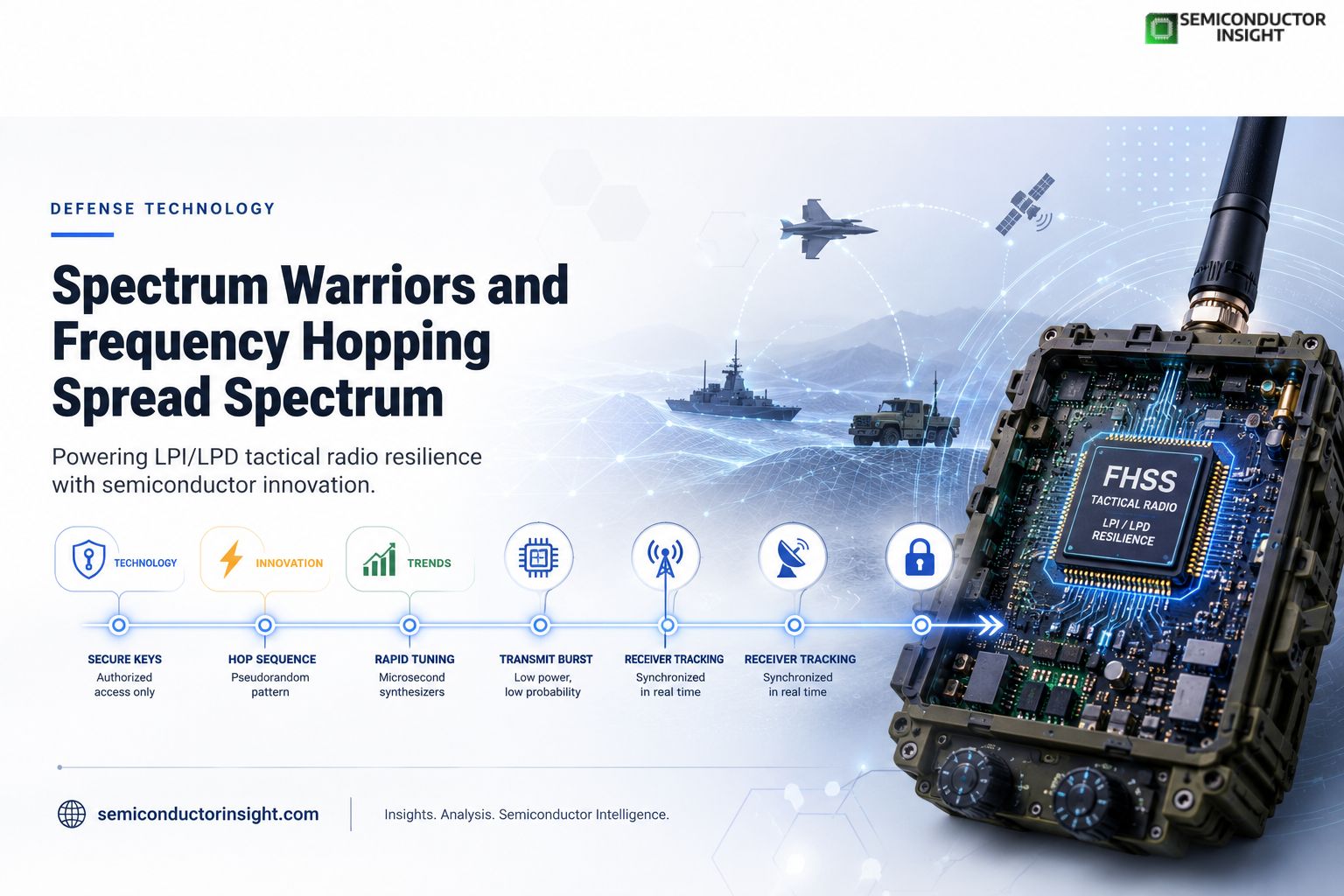
Signal Path Visualization: Secure key loading → Pseudorandom hop sequence generation → Rapid synthesizer tuning → Transmission burst on current frequency → Synchronized receiver tracking → Error correction and decryption. This seamless cycle keeps voice, data, and position information flowing securely even under electronic attack.
Core Semiconductor Building Blocks Enabling Hopping Precision
- Modern tactical radios integrate high-speed frequency synthesizers based on phase-locked loops and direct digital synthesis chips that achieve microsecond settling times.
- These semiconductor components allow hops fast enough to evade detection while maintaining signal integrity. Embedded cryptographic modules generate the shared transmission security keys that dictate the hop pattern, ensuring only paired units stay synchronized.
- Power amplifiers and low-noise receivers optimized for burst transmissions further reduce the radio’s electromagnetic footprint.
- Recent semiconductor integrations include software-defined architectures where waveforms load dynamically, supporting both legacy SINCGARS compatibility and advanced LPI/LPD modes.
Battlefield Stories from Operational Deployments
U.S. and allied forces have fielded tens of thousands of SINCGARS radios since the early 1990s, with continued use in training and operations as seen in recent Army Central Command activities. These units provide frequency-hopping voice and data links critical for ground maneuver units. Link 16 terminals, numbering over 11,000 MIDS-LVT units delivered across joint, coalition, and partner platforms, connect aircraft, ships, and ground stations in real-time tactical data networks.
In multinational exercises, these systems demonstrate resilience against simulated jamming, allowing forces to coordinate without revealing positions. Recent enhancements incorporate adaptive hopping that avoids detected interference frequencies on the fly.
Example System Characteristics
SINCGARS operates in the 30-88 MHz band with a hop rate around 150 hops per second and is used in manpack and vehicular radios. Link 16 / MIDS covers 969-1206 MHz and uses fast pulse-based signalling for aircraft, ships, and ground platforms. HAVE QUICK works in the 225-400 MHz range, employs high-rate frequency hopping, and is primarily used for aeronautical communications.
Integration with Broader Tactical Networks
Frequency hopping capabilities now mesh with wider network architectures. Software-defined radios load multiple waveforms, allowing seamless transitions between hopping modes and other secure links. This supports everything from squad-level voice to theater-wide data sharing while preserving LPI/LPD traits.
Ongoing work at defense research centers explores hybrid approaches combining frequency hopping with other spread-spectrum methods for even greater resilience in dense electromagnetic environments.
Performance Pointers in Action:
- Hop sequences change thousands of times per minute, frustrating enemy direction-finding equipment.
- Low-power burst modes keep signals near or below noise floors.
- Synchronization maintains links across moving platforms without constant rekeying.
- Semiconductor hardening ensures operation in extreme temperatures, vibration, and electronic warfare conditions.
Innovations at the Chip Level Driving Next Capabilities
Advances in gallium nitride and silicon carbide semiconductors improve power efficiency for longer battery life in manpack units. Faster digital signal processors handle more sophisticated anti-jam algorithms and real-time hop pattern adaptation. Research into cognitive radio elements allows systems to sense spectrum usage and adjust hopping strategies autonomously.
These developments extend operational reach while shrinking the physical and power footprint of tactical radios, directly benefiting dismounted soldiers and unmanned systems.
Lastly before we wrap up, don’t forget to look at our most recent exclusive report for in-depth insights: https://semiconductorinsight.com/report/frequency-hopping-spread-spectrum-for-lpi-lpd-tactical-radio-market/
Global Collaboration and Interoperability Efforts
NATO and partner nations standardize on compatible hopping protocols, enabling coalition operations where forces from different countries share secure links. Training programs emphasize proper key management and waveform employment to maximize the protective advantages of these technologies.
Case studies from joint exercises highlight how frequency hopping maintains communications when traditional fixed-frequency systems fail completely.
From legacy proven systems like SINCGARS to networked Link 16 platforms, this technology remains foundational to electronic warfare superiority. As semiconductor capabilities evolve, the frequency hopping spread spectrum approach continues safeguarding tactical communications in an era of sophisticated adversaries.

Comments (0)