
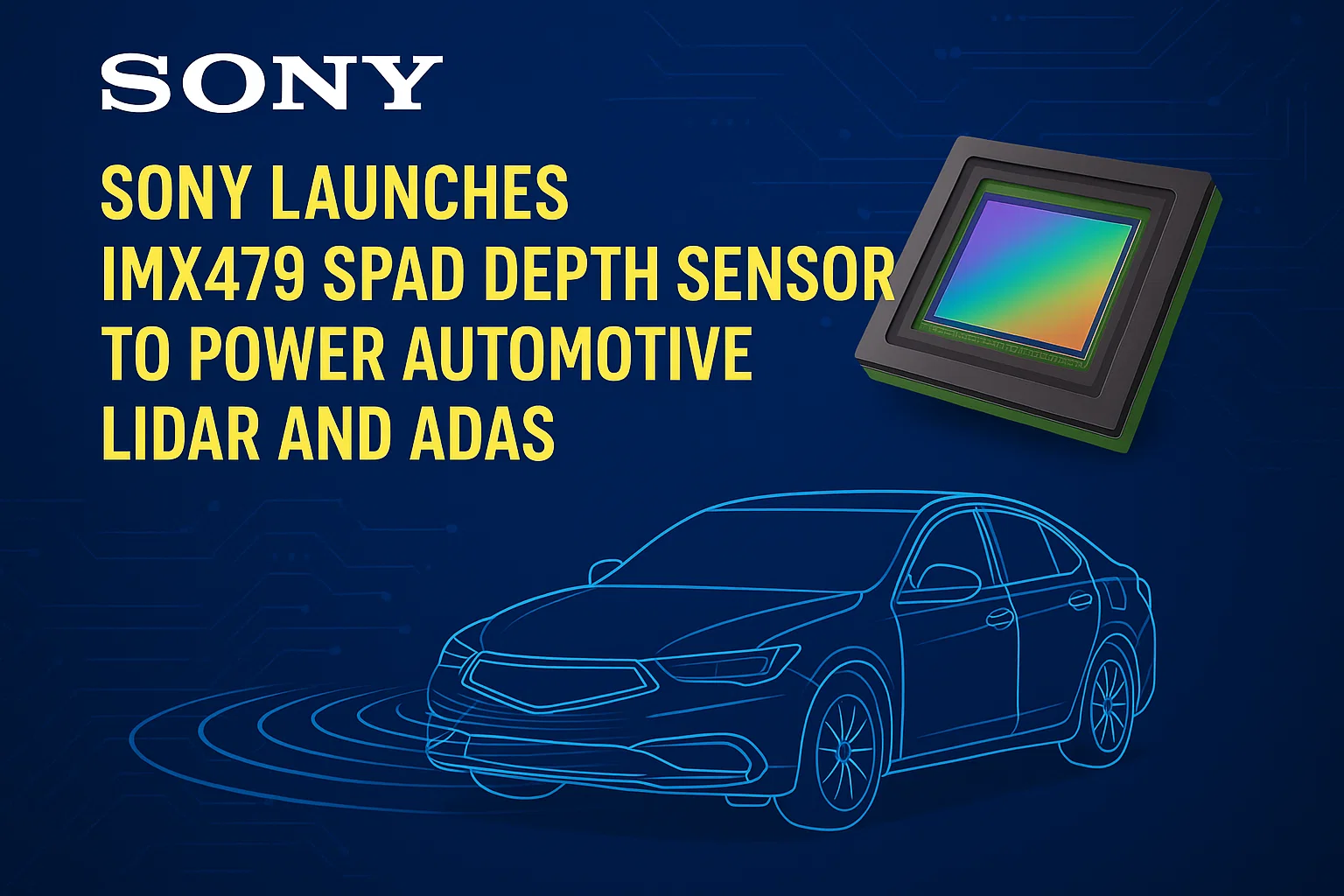
Sony Launches IMX479 SPAD Depth Sensor to Power Automotive LiDAR and ADAS
The miniature photometric sensor industry has quietly become one of the most transformative segments within the broader sensor and semiconductor ecosystem. As technology trends lean toward miniaturization, efficiency, and multifunctionality, the demand for compact, high-performance photometric sensors has increased across diverse industries from consumer electronics and wearables to healthcare, automotive safety, smart lighting, and industrial automation.
Recent innovations, such as self-powered light sensors, the world’s smallest photoplethysmography (PPG) sensor head, and Sony’s SPAD-based LiDAR depth sensors, have showcased how quickly the industry is moving toward smaller footprints, higher sensitivity, and enhanced integration. These advancements align with broader technological shifts in AI-driven imaging, Internet of Things (IoT), automotive autonomy, and precision healthcare.
Financially, the Miniature Photometric Sensor Market was valued at US$ 194 million in 2024 and is projected to reach US$ 318 million by 2032, growing at a CAGR of 6.4% during the forecast period (2025–2032). This steady expansion highlights not only the technological promise but also the increasing commercial viability of these sensors in everyday applications.
Access Your Free Sample Report- Miniature Photometric Sensor Market
Understanding Miniature Photometric Sensors
What They Are
A photometric sensor is a device that measures light intensity. When engineered in miniature form, these sensors offer compactness without compromising precision. They typically detect illumination, brightness levels, and changes in light, often using photodiodes, phototransistors, or advanced semiconductor structures such as Single Photon Avalanche Diodes (SPADs).
Why Miniaturization Matters
- Wearable technology requires ultra-small, power-efficient sensors.
- Automotive LiDAR demands lightweight, highly sensitive sensors that can fit seamlessly into advanced driver-assistance systems.
- Smart healthcare devices need sensors capable of embedding into patches, smartwatches, or even contact lenses.
- Energy-efficient lighting relies on miniature, self-powered photometric sensors to adjust brightness dynamically.
Miniaturization is not just about shrinking dimensions; it is about creating a sensor ecosystem that is self-sufficient, cost-effective, and capable of mass deployment.
Recent Developments Driving the Market Forward
1. Cricket: Self-Powered, Battery-Free Light Sensor
One of the most striking recent innovations is the development of Cricket, a battery-free, self-powered miniature photometric sensor. Unlike traditional designs, Cricket harnesses energy directly from ambient light. When it accumulates enough energy, it emits a radio-frequency chirp that reflects light intensity.
Key Highlights:
- Eliminates the need for external batteries, reducing size and environmental footprint.
- Can be deployed in large arrays to map and optimize building illumination.
- Paves the way for self-adjusting sunglasses or smart eyewear that automatically adapts to ambient light.
This breakthrough is important because energy harvesting is a defining trend in IoT and smart sensing technologies. Cricket demonstrates how miniature photometric sensors can evolve into sustainable, zero-maintenance solutions.
2. World’s Smallest PPG Sensor Head (TSLC & SCIVAX)
In April 2025, TSLC Corporation and SCIVAX introduced the world’s smallest photoplethysmography (PPG) sensor head, a leap forward for wearable healthcare.
What Makes It Revolutionary:
- Occupies only ~1 mm² area, a tenth of traditional designs.
- Half the thickness of conventional sensors.
- Uses integrated resin packaging for cost efficiency.
- Ideal for beauty tech, nursing devices, and wearable medical monitors.
By reducing both size and manufacturing costs, this innovation expands accessibility to health monitoring in markets like elderly care, fitness tracking, and preventive medicine.
The miniaturization of photometric healthcare sensors is vital at a time when personalized medicine and telehealth are growing rapidly. Devices like smart rings, skin patches, and micro-wearables will increasingly rely on such ultra-small PPG sensors.
Download Sample Report PDF- Miniature Photometric Sensor Market
3. Sony’s IMX479 SPAD Depth Sensor for Automotive LiDAR
Sony Semiconductor Solutions (SSS) recently introduced the IMX479, a stacked Single Photon Avalanche Diode (SPAD) depth sensor tailored for automotive LiDAR.
Key Capabilities:
- 520 depth pixels with industry-leading resolution.
- 20 frames per second, the fastest in its class.
- Long-range detection up to 300 m.
- Distance resolution of 5 cm with 37% photon detection efficiency at 940 nm.
Why it matters: SPAD-based photometric sensors enable precise photon counting, making them essential for autonomous driving and ADAS (Advanced Driver Assistance Systems).
As vehicles become smarter and safer, miniature SPAD photometric sensors like Sony’s IMX479 will underpin collision avoidance, 3D mapping, and adaptive navigation systems.
Market Growth Drivers
The projected CAGR of 6.4% (2025–2032) reflects robust drivers across industries:
- Healthcare & Wearables
- Rising adoption of smartwatches, fitness trackers, and medical monitoring devices.
- Miniature PPG sensors are powering heart rate, oxygen saturation, and stress monitoring.
- Automotive & Mobility
- LiDAR integration into ADAS and autonomous vehicles.
- Photometric sensors play a critical role in safety and navigation.
- Smart Lighting & Buildings
- Demand for energy-efficient, adaptive lighting systems.
- Battery-free photometric sensors reduce infrastructure and maintenance costs.
- Consumer Electronics
- Integration into VR headsets, AR glasses, and smart eyewear.
- Photometric sensors support dynamic brightness control.
- Industrial & Research Applications
- Used in precision measurement, photometry labs, and optical calibration.
- Growing role in semiconductor testing and scientific instrumentation.
Challenges Facing the Industry
While the trajectory is positive, several hurdles must be addressed:
- Manufacturing Costs: Scaling miniature sensors with advanced packaging requires significant investment.
- Energy Efficiency vs. Performance: Striking a balance between ultra-low power consumption and high sensitivity remains challenging.
- Integration Complexity: Embedding sensors in tiny wearables or automotive systems requires overcoming heat, alignment, and connectivity issues.
- Standardization: Lack of universal standards in sensor calibration may hinder interoperability across industries.
Competitive Landscape
Major companies and research institutions are actively pushing innovation:
- Sony Semiconductor Solutions (SSS): Focus on automotive SPAD depth sensors.
- TSLC & SCIVAX: Leaders in miniaturized PPG healthcare sensors.
- Hamamatsu Photonics: Pioneer in back-illuminated CMOS and photometric imaging sensors.
- Start-ups like Cricket Developers: Exploring battery-free, self-powered sensing platforms.
Competition is likely to intensify as semiconductor giants, healthcare device makers, and automotive technology companies increasingly rely on miniature photometric sensors.
Regional Insights
- North America: Strong presence of automotive LiDAR developers and healthcare startups.
- Europe: Research-driven ecosystem with companies focusing on photonics and optical sensing.
- Asia-Pacific: The fastest-growing region due to consumer electronics demand (China, South Korea, Japan) and semiconductor manufacturing leadership (Taiwan).
- Middle East & Latin America: Emerging markets for smart city lighting and telehealth solutions.
Click Here To Download Full Sample Report- Miniature Photometric Sensor Market
Future Outlook (2025–2032)
The coming years will witness a dramatic expansion of miniature photometric sensors into everyday devices and infrastructures. Some predictions include:
- Healthcare Ubiquity: Micro PPG sensors in skin patches, implantables, and even smart textiles.
- Automotive Standardization: Miniature LiDAR depth sensors will become mandatory components in ADAS-equipped vehicles.
- Energy Autonomy: Battery-free photometric sensors will dominate IoT deployments, reducing maintenance costs.
- AI Integration: Coupling sensors with AI chips will enable real-time interpretation of light-based data in wearables and autonomous machines.
- Cross-Industry Applications: From agriculture (light monitoring for crops) to defense (night-vision and optical tracking), miniature photometric sensors will penetrate new domains.
The miniature photometric sensor industry is entering a golden era of innovation and expansion. With breakthroughs such as battery-free Cricket sensors, the world’s smallest PPG healthcare modules, and Sony’s high-speed SPAD automotive sensors, the field is demonstrating remarkable versatility.
The market’s projected growth from US$ 194 million in 2024 to US$ 318 million by 2032, at a steady 6.4% CAGR, underscores the rising relevance of these compact light-measuring devices. As industries demand smarter, smaller, and more efficient solutions, miniature photometric sensors are poised to become foundational technologies for the future of healthcare, mobility, smart living, and beyond.

Comments (0)