
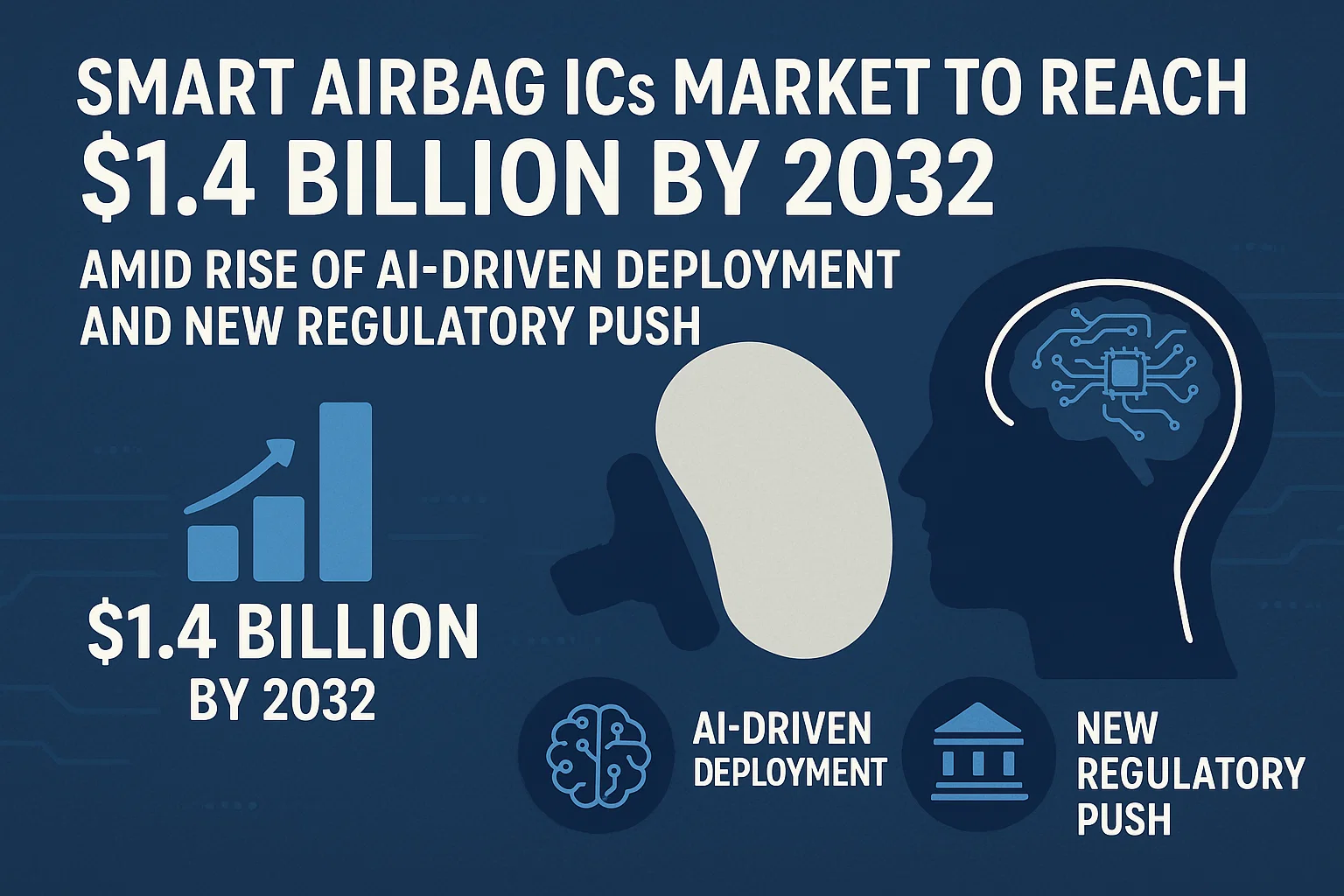
Smart Airbag ICs Market to Reach $1.4 Billion by 2032 Amid Rise of AI-Driven Deployment and New Regulatory Push
In today’s increasingly automated automotive landscape, safety continues to stand as a defining pillar of innovation. While autonomous systems, electric drivetrains, and digital cockpits command headlines, the silent protectors—airbags—are being quietly transformed at the chip level. At the heart of this evolution lies a critical component: the airbag Integrated Circuit (IC).
In 2024, the Passenger Car Airbag ICs market was valued at USD 1,160 million. With the sector expected to grow at a modest yet steady CAGR of 2.8%, the market is projected to reach USD 1,400 million by 2032. This growth reflects a fusion of advancing safety regulations, rising vehicle ownership, and the push toward intelligent automotive systems.
Access Your Free Sample Report- Passenger Car Airbag ICs Market
- Understanding Passenger Car Airbag ICs
Airbag ICs are microelectronic chips integrated into the airbag control module (ACM) of a car. Their job is precise and life-critical: detect a collision using data from multiple sensors, process the event with near-zero latency, and trigger deployment of the airbags within milliseconds.
Key functions include:
- Signal processing from crash sensors and accelerometers
- Power management to ensure instant readiness
- Trigger mechanisms for airbag deployment
- Self-testing and diagnostics
In modern cars, these ICs are part of a broader Electronic Control Unit (ECU) ecosystem that interlinks with Advanced Driver Assistance Systems (ADAS), cameras, radars, and more.
- Market Overview: 2024–2032
- Market Valuation (2024): USD 1,160 million
- Projected Valuation (2032): USD 1,400 million
- CAGR: 2.8%
- Key Growth Regions: Asia-Pacific, North America, Europe
- Dominant Segments: Mid-range and premium passenger vehicles, SUVs
Key Drivers:
- Growing passenger vehicle production in emerging markets
- Stricter government safety mandates (e.g., Bharat NCAP, Euro NCAP)
- Rising consumer awareness regarding crash protection
- Technological advancement toward AI-integrated SoCs in vehicles
Key Restraints:
- Slow adoption of high-end safety ICs in low-cost vehicles
- Supply chain vulnerabilities in the semiconductor industry
- High R&D costs limiting mid-tier OEM innovation
- Recent Industry Developments
Rise of Predictive & AI-Enabled Airbag Systems
Traditionally, airbags reacted after a crash. But 2024 has marked a clear shift toward predictive deployment, where airbag ICs analyze:
- Vehicle speed
- Pre-impact angles
- Occupant positioning
- Braking patterns
ICs now leverage sensor fusion, integrating data from LIDAR, radar, cameras, and seat-pressure sensors. The goal? To anticipate collisions and optimize deployment force, speed, and direction.
Companies like STMicroelectronics and Infineon Technologies are leading the charge with intelligent SoCs that merge real-time data analytics with deployment logic.
Download Sample Report PDF- Passenger Car Airbag ICs Market
ZF’s Revolutionary Footwell Airbag (2024)
One of the most headline-grabbing innovations in 2024 was by ZF LIFETEC, which unveiled a footwell airbag system. This product is designed to protect lower limbs during frontal collisions—an area traditionally overlooked.
While the physical airbag is innovative, the ICs behind it had to be redesigned. These chips must analyze a new range of kinematic data and deploy without interfering with existing systems. This has prompted new development in multi-zone, low-latency ICs capable of handling unique deployment logic.
Integrated SoC Airbag Control Chips
Rather than multiple chips handling sensing, decision-making, and deployment, new System-on-Chip (SoC) solutions are gaining popularity. These integrate:
- Microcontrollers
- Accelerometers
- Signal amplifiers
- Deployment triggers
This not only reduces cost and space, but also improves reliability and response time. Bosch and Analog Devices have been working on scalable SoC platforms adaptable for small cars to luxury vehicles.
- Regional Insights and Drivers
🇨🇳 China & Asia-Pacific: Dominating Volume
- China remains the largest producer and consumer of passenger vehicles.
- Mandatory airbag requirements and growing SUV adoption drive demand.
- Local IC design houses (e.g., BYD Semiconductor) are gaining traction.
🇮🇳 India: Accelerating With Regulations
- India’s Bharat NCAP safety ratings took effect, boosting OEM interest in multi-airbag designs.
- The airbag IC market here is expected to grow at ~6.4% CAGR through 2030.
- Leading local manufacturers are collaborating with global suppliers (e.g., Bosch India).
🇺🇸 North America: High Safety Culture
- U.S. buyers prioritize crash safety; most cars have 6–10 airbags.
- ICs must comply with NHTSA standards and integrate with sophisticated ADAS systems.
- The region is seeing high adoption of AI-enhanced airbag systems.
- Key Players Shaping the Future
Here are some of the top names influencing the airbag IC space:
| Company | Focus Area | Recent Developments |
| Infineon Technologies | MEMS-based ICs, power-efficient design | Developing integrated SoCs for modular vehicle platforms |
| STMicroelectronics | Sensor-IC fusion, diagnostics | Collaborated with Tier-1 suppliers on intelligent airbag control |
| Bosch | Complete safety ECUs | Introduced smaller form-factor airbag control chips for EVs |
| Analog Devices (ADI) | High-reliability analog ICs | Rolled out smart deployment ICs with fault isolation features |
| Denso Corporation | Integrated vehicle safety | Working on AI-based deployment logic for next-gen Toyota models |
- Technology Trends Shaping the Market
Artificial Intelligence
The adoption of AI-enabled ICs in airbag systems marks a transformative step. These chips learn occupant behavior over time—detecting if a child is present, if someone is reclined, or if seatbelt tension changes—and adjust deployment parameters accordingly.
Miniaturization & 3D Packaging
The move to 3D chip packaging and advanced substrates allows more functionality in less space—ideal for compact vehicle designs and modular dashboards.
Self-Diagnostics & Redundancy
Newer airbag ICs can self-monitor for failures, degrading components, or sensor mismatches—ensuring fail-safe operations. Redundant circuits and power paths are also now common in safety-critical environments.
- Regulatory Landscape & Its Impact
Governments across the globe are implementing stricter crash safety norms:
- EU: Euro NCAP revisions call for better side and rear collision protection—driving demand for new airbag zones and corresponding IC support.
- India: Mandatory six airbags in new cars by 2026 boosts IC volume significantly.
- USA: Proposals for improved pedestrian protection airbags will soon extend IC integration beyond cabin interiors.
These evolving norms mean more ICs per vehicle, even in budget segments—a win for volume and innovation alike.
- Opportunities and Challenges Ahead
Opportunities:
- Growth in electric vehicles (EVs) needing lightweight, efficient ICs
- Innovations like external airbags, under-seat airbags, and motorcycle airbag systems
- Local sourcing trends fostering regional chip design houses
Challenges:
- Semiconductor supply chain constraints post-2020
- Cybersecurity risks—airbag systems could be targeted in connected vehicles
- Integrating legacy airbag modules with modern ICs in developing nations
Click Here To Download Full Sample Report- Passenger Car Airbag ICs Market
- Future Outlook (2025–2032)
As we step into a future of autonomous and highly connected vehicles, passenger safety will remain central. Airbags, now enhanced with intelligent control ICs, will not just be reactive shields but active participants in crash prevention and injury minimization.
Between 2025 and 2032, expect:
- OEMs to standardize intelligent airbag systems
- ICs to become software-definable, allowing OTA updates
- Broader use of low-power ICs for energy-efficient EV deployment
- Strategic partnerships between automakers and semiconductor firms
With consistent innovation and steady market expansion, the Passenger Car Airbag ICs market is poised to redefine what safety means in modern mobility.
While the world of car technology continues to captivate with autonomous driving and electrification, the evolution of airbag ICs is a testament to the quiet brilliance of safety engineering. From smarter sensors to AI-powered deployment, the humble airbag chip is now a cutting-edge guardian of human life.
With a CAGR of 2.8% through 2032, growing regional adoption, and strong technological momentum, this segment is far from static. It’s dynamic, essential, and headed for a future where every millisecond—and every life—matters.

Comments (0)