
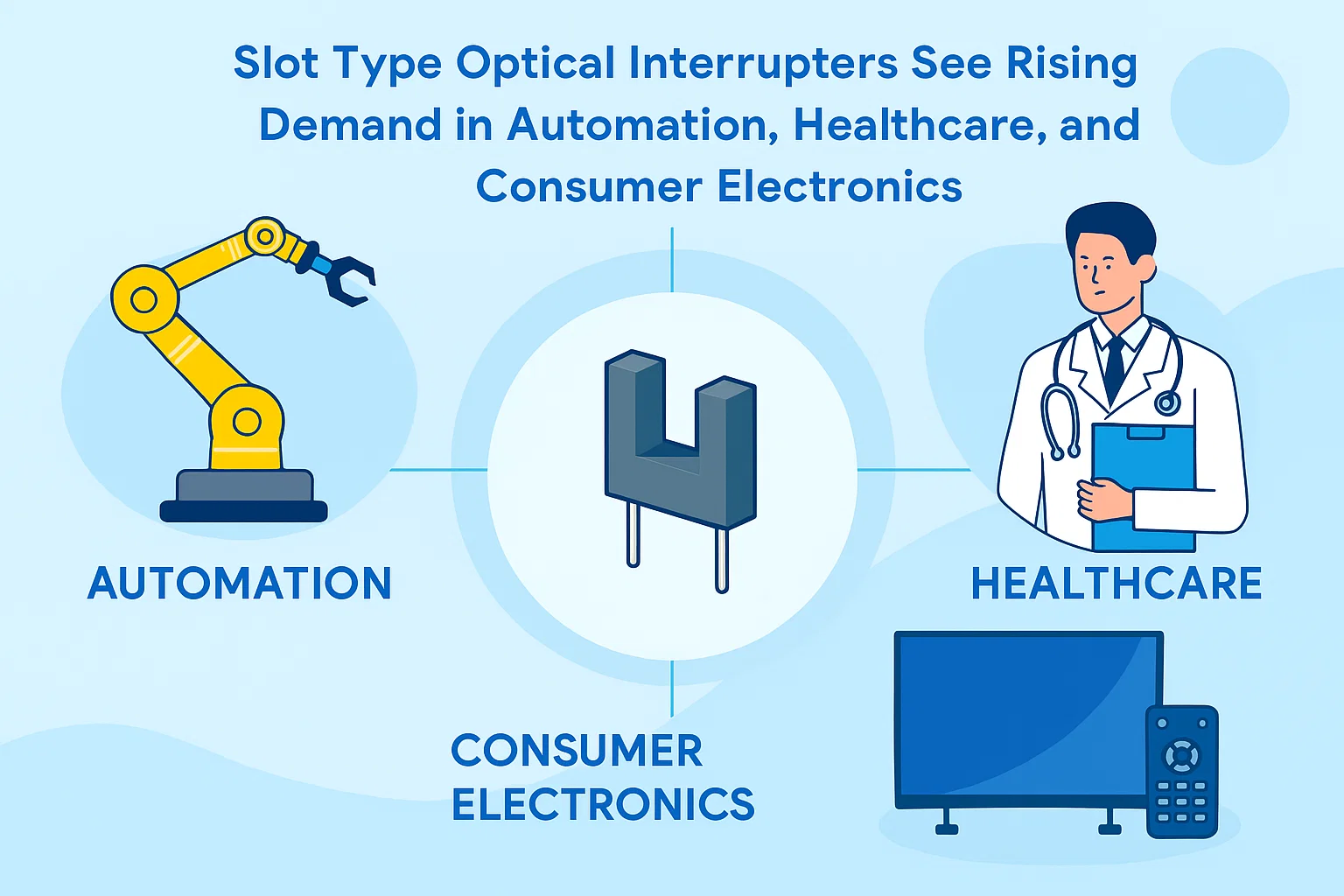
Slot Type Optical Interruptors See Rising Demand in Automation, Healthcare, and Consumer Electronics
The slot type optical interruptor industry is entering an era of remarkable growth, driven by technological advancements, automation trends, and expanding applications across sectors such as automotive, industrial automation, healthcare, and consumer electronics. According to the latest insights, the global slot type optical interruptor market was valued at US$ 892 million in 2024 and is projected to reach US$ 1.43 billion by 2032, growing at a CAGR of 7.0% during the forecast period from 2025 to 2032.
This growth trajectory underscores not only the critical role of these compact optical sensors in enabling modern technology but also the transformative impact of innovations in sensing accuracy, miniaturization, and reliability.
Access Your Free Sample Report- Slot Type Optical Interruptor Market
Understanding Slot Type Optical Interruptors
Slot type optical interruptors, sometimes referred to as photointerrupters, are non-contact sensors designed to detect the presence or absence of an object within a slot. They typically consist of a light-emitting diode (LED) on one side and a photodetector on the opposite side, housed within a compact casing. When an object interrupts the light beam in the slot, the sensor generates a signal—making it ideal for position sensing, object detection, and speed measurement.
Their inherent precision, fast response, and durability have made them indispensable in numerous industries. Unlike mechanical switches, they offer long operational life and resistance to dust and mechanical wear, aligning well with the needs of automation-driven environments.
Market Outlook and Growth Dynamics
The slot type optical interruptor market is experiencing robust momentum, propelled by several converging trends:
- Market Size: Valued at US$ 892 million in 2024.
- Forecast: Expected to reach US$ 1.43 billion by 2032.
- CAGR: 7.0% (2025–2032).
This growth is strongly linked to the rise of Industry 4.0, smart consumer devices, and EV infrastructure, all of which require high-precision sensors for safe, efficient, and automated operations.
Recent Developments Shaping the Industry
Miniaturization and Advanced Integration
One of the most notable trends in recent years is the push toward miniaturized slot interrupters without compromising sensitivity or reliability. Manufacturers are developing sensors as small as 2–3 mm, enabling integration into compact electronics like smartphones, wireless earbuds, and wearable devices.
These innovations not only save space but also reduce power consumption, aligning with the energy efficiency goals of modern electronics.
Industrial Automation and Smart Manufacturing
The global shift to automation in manufacturing and logistics has driven demand for rugged, reliable optical sensors. Slot type interrupters are now widely used in:
- Robotics for precise positioning of moving parts.
- Conveyor systems for counting, alignment, and object detection.
- 3D printers for ensuring accurate paper or material feed.
These sensors are increasingly designed with dust-proof, moisture-resistant housings, making them ideal for harsh factory environments.
Automotive Sector Innovations
In the automotive sector, slot interrupters are being adopted for gear position sensing, seat belt systems, power window detection, and safety-critical applications.
A significant development is the use of optical interrupters in electric vehicle (EV) charging systems. They help ensure proper connector alignment, preventing overheating or electrical hazards during high-power charging. With EV adoption rising globally, this application represents a substantial growth driver for the industry.
Additionally, in railway systems, optical interrupters are being used for track switching and position monitoring. Europe has introduced requirements for SIL-3 certification by 2025, which is creating opportunities for manufacturers offering highly reliable, safety-certified components.
Healthcare and Medical Devices
The medical sector has seen a surge in demand for contactless sensing solutions, particularly in the post-pandemic era. Slot interrupters are being integrated into:
- Infusion pumps for monitoring flow and preventing occlusion.
- Robotics-assisted surgical systems for high-precision motion detection.
- MRI-compatible devices where non-magnetic, optical-based sensing is critical.
Recent developments highlight sterile, EMI-shielded interrupters specifically designed for medical equipment, which must meet stringent global standards such as IEC 60601-1-2.
Download Sample Report PDF- Slot Type Optical Interruptor Market
Consumer Electronics and Miniaturized Devices
Consumer electronics remain a vibrant market segment for slot interrupters. Key applications include:
- Smartphones: Used in SIM tray detection and camera stabilization systems.
- Wireless earbuds: For lid and case detection.
- Gaming consoles: For precise input/output detection.
- Printers: For paper and ink cartridge alignment.
The drive toward miniaturization has resulted in ultra-compact interrupters that consume less energy while offering fast switching speeds, meeting the performance needs of next-gen devices.
Regulatory and Environmental Compliance
Sustainability and compliance have become non-negotiable priorities in the industry. Manufacturers are now developing sensors that comply with:
- RoHS (Restriction of Hazardous Substances).
- REACH (Registration, Evaluation, Authorization, and Restriction of Chemicals).
- ISO 9001 and ISO 14001 certifications.
Moreover, automotive-grade optical interrupters must meet AEC-Q102 standards, while safety-critical rail applications demand IEC 60747-5-5 compliance. These regulatory shifts are pushing innovation in materials, design, and durability.
Barriers to Entry and Competitive Landscape
While demand is growing, new players face significant challenges entering the market:
- High production setup costs: ISO Class 6 cleanrooms can exceed USD 12 million.
- Time-intensive certifications: Meeting AEC-Q102 or IEC standards may take 18–24 months and cost more than USD 500,000 per product line.
- Patent dominance: Established players like Omron, Vishay, Everlight, and Panasonic hold patents covering anti-crosstalk designs and temperature compensation.
These barriers reinforce the dominance of existing giants, though they also ensure quality and reliability across applications.
Key Application Areas Driving Growth
| Sector | Applications of Slot Type Optical Interruptors |
| Automotive | Gear sensing, power windows, EV charging, rail switching |
| Healthcare | Infusion pumps, surgical robotics, MRI-compatible devices |
| Industrial Automation | Conveyor belts, robotics, assembly lines, 3D printers |
| Consumer Electronics | Smartphones, earbuds, gaming consoles, printers |
| Infrastructure | Toll gates, license plate recognition, EV fast-charging systems |
Supply Chain and Global Landscape
The slot type optical interruptor industry is characterized by a highly specialized supply chain:
- Asia-Pacific, particularly China, Japan, and South Korea, dominates production due to strong semiconductor ecosystems and robust consumer electronics manufacturing.
- Europe is seeing strong demand in rail systems and automotive due to stringent safety regulations.
- North America continues to adopt optical interrupters in medical devices, EVs, and smart manufacturing.
However, global supply chain disruptions in recent years (particularly for semiconductors) have emphasized the need for localized manufacturing and vertical integration by large players.
Opportunities and Challenges
Opportunities
- EV adoption: Rising EV infrastructure demands reliable charging safety sensors.
- Smart factories: Industry 4.0 initiatives are boosting demand for automation-grade sensors.
- Healthcare boom: Precision sensing in advanced medical devices is a major growth driver.
- Miniaturization: Expanding opportunities in consumer electronics and wearables.
Challenges
- High entry barriers for newcomers.
- Patent concentration among a few key players.
- Regulatory costs and certification timelines.
- Supply chain volatility impacting semiconductor components.
Click Here To Download Full Sample Report- Slot Type Optical Interruptor Market
Future Outlook
The future of the slot type optical interruptor industry looks bright and innovation-driven. With the rise of autonomous vehicles, 5G-enabled consumer electronics, smart healthcare devices, and sustainable industrial automation, demand is poised to accelerate.
Key expected trends by 2032 include:
- Wider adoption in AI-powered robotics.
- Integration with IoT ecosystems for real-time data capture.
- Expansion of medical-grade, EMI-resistant interrupters.
- Adoption of silicon photonics for higher precision sensing.
- Increasing demand from emerging economies investing in rail, toll, and EV infrastructure.
The slot type optical interruptor market, valued at US$ 892 million in 2024, is projected to surge to US$ 1.43 billion by 2032, at a steady 7.0% CAGR. This growth reflects not only the increasing industrial and consumer demand but also the technological innovation and regulatory evolution driving the sector forward.

Comments (0)