

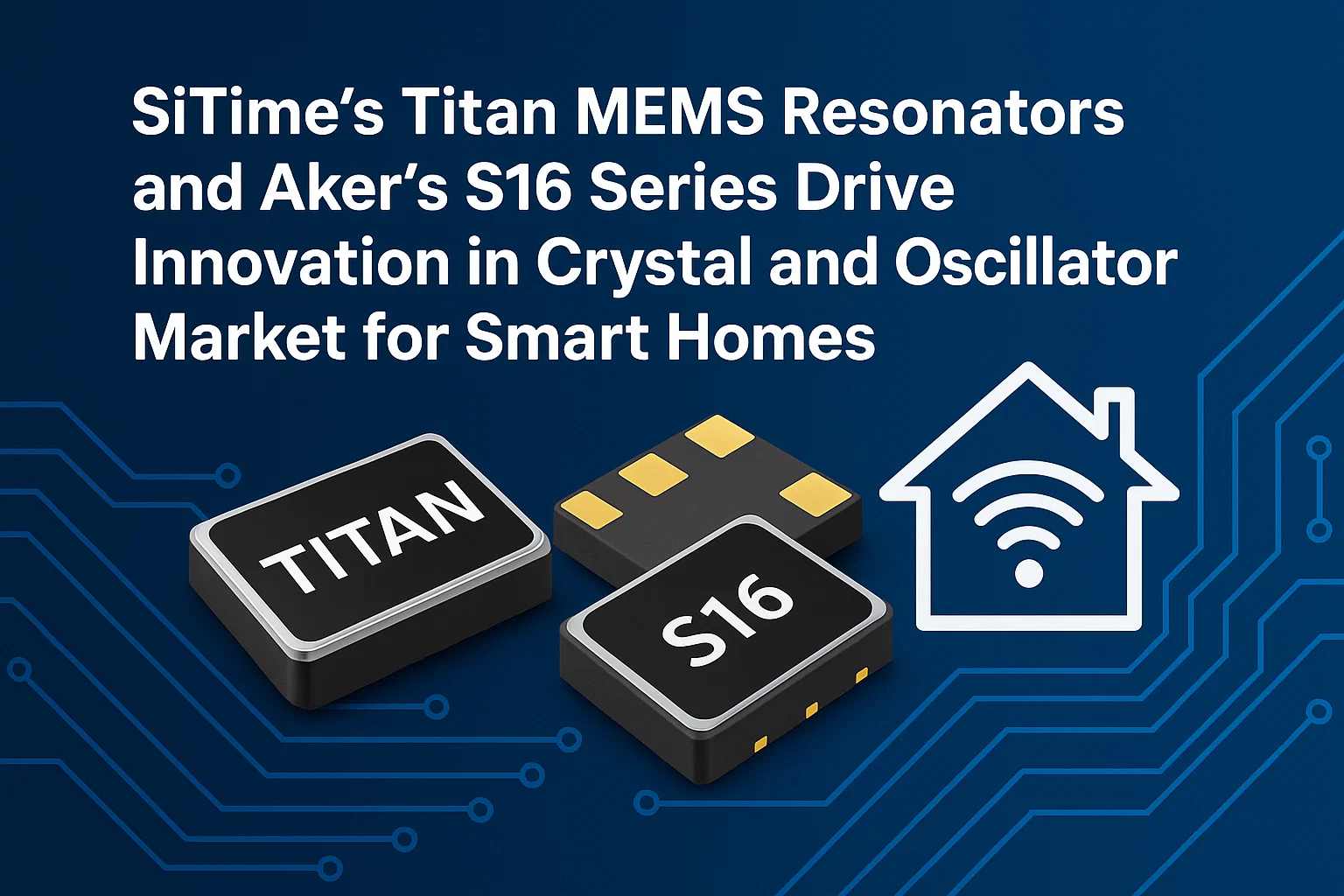
SiTime’s Titan MEMS Resonators and Aker’s S16 Series Drive Innovation in Crystal and Oscillator Market for Smart Homes
The smart home ecosystem has evolved rapidly over the past decade, integrating advanced technologies such as IoT connectivity, voice-enabled automation, and AI-driven energy optimization. At the heart of these connected devices are crystals and oscillators, which play a critical role in delivering accurate timing, synchronization, and stable frequency control. These tiny yet indispensable components enable seamless communication between devices, ensuring everything from smart speakers to connected thermostats operates reliably and efficiently.
According to recent industry data, the Crystal and Oscillators for Smart Home Market was valued at USD 179 million in 2024 and is projected to reach USD 230 million by 2032, growing at a CAGR of 3.7% during the forecast period. This steady growth highlights how essential these components are in the era of hyperconnected living spaces, where reliability, miniaturization, and power efficiency are paramount.
Access Your Free Sample Report- Crystal and Oscilators for Smart Home Market
The Role of Crystals and Oscillators in Smart Home Devices
Before exploring recent developments, it’s important to understand why crystals and oscillators are so vital to smart home technology.
Crystals and oscillators act as the “heartbeat” of electronic systems by providing precise timing and frequency references. In smart home devices, they:
- Enable communication protocols: Wi-Fi, Bluetooth, Zigbee, Z-Wave, and Thread require precise frequency control to maintain stable connections between devices like smart bulbs, cameras, and hubs.
- Synchronize data processing: Microcontrollers and SoCs in connected appliances rely on oscillators for clock signals to process commands accurately.
- Reduce latency: Low-jitter oscillators ensure seamless operation in voice-controlled assistants and streaming devices.
- Optimize battery life: Low-power oscillators are essential for wireless sensors and battery-operated smart devices.
As smart homes become more complex, timing precision becomes even more critical. This has driven companies to innovate beyond traditional quartz solutions, leading to the emergence of advanced MEMS oscillators, ultra-miniaturized crystal packages, and high-performance resonators.
Market Overview and Growth Outlook
The global market for crystals and oscillators used in smart home applications has witnessed consistent growth due to the proliferation of connected devices.
- 2024 Market Value: USD 179 million
- Projected 2032 Market Value: USD 230 million
- CAGR (2024–2032):7%
Key Growth Drivers
- Rising adoption of smart home systems: From smart speakers to connected HVAC systems, the increasing demand for automation drives the need for reliable timing solutions.
- Miniaturization of devices: As smart home devices become smaller and more power-efficient, ultra-compact oscillators are in demand.
- Expansion of IoT networks: Low-power wireless protocols require stable, low-drift timing solutions to function effectively.
- Shift towards sustainable energy solutions: Smart meters and energy management systems rely on precise timing for accurate readings and efficient load balancing.
Recent Technological Developments
1. SiTime Titan MEMS Resonators – Revolutionizing Miniaturization
In September 2025, SiTime Corporation made headlines with the launch of its Titan MEMS resonator platform, a groundbreaking development that redefines timing solutions for space-constrained devices like smart sensors and wearables.
Key Features:
- Ultra-small size: Packages as small as 46 × 0.46 mm, which is up to 7× smaller than traditional quartz resonators.
- Energy efficiency: Offers up to 50% lower oscillator circuit power consumption compared to quartz.
- Rapid startup: 3× faster startup time with significantly reduced energy requirements.
- Extreme durability: Withstands shock, vibration, and temperature variations from –40°C to +125°C.
Impact on Smart Home Devices:
The Titan platform is a game-changer for battery-powered IoT devices, such as:
- Smart door locks and security sensors
- Wireless environmental monitors
- Smart lighting controllers
- Voice assistant devices with edge AI capabilities
By reducing both size and power consumption, these resonators enable manufacturers to build sleeker, longer-lasting devices without compromising performance.
“Smaller, more resilient timing solutions like Titan allow us to design smarter devices that fit seamlessly into homes while delivering the reliability consumers expect.” – Industry Analyst, EDN News
2. Aker Technology’s S16 Ultra-Compact Oscillators
Aker Technology, a leading timing component manufacturer, introduced its S16 Series Crystal Oscillator, designed specifically for smart home and IoT applications.
Specifications:
- Package Size:6 × 1.2 × 0.7 mm
- Frequency Range: 2 MHz – 60 MHz
- Voltage Options:8V / 2.5V / 3.3V with support for 1.62V – 3.63V
- Frequency Stability: ±25 ppm to ±100 ppm
Why It Matters:
Smart home devices such as connected cameras, voice assistants, and thermostats require stable timing across a wide range of environmental conditions. The S16 series addresses this by combining stability, versatility, and small footprint, making it ideal for next-gen smart devices where PCB space is limited.
This launch demonstrates the industry’s ongoing shift toward multi-protocol, high-efficiency smart home platforms.
Download Sample Report PDF- Crystal and Oscilators for Smart Home Market
3. Abracon Expands MEMS Oscillator Portfolio
In early 2025, Abracon, a global leader in timing solutions, announced a significant expansion of its MEMS oscillator lineup. This move included:
- 50+ new series
- Over 1,700 part numbers
Innovative Features Introduced:
- Dual-output options for hybrid designs
- Ultra-low power consumption for battery-powered devices
- Differential outputs for noise-sensitive smart home applications
- Tight stability options for advanced wireless connectivity
This expansion aims to reduce supply chain disruptions and provide design engineers with more choices when creating custom smart home devices. It also highlights the growing demand for flexible and robust timing solutions as IoT ecosystems become increasingly diverse.
4. Academic Breakthroughs: SAW Phononic Crystal Oscillators
While commercial launches dominate headlines, academic research is pushing boundaries for the next generation of oscillators.
A 2025 research study introduced a 1 GHz Surface Acoustic Wave (SAW) phononic crystal oscillator with groundbreaking results:
- Phase noise suppression of 40 dB through injection locking
- Frequency drift reduced to below 0.35 Hz over several minutes
- Potential to enhance wireless communication modules in smart home devices
These advancements suggest a future where smart home systems could operate with ultra-precise timing, reducing interference and improving device interoperability.
Market Segmentation Analysis
By Product Type:
- Quartz Crystals:
- Traditional solution offering high accuracy
- Cost-effective for mass-produced devices like smart light switches and basic sensors
- MEMS Oscillators:
- Superior resistance to shock and temperature
- Preferred for portable and premium devices like smartwatches and security cameras
By Application:
- Smart Lighting Systems
- Smart Speakers & Voice Assistants
- Connected Security Devices
- Home Automation Hubs
- Smart Energy Systems (Meters & Thermostats)
By Region:
- North America: Leads adoption due to high smart home penetration and strong presence of tech giants.
- Europe: Growth driven by energy efficiency mandates and sustainability initiatives.
- Asia-Pacific: Fastest-growing region, fueled by rising urbanization and affordable smart home solutions.
Trends Shaping the Future
1. Miniaturization and Integration
With devices becoming smaller, oscillators must fit into tighter spaces. MEMS technology like SiTime’s Titan enables co-packaging with microcontrollers and wireless chips, streamlining design.
2. Sustainability Focus
As smart homes play a role in energy conservation, manufacturers are emphasizing low-power oscillators to extend battery life and reduce environmental impact.
3. Multi-Protocol Support
Modern smart home hubs often support Wi-Fi, Zigbee, Thread, and Matter simultaneously. Oscillators with tight stability and low jitter are critical for seamless protocol integration.
4. Supply Chain Diversification
Recent semiconductor shortages have highlighted the need for diversified sourcing. Companies like Abracon are expanding portfolios to ensure component availability for global manufacturers.
Challenges in the Industry
Despite strong growth, the crystal and oscillator market for smart homes faces certain challenges:
- Competition from integrated timing solutions: Some SoCs now feature built-in oscillators, reducing discrete component demand.
- Cost pressures: As smart home devices become more affordable, manufacturers seek low-cost timing solutions without sacrificing quality.
- Thermal stability issues: Devices operating in variable environments need oscillators with high temperature tolerance to maintain performance.
Addressing these challenges will require continued innovation and collaboration between component makers and device manufacturers.
Strategic Moves by Key Players
- SiTime: Focusing on MEMS innovation with platforms like Titan to disrupt traditional quartz dominance.
- Abracon: Expanding product diversity to meet varying IoT requirements and mitigate supply chain risks.
- Aker Technology: Targeting niche smart home applications with ultra-compact oscillators.
- Academic Institutions: Driving long-term innovation through SAW oscillator research.
Click Here To Download Full Sample Report- Crystal and Oscilators for Smart Home Market
Future Outlook
By 2032, as the smart home ecosystem matures, crystals and oscillators will continue to evolve alongside emerging technologies like AI edge computing, Matter protocol standardization, and sustainable energy systems. MEMS-based timing solutions are expected to gain significant market share, driven by their resilience, size advantages, and performance in multi-protocol environments.
The steady 3.7% CAGR reflects both the growing demand for smart devices and the continuous push for higher reliability and efficiency in timing solutions.

Comments (0)