
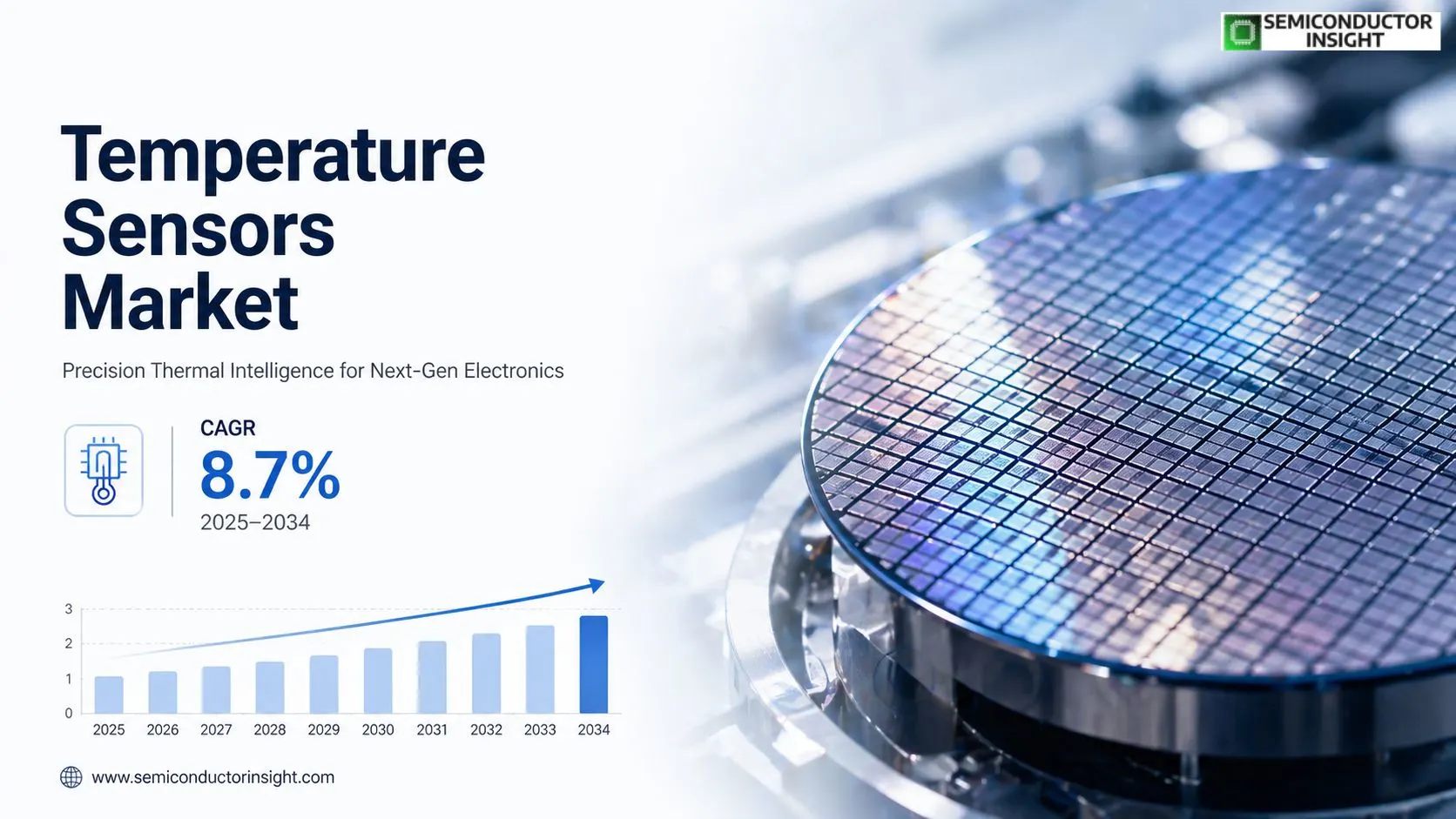
Silicon Meets Sensing Inside the Temperature Sensors Market Landscape
Temperature sensors are no longer simple components tucked inside electronic systems; they have become essential elements in semiconductor-driven architectures. In modern chips, temperature is not just a by-product of operation it is a parameter that directly influences performance, efficiency, and lifespan. As transistor densities increase and nodes shrink below 5 nanometers, even a minor thermal fluctuation of 1-2°C can impact circuit stability.
Globally, semiconductor manufacturing processes now operate in environments where thermal control must be maintained within ±0.1°C precision. This level of sensitivity has elevated temperature sensors from passive devices to active participants in chip-level decision-making.
The Semiconductor Fabric of Temperature Sensing
Temperature sensors in semiconductor systems are typically built using silicon-based structures that convert thermal variations into electrical signals. These include diode-based sensors, resistance temperature detectors (RTDs), and CMOS-integrated thermal sensors.
A closer look at their functional mechanisms reveals:
- PN junction sensors relying on voltage variation (~−2 mV/°C)
- Silicon bandgap sensors offering accuracy within ±0.5°C
- Thermistors with resistance changes up to 5% per °C
- On-chip digital sensors capable of direct integration with microcontrollers
These sensing elements are often embedded directly into processors, power management ICs, and memory modules, enabling real-time thermal feedback.
Feel Free to Reach Our Most Recent Updates of the Relevant Report: https://semiconductorinsight.com/report/non-contact-temperature-sensors-market/
Integration at the Nanoscale
One of the defining trends in the semiconductor domain is the integration of temperature sensors directly onto silicon wafers. This eliminates the need for external sensing components and improves response time.
Key integration characteristics include:
- Sensor footprints as small as 0.01 mm²
- Response times below 10 milliseconds
- Power consumption under 10 microwatts for ultra-low-power devices
- Compatibility with advanced nodes such as 3 nm and 2 nm technologies
Such integration is critical for compact devices like smartphones, wearables, and IoT modules, where space and energy efficiency are tightly constrained.
How Advanced Chips Enable Real Business Impact?
Temperature sensors play a critical role across a wide range of semiconductor-based systems. In high-performance computing, processors can reach junction temperatures of 90-105°C, making accurate thermal monitoring essential to avoid failures. In automotive electronics, sensors must perform reliably in extreme conditions ranging from -40°C to 150°C, particularly in electric vehicles where battery management systems rely heavily on thermal data.
Their use is also expanding in several fast-growing areas, including AI accelerators that handle workloads above 500 watts per chip, 5G infrastructure equipment operating under thermal loads above 80°C, and power electronics built with wide-bandgap semiconductors such as SiC and GaN. Temperature sensors are also becoming increasingly important in data centres, where cooling can account for nearly 30-40% of total energy consumption.
Material Science behind Thermal Sensitivity
The effectiveness of temperature sensors is deeply tied to semiconductor material properties. Silicon remains dominant, but alternative materials are gaining attention.
Material insights include:
- Silicon (Si) with predictable bandgap behavior for stable sensing
- Gallium Nitride (GaN) enabling high-temperature operation beyond 200°C
- Silicon Carbide (SiC) offering thermal conductivity above 120 W/m·K
- Platinum in RTDs ensuring linear resistance-temperature relationships
These materials define how sensors perform under varying thermal and electrical conditions.
Emerging Patterns in Thermal Intelligence
The idea of thermal intelligence is changing the role of temperature sensors from simple monitoring tools into part of predictive systems that can anticipate overheating and improve overall performance. These sensors are now being used more strategically, especially in environments where timely thermal insights are critical.
Recent developments include AI-based thermal prediction models that work with sensor data, multi-sensor arrays that map heat across chips more precisely, wireless temperature sensing for distributed semiconductor systems, and self-calibrating sensors that help reduce drift over time. These advancements are especially important in edge computing and autonomous systems, where accurate thermal data supports fast and reliable decision-making.
Popular Models Available Online
- 10K Thermistor Module:Widely used in DIY electronics projects for temperature tracking.
- PT100 Pencil Probe:Industrial-grade, high-accuracy Platinum RTD.
- Infrared Gun/Sensor (SG 380):Handheld or fixed sensors for non-contact reading from -50°C to 550°C.
- Smart Sensors (e.g., Tapo T310):Wi-Fi-enabled sensors for smart home automation and real-time monitoring via phone.

Comments (0)