
Silicon Focus Rings Market Share Shifts Driven by Precision Welding and Supply Management
In modern semiconductor fabrication, the smallest components often play the largest roles. Although silicon focus rings are silent in plasma etching chambers, they have a crucial impact on wafer uniformity, edge definition, and process repeatability. These rings have evolved from being a consumable accessory to a process-defining component inside etch equipment platforms as chip geometries decrease and device complexity rises.
Focus rings develop through material refining, purity control, and design optimization, in contrast to front-end materials that garner attention for innovative headlines. This reality is reflected in their market, which is more influenced by process improvements, node changes, and equipment utilization rates across fabrications than by fluctuations in volume.
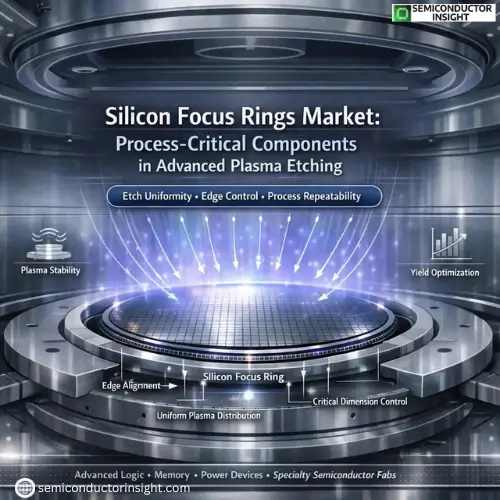
Why Focus Rings Are Becoming Process-Critical Components
At a fundamental level, silicon focus rings help stabilize plasma behavior and ensure uniform ion distribution across the wafer surface. As fabrications push toward advanced nodes, even marginal deviations at the wafer edge can translate into yield losses that outweigh the cost of the component itself.
Key performance expectations now placed on silicon focus rings include:
- Maintaining consistent electrical and thermal behavior throughout long etch cycles
- Minimizing particle generation under aggressive plasma conditions
- Preserving dimensional stability despite repeated exposure to high-energy environments
- Supporting tighter process windows required for sub-10 nm architectures
This shift has elevated focus rings from standard consumables to carefully specified components, often qualified alongside process recipes.
Market Momentum Linked to Fabrication Utilization, Not Just New Builds
Unlike equipment markets that spike with new fab announcements, the silicon focus rings market moves in rhythm with fabrication utilization rates and maintenance cycles. Even during periods of cautious capital spending, existing fabs continue to replace focus rings regularly to maintain etch consistency.
This creates a market profile characterized by:
- Predictable replacement demand tied to tool uptime
- Stable consumption across logic, memory, and power device fabrications
- Ongoing demand even during cyclical downturns in wafer starts
In regions with high fabrication density, replacement demand often outweighs demand from newly installed tools.
Application Landscape: Where Demand Concentrates
Silicon focus rings are used across a wide range of etching processes, but demand intensity varies by device type and manufacturing complexity.
High-impact application areas include:
- Advanced Logic Devices: Tight pattern fidelity and edge uniformity requirements make focus ring performance non-negotiable.
- Memory Manufacturing (DRAM & NAND): High layer counts and repeated etch steps accelerate wear, increasing replacement frequency.
- Power and Analog Devices: Longer production runs emphasize durability and contamination control over extreme miniaturization.
- Specialty Semiconductor Processes: MEMS, sensors, and RF devices rely on stable plasma behavior, even if feature sizes are larger.
How the Value Chain Shapes Competitive Positioning?
The silicon focus rings market favors suppliers that understand semiconductor process realities rather than just material supply. Success depends on tight coordination with equipment platforms and process engineers.
Competitive differentiation typically centres on:
- Material purity consistency across batches
- Dimensional accuracy aligned with specific etch chambers
- Surface finish engineered to reduce particle shedding
- Proven performance across multiple plasma chemistries
Because qualification cycles are long, once a focus ring is approved for a specific tool configuration, suppliers often retain that position for extended periods.
You Can Now Go Through Our Recent Report:
https://semiconductorinsight.com/report/silicon-focus-rings-market/
Process Flow Insight: Where Focus Rings Fit in Etch Operations
Wafer Loading
→ Focus Ring Alignment & Plasma Stabilization
→ Uniform Ion Distribution across Wafer Surface
→ Controlled Edge Etching & Reduced Profile Distortion
→ Consistent Critical Dimensions & Higher Yield
This sequence highlights why even small deviations in focus ring performance can ripple through the entire process outcome.
Regional Demand Patterns Reflect Manufacturing Density
Demand for silicon focus rings closely follows semiconductor manufacturing concentration rather than end-market consumption.
- Asia-Pacific leads in volume demand due to high fab density and continuous production cycles.
- North America shows strong demand linked to advanced logic and R&D-intensive manufacturing.
- Europe maintains steady consumption driven by power electronics and automotive semiconductor production.
In each region, replacement frequency and tool uptime remain the dominant demand drivers.
What Buyers Are Prioritizing in Current Era?
Purchasing decisions are increasingly shaped by operational risk reduction rather than upfront cost savings. Fab operators look for suppliers that reduce unplanned downtime and maintain consistent process results.
Current buyer priorities include:
- Predictable lifespan under aggressive plasma conditions
- Low variability between replacement cycles
- Strong technical support during tool qualification
- Reliable global supply to support multi-fab operations
As fabs move toward higher automation, component consistency has become as important as performance.
Market Outlook: Stability Backed by Process Dependency
The silicon focus rings market does not experience dramatic demand spikes, but it benefits from structural stability. As long as plasma etching remains central to semiconductor fabrication, focus rings will remain indispensable. Rather than rapid expansion, the market’s strength lies in its deep integration with core semiconductor processes making it resilient, technical, and strategically important.
- Increased etch complexity at advanced nodes
- Higher replacement rates driven by aggressive process conditions
- Expansion of specialty semiconductor manufacturing

Comments (0)