
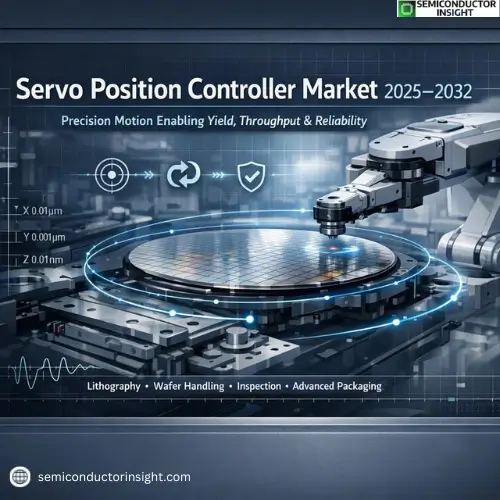
Servo Position Controllers Market Share, Demand Evolution, and Technology Momentum
In modern semiconductor manufacturing, movement is no longer just mechanical it is calculated, synchronized, and measured down to fractions of a micron. Every wafer transfer, every lithography alignment, and every inspection step depends on motion systems that respond instantly and stop precisely. At the centre of this silent choreography sits the servo position controller, acting as the intelligence layer that converts digital commands into controlled, repeatable motion.
This blog explores how Servo Position Controller Market has become a foundational pillar of semiconductor equipment design, influencing yield, throughput, and equipment reliability across fabrications worldwide.
Why Position Control Has Become a Strategic Priority?
As chip geometries continue shrinking and device architectures grow more complex, motion tolerances inside semiconductor tools have tightened dramatically. A minor positional deviation that once went unnoticed can now lead to overlay errors, misalignment defects, or wafer damage.
Servo position controllers address this challenge by continuously comparing commanded positions with real-time feedback from encoders and sensors. Rather than simply driving motors, these controllers actively correct motion in milliseconds, ensuring consistent placement even under variable loads or thermal drift.
This capability is especially critical in semiconductor environments where equipment operates continuously, often under vacuum or cleanroom constraints, leaving little margin for mechanical error.
The Semiconductor Equipment Ecosystem That Depends on Servo Controllers
Servo position controllers are embedded across a wide range of semiconductor manufacturing and handling systems. Their role is not visible to operators, yet their performance directly influences tool uptime and process stability.
They are widely deployed in:
- Wafer handling robots and transfer arms
- Lithography and metrology stages
- Chemical mechanical polishing (CMP) platforms
- Inspection and probing equipment
- Advanced packaging and die bonding systems
Technology Evolution inside Modern Servo Controllers
Today’s servo position controllers are far removed from earlier analog systems. The latest designs incorporate high-speed digital signal processing, adaptive control algorithms, and multi-axis coordination.
Instead of reacting to errors after they occur, modern controllers predict motion behavior, adjusting torque and speed in anticipation of dynamic changes. This predictive capability is becoming essential in semiconductor tools where rapid movements must stop precisely without vibration.
A key advancement has been the integration of absolute encoders and high-resolution feedback loops, allowing controllers to maintain positional awareness even after power interruptions an important factor in minimizing downtime during fab restarts.
Integration with Smart Manufacturing Architectures
Servo position controllers are increasingly designed to operate as part of a broader digital manufacturing ecosystem. They now communicate seamlessly with PLCs, industrial PCs, and factory automation networks.
This connectivity allows:
- Remote diagnostics and performance monitoring
- Real-time motion data logging for yield analysis
- Faster fault isolation during tool maintenance
As semiconductor fabrications move toward predictive maintenance models, servo controllers are becoming valuable data sources rather than isolated motion components.
Import & Export and Supply Chain Considerations
The Servo Position Controller Market is shaped by a global supply chain, with high-precision components often sourced from Japan, Germany, South Korea, and the United States. Semiconductor equipment manufacturers typically favor suppliers with proven reliability and long product lifecycles, as redesigning motion systems mid-tool generation is costly.
Export regulations also influence market dynamics. In advanced semiconductor nodes, motion control hardware may fall under technology export scrutiny, particularly when integrated into tools used for sub-10nm manufacturing. This has encouraged regional diversification of controller suppliers and localized production strategies in Asia-Pacific and Europe.
For a more thorough report, please contact us using our most recent report:
https://semiconductorinsight.com/report/servo-position-controller-market/
Regulatory and Compliance Landscape
While servo position controllers themselves are not process chemicals or consumables, they must comply with stringent industrial standards. Semiconductor fabrications require motion systems that meet electrical safety norms, EMC compliance, and cleanroom compatibility.
Controllers used in wafer handling systems must support low-particle generation, stable thermal behavior, and long operational life without frequent recalibration. These requirements raise entry barriers and favor established vendors with deep application knowledge.
Performance Advantages and Operational Trade-Offs
Servo position controllers deliver measurable benefits, but they also introduce complexity.
Among the main benefits are:
- Exceptional positioning accuracy and repeatability
- Faster motion cycles without sacrificing stability
- Improved equipment yield and reduced scrap
However, these benefits come with trade-offs. Advanced controllers require skilled integration, precise tuning, and higher upfront investment. For semiconductor toolmakers, the challenge lies in balancing controller sophistication with system simplicity and long-term serviceability.
Market Momentum and Investment Signals
Investment in semiconductor capacity expansion has directly fueled demand for high-performance motion control systems. As new fabrications are built to support AI processors, power devices, and advanced packaging, servo position controllers are being specified earlier in equipment design cycles.
Equipment manufacturers increasingly treat motion control as a competitive differentiator, not just a functional requirement. Controllers that enable faster ramp-up times and consistent performance across global fab installations gain preference during supplier selection.

Comments (0)