
Sensor Iron Core Market Breakthroughs Supporting Safety and Efficiency
In the age of autonomous systems, smart manufacturing, and Industry 4.0, sensors have become the nervous system of modern technology. At the heart of many sensor designs lies a component often overlooked yet critically important the iron core. Far from being a simple piece of metal, the iron core is central to how many electromagnetic sensors operate, influencing sensitivity, accuracy, and efficiency across a vast range of applications from automotive safety to industrial automation and medical devices.
As digitalization reshapes industries, demand for highly reliable and high-performance sensors is surging. Governments and corporations are investing heavily in infrastructure that relies on precise measurement and feedback systems. Sensor Iron Core Market is riding this wave, expanding into technologies that demand faster response times, greater thermal stability, and superior signal clarity.
How Iron Core Technology Enhances Sensor Accuracy?
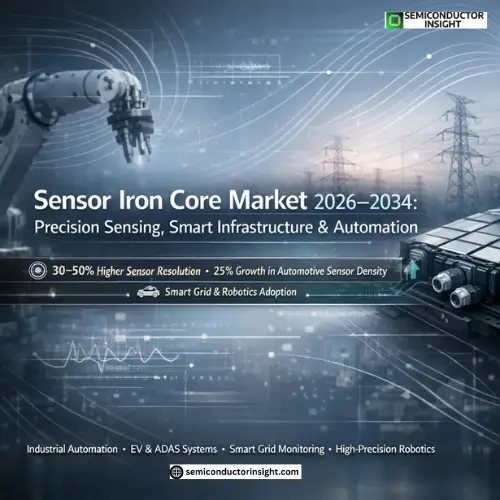
- Iron core components are foundational in sensors that detect magnetic fields, current, and motion. In electromagnetic induction sensors, an iron core intensifies magnetic flux, yielding a stronger, more stable signal. This intrinsic property dramatically improves resolution often by 30 % to 50 % compared with air-core alternatives making iron core sensors a preferred choice in precision control systems.
- Heavy machinery in smart factories, robotic arms in assembly lines, and next-generation wind turbines all depend on iron-core-based current sensors to monitor performance.
- In robotics, for example, feedback loops powered by iron core sensors enable repeated positioning accuracy better than ±0.1 mm, crucial for high-tolerance manufacturing.
- The physics are simple yet profound: iron’s high magnetic permeability channels magnetic fields more effectively, reducing noise and enabling sensors to detect minute variations that would otherwise be lost. This holds especially true in environments with significant electrical interference, such as industrial plants and power stations.
Modern Automotive Safety Fuelled by Iron Core Magnetics
Automobiles are rapidly becoming rolling networks of sensors and actuators. Iron core sensors play a vital role in systems like anti-lock braking, traction control, and electric power steering. In the last two years, sensor density per passenger vehicle has increased by 25%, driven by advanced driver assistance systems (ADAS) and electrification trends.
Current sensors with iron cores monitor battery performance and motor current in electric vehicles (EVs). Automotive OEMs report that these sensors help extend battery life by optimizing charging cycles and reducing thermal stress improvements of up to 15 % in energy efficiency have been documented in recent EV models.
Moreover, iron core sensors are integral to proximity detection and collision mitigation. Ultrasonic and magnetic field sensors using refined core materials now enable sub-centimeter detection accuracy at ranges up to 10 m, supporting safer lane-change assists and parking technologies.
Chemical Interactions inside Sensor Environments
One of the emerging concerns in sensor design is how material chemistry interacts with operating environments. Sensors placed near corrosive chemicals, high humidity, or extreme temperatures must maintain performance without degradation. Iron cores are typically alloyed or coated often with nickel, zinc, or epoxy resins to enhance corrosion resistance.
In chemical processing plants, sensors near aggressive media such as sulphuric acid or chlorine gas require protective measures because bare iron is prone to oxidation. Recent upgrades in sensor housing use polymer barriers and passivation layers that extend mean time between failure (MTBF) by over 40 % in harsh conditions.
At the same time, research into nano-scale coatings is showing promise. Graphene-infused barriers applied to iron cores significantly reduce surface oxidation and improve thermal conductivity. These coatings promise to make sensors more robust in extreme environments while maintaining signal fidelity.
Iron Core Sensors in Smart Grid and Energy Infrastructure
As countries invest billions in upgrading electrical grids to smart grid architecture, precision sensing is becoming indispensable. Iron core current transformers and fluxgate sensors are widely deployed to monitor power flows, voltage fluctuations, and fault conditions.
In utility substations, real-time measurements feed analytics platforms that optimize power distribution and detect anomalies within milliseconds. In fact, power utilities report that deploying intelligent sensors with advanced iron cores has reduced outage recovery times by more than 20 % in major metropolitan areas.
Government incentives are accelerating this transition. In the United States, for example, federal infrastructure funding has earmarked billions of dollars for grid modernization over the next five years, with mandates requiring improved sensor accuracy and resilience against cyber-physical threats. Europe and East Asian economies have adopted similar policies, aiming to electrify more of their grids and integrate renewable resources at scale.
For More Detailed Insights You Can Surf Our Latest Report Here:
https://semiconductorinsight.com/report/sensor-iron-core-market/
Industrial Robotics and Iron Core Sensor Precision
Industrial robotics is one of the fastest-growing application segments for iron core sensor technology. Robotics manufacturers are pushing for real-time motion control and force feedback systems that require resolution improvements of up to 60 % compared to legacy designs.
In assembly lines producing electronics and medical equipment, robots equipped with advanced iron core magnetic encoders maintain speed and accuracy levels that ensure defect rates below 0.5 %. This push for near-perfect quality mandates smarter sensors that can handle vibration, electrical noise, and temperature swings conditions under which iron core designs excel.
Government Regulations Driving Safety and Performance Standards
- Regulatory bodies around the world are imposing more rigorous safety and performance standards for sensor systems, particularly in sectors such as automotive and energy infrastructure.
- For instance, automotive safety regulators now require higher detection benchmarks in ADAS systems, effectively pushing adoption of iron core sensors for improved reliability.
- In industrial settings, compliance with international standards such as IEC 61508 and ISO 13849 has become a must. These standards stress redundancy, fault detection, and long-term stability traits where iron core sensors offer demonstrable advantages due to their structural and electromagnetic properties.
- Programs like the European Commission’s push for “Green Digitalization” also provide funding for sensor R&D, particularly for sustainable manufacturing and energy efficiency projects.
Looking forward, the Sensor Iron Core Market is poised for sustained expansion. Trends such as miniaturization, additive manufacturing of magnetic components, and integration with AI-driven sensor analytics are reshaping the landscape.
Next-generation iron core sensors are expected to be lighter, more corrosion-resistant, and far more integrated with digital systems than ever before. With new policies supporting smart infrastructure, the need for high-precision, chemically resilient, and thermally stable sensors will only grow.
Whether in cutting-edge EVs, industrial automation platforms, or critical energy networks, iron core technology continues to anchor the future of sensing quietly delivering the accuracy and dependability that tomorrow’s interconnected world depends on.

Comments (0)