
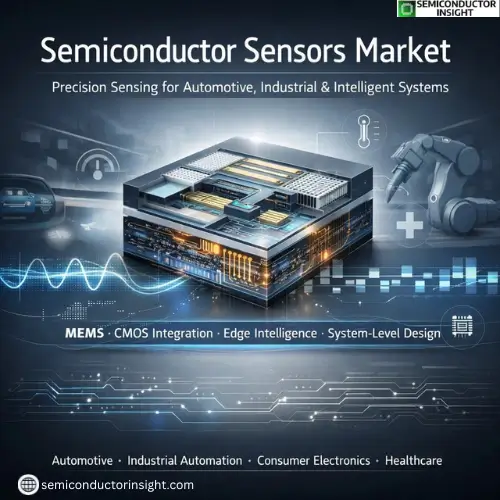
Semiconductor Sensors Market Intelligence to Increase Technology Evolution, Demand Signals, and Industry Shifts
Semiconductor sensors have moved far beyond basic signal detection. Today, they act as decision-enabling components, converting physical parameters into actionable digital intelligence. Whether embedded inside vehicles, medical equipment, industrial automation systems, or consumer electronics, semiconductor sensors now form the foundational layer of smart hardware ecosystems.
This market is defined not only by unit volumes but by precision engineering, material innovation, and system-level integration. As electronic systems demand faster response times and lower power consumption, sensor architectures are evolving to deliver accuracy at the edge.
Market Definition and Functional Scope
Semiconductor sensors market comprises integrated electronic components designed to detect, measure, and convert physical, chemical, or biological signals into electrical outputs. These sensors are fabricated using semiconductor materials such as silicon, compound semiconductors, and MEMS-based structures.
Key sensor categories include pressure sensors, temperature sensors, image sensors, motion sensors, gas sensors, magnetic sensors, and biosensors. Their deployment spans discrete components, system-on-chip configurations, and multi-sensor modules integrated directly into electronic platforms.
Technology Foundations Driving Market Momentum
At the heart of this market lies continuous advancement in CMOS compatibility, MEMS fabrication, and mixed-signal integration. Manufacturers are increasingly aligning sensor designs with advanced process nodes to reduce footprint while improving sensitivity.
Material engineering is also gaining prominence. The use of compound semiconductors and specialized coatings enhances performance in harsh environments, enabling sensors to operate reliably under extreme temperature, vibration, and chemical exposure conditions.
This technological depth is positioning semiconductor sensors as high-value components rather than commodity parts.
Application Expansion across Core Semiconductor Verticals
Automotive electronics represent one of the most influential demand centers. Semiconductor sensors enable functions ranging from engine management and battery monitoring to advanced driver assistance systems and cabin intelligence. The shift toward electrification and autonomy is increasing sensor density per vehicle.
In industrial electronics, sensors are critical for process automation, predictive maintenance, and energy optimization. Semiconductor sensors provide real-time feedback that supports operational efficiency and equipment longevity.
Consumer electronics continue to drive scale, particularly in smartphones, wearable, and smart home devices, where sensors enhance user interaction and device responsiveness.
To Know More about the Report, You Can Freely Browse Our Latest Updated Report:
https://semiconductorinsight.com/report/global-semiconductor-sensors-market/
Integration Trends and System-Level Design
A defining trend in this market is the transition from standalone sensors to integrated sensing systems. Manufacturers are embedding signal conditioning, data processing, and communication interfaces directly into sensor chips.
This integration reduces latency, lowers power consumption, and simplifies board-level design for device manufacturers. As a result, semiconductor sensors are increasingly selected based on system compatibility rather than isolated performance metrics.
This shift is strengthening collaboration between sensor suppliers and system designers early in the product development cycle.
Manufacturing Economics and Supply Considerations
Sensor fabrication requires a balance between advanced processing and cost efficiency. While leading-edge nodes support miniaturization, many sensor applications favor mature process technologies due to reliability and yield stability.
Supply chain resilience has become a strategic priority. Manufacturers are diversifying fabrication locations, qualifying multiple foundry partners, and securing long-term wafer supply agreements to mitigate production disruptions.
Packaging innovation, including wafer-level and chip-scale packaging, is also contributing to cost optimization and performance consistency.
Competitive Landscape and Strategic Positioning
The market for semiconductor sensors is made up of both specialized sensor-focused players and diverse semiconductor corporations. Competitive differentiation increasingly depends on application expertise, customization capability, and long-term supply reliability.
Leading companies are investing in:
- Application-specific sensor platforms
- Co-development programs with OEMs
- Proprietary calibration and testing technologies
These strategies help suppliers move up the value chain while maintaining strong customer lock-in.
Regulatory Influence and Quality Standards
Sensors deployed in automotive, healthcare, and industrial environments must comply with stringent regulatory and quality standards. Certification requirements influence design timelines, testing protocols, and material selection.
Compliance with functional safety standards and environmental regulations is shaping product roadmaps, particularly for sensors used in safety-critical systems.
Semiconductor sensors market is entering a phase where data relevance outweighs raw signal detection. Sensors are evolving into intelligent nodes capable of pre-processing information before transmission.
Emerging opportunities lie in edge AI integration, sensor fusion architectures, and ultra-low-power designs. As electronic systems become more autonomous and connected, semiconductor sensors will play a central role in enabling responsiveness and reliability.
Semiconductor sensors market is no longer defined by sensing alone—it is defined by how effectively physical reality is translated into digital intelligence. Companies that align sensor innovation with system-level needs will shape the next generation of electronic platforms.

Comments (0)