

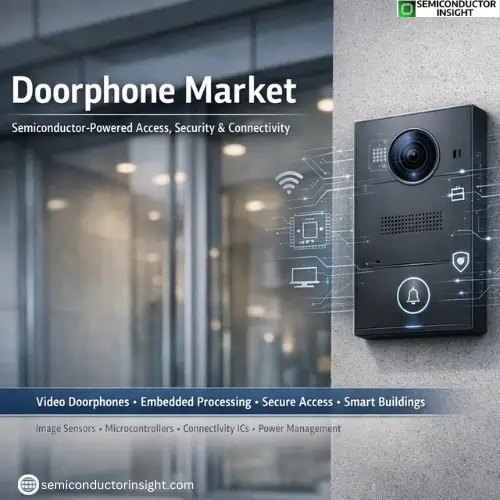
Semiconductor Doorphone Market: Silicon at the Front Door of Smart Living
How Entry Systems Became Intelligent Electronic Gatekeepers?
The modern doorphone is no longer a simple intercom mounted near an entrance. It has evolved into a compact electronic system powered by advanced semiconductor components that enable video processing, audio clarity, secure authentication, and seamless connectivity. As homes, apartments, and commercial buildings shift toward smarter access control, the doorphone market is increasingly defined by semiconductor performance rather than mechanical design.
At its core, today’s doorphone is a convergence point for sensing, processing, communication, and power management each function relying heavily on semiconductor innovation.
Doorphone market encompasses electronic communication and access systems that enable real-time audio and video interaction between indoor and outdoor units. From a semiconductor standpoint, these systems integrate microcontrollers, image sensors, audio codecs, power ICs, connectivity chipsets, and memory components to deliver reliable, low-latency performance.
What differentiates this market within the semiconductor ecosystem is its demand for always-on reliability, low power consumption, and compact system integration, especially in residential and multi-tenant installations.
Why Semiconductors Are Central to Doorphone Evolution?
Doorphones operate at the edge of building infrastructure, where conditions are unpredictable. Temperature fluctuations, humidity, and power instability place high demands on electronic components. Semiconductor vendors supporting this market must prioritize robustness and long lifecycle support.
Key semiconductor functions embedded in modern doorphones include:
- Real-time image processing for video doorphones
- Digital signal processing for noise-free voice communication
- Secure authentication and encryption for access control
- Power regulation for continuous standby operation
This multi-functionality has turned doorphones into miniature embedded systems, rather than simple communication devices.
Video Doorphones Driving Silicon Content Growth
The shift from audio-only systems to video-enabled doorphones has significantly increased semiconductor content per unit. High-definition cameras, infrared sensors for night vision, and display drivers are now standard features in mid- and premium-range products.
Image sensors and video processing ICs play a critical role in:
- Facial visibility under varying lighting conditions
- Motion-triggered activation
- Integration with smart home displays and mobile devices
As resolution standards increase and latency expectations tighten, semiconductor efficiency directly influences product competitiveness.
Connectivity Chips Reshaping System Architecture
Connectivity has become a defining feature of next-generation doorphones. Systems are increasingly integrated with building networks, smartphones, and cloud-based security platforms. This has accelerated the adoption of Wi-Fi, Ethernet, and Bluetooth-enabled chipsets within doorphone designs.
From a market standpoint, this connectivity trend is:
- Expanding doorphones beyond standalone units into networked security nodes
- Increasing firmware complexity and memory requirements
- Driving demand for secure communication protocols implemented at the silicon level
Semiconductor suppliers offering integrated connectivity and security solutions are gaining preference among system manufacturers.
Power Management as a Competitive Differentiator
Doorphones are expected to remain operational around the clock, often with limited power budgets. Power management ICs (PMICs) are therefore critical to ensuring long standby times, stable voltage regulation, and efficient wake-up mechanisms.
In multi-apartment and commercial installations, energy efficiency directly impacts operational costs. As a result, low-power semiconductor architectures are becoming a key purchasing criterion for doorphone OEMs and system integrators.
Security and Embedded Processing Requirements
Security concerns have elevated the role of embedded processors and secure elements within doorphone systems. Unauthorized access, data interception, and device tampering are now addressed at the semiconductor level through encryption engines and secure boot mechanisms.
This trend has positioned doorphones closer to access control and surveillance markets, increasing regulatory and performance expectations for the underlying chips.
Manufacturing and Supply Chain Considerations
From a semiconductor supply perspective, the doorphone market favors components with long production lifecycles. Building infrastructure products are expected to remain serviceable for many years, unlike consumer electronics with rapid refresh cycles.
This has led to:
- Preference for mature semiconductor nodes with proven reliability
- Strategic sourcing agreements between OEMs and chip manufacturers
- Reduced tolerance for component obsolescence
These dynamics make the doorphone market attractive for semiconductor companies seeking stable, volume-driven demand rather than short-term spikes.
At Last before Ending, Don’t Forget to Browse Our Recent Exclusive Report for Detailed Insights:
https://semiconductorinsight.com/report/doorphone-market/
Regional Adoption Patterns and Semiconductor Demand
Urbanization and high-density housing are driving doorphone installations globally. Semiconductor demand is strongest in regions with rapid residential construction and smart city initiatives.
In emerging markets, cost-optimized semiconductor solutions dominate, while developed regions emphasize feature-rich, secure, and connected systems. This divergence is influencing chip design strategies and regional manufacturing footprints.
Prospects through Silicon Innovation
The doorphone industry anticipates progressive development into a sensor-rich access intelligence platform. Integration with facial recognition, AI-based visitor analytics, and building management systems will further increase semiconductor complexity.
The next phase of growth will depend on:
- Higher integration levels to reduce system size
- Enhanced edge processing to minimize cloud dependency
- Improved security architectures embedded at the chip level
For semiconductor vendors, doorphones represent a growing edge-market where performance, efficiency, and reliability converge.
Doorphone market is no longer peripheral to semiconductor strategy. It is a steadily expanding segment where embedded intelligence, connectivity, and power efficiency define market leadership.
As access control becomes smarter and more digital, semiconductors will continue to determine how secure, responsive, and scalable doorphone systems can be.

Comments (0)