
Semiconductor Capital Equipment Market Transforming Next Generation Electronics
Semiconductor capital equipment market represents the backbone of modern electronics manufacturing, enabling the production of integrated circuits that power smartphones, data centres, automotive systems, and artificial intelligence technologies. This industry includes highly sophisticated machinery used in wafer fabrication, chip assembly, and testing processes, forming the technological infrastructure behind global digitalization.
Semiconductor capital equipment refers to specialized tools such as lithography systems, etching machines, deposition tools, and inspection technologies that enable precise material manipulation at atomic scales. These systems support hundreds of manufacturing steps involved in transforming silicon wafers into functional microchips. The growing demand for high-performance computing, connected devices, and smart technologies continues to strengthen industry investments in advanced equipment platforms.
The market’s evolution is also closely linked with technological breakthroughs discussed in ASML and Applied Materials innovations, which continuously push the boundaries of semiconductor manufacturing efficiency and precision.
Core Equipment Technologies Shaping Semiconductor Manufacturing
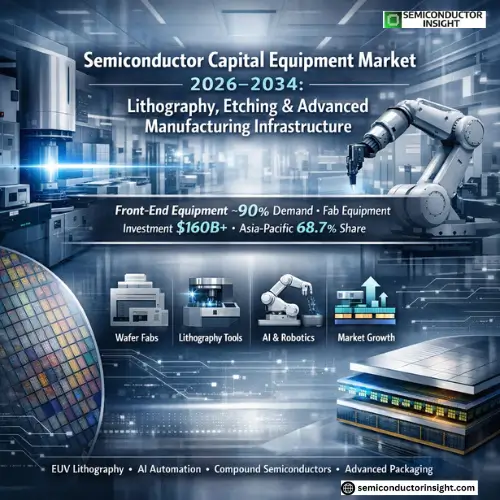
The semiconductor capital equipment ecosystem is primarily divided into front-end and back-end manufacturing systems, each playing a crucial role in chip production. Front-end equipment dominates the industry, accounting for nearly 90% of equipment demand, as it performs wafer processing operations including patterning, deposition, and surface treatment.
Among these technologies, lithography equipment plays a central role by transferring circuit patterns onto silicon wafers using advanced light sources. The transition toward extreme ultraviolet lithography supports chip fabrication at advanced nodes such as 5nm and below, enabling higher transistor density and improved performance.
Similarly, etching equipment removes unwanted material to create circuit structures, while thin-film deposition systems apply uniform material layers required for transistors and interconnects. Ion implantation tools modify electrical properties by introducing dopants, and chemical mechanical planarization ensures smooth wafer surfaces for multilayer structures.
You can freely browse our most recent updated report to learn more about it before scrolling further:
https://semiconductorinsight.com/report/semiconductor-capital-equipment-market/
Back-end equipment focuses on testing, assembly, and packaging processes that ensure chip reliability and performance. The growing complexity of system-on-chip architectures has significantly increased demand for automated test equipment and advanced packaging technologies.
Investment Expansion and Global Manufacturing Race
The semiconductor capital equipment market is experiencing unprecedented investment activity as countries and corporations seek supply chain resilience and technological leadership. Global fabrication facility spending exceeded 160 billion in equipment investments, with the majority directed toward front-end manufacturing tools supporting advanced chip production.
Asia-Pacific currently leads equipment installations with nearly 68.7% global share, driven by strong manufacturing capacity expansion and government initiatives supporting domestic semiconductor ecosystems. Meanwhile, new fabrication facilities across North America and Europe are accelerating regional demand for advanced processing systems.
Government-backed semiconductor programs, increasing artificial intelligence adoption, and rising demand for automotive electronics continue to fuel capital expenditure in wafer fabrication technologies.
Emerging Trends Transforming Equipment Innovation
Several emerging trends are reshaping the semiconductor capital equipment landscape. One of the most significant developments is the integration of artificial intelligence and automation in equipment systems, enabling predictive maintenance, process optimization, and real-time quality monitoring.
Another important trend involves the growth of compound semiconductor manufacturing, including silicon carbide and gallium nitride technologies, which require specialized deposition and thermal processing equipment. These materials support high-efficiency power electronics used in electric vehicles and renewable energy systems.
The industry is also witnessing rapid innovation in advanced packaging technologies, including chiplet integration and heterogeneous architectures, which improve performance while reducing power consumption. These trends highlight the increasing technological complexity of semiconductor manufacturing equipment.
Digital transformation, growing semiconductor applications across industries, and ongoing technical scaling will all influence the semiconductor capital equipment market in the future. Increasing demand for artificial intelligence processors, high-speed communication devices, and smart infrastructure will require more advanced manufacturing equipment capable of extreme precision and efficiency.
As semiconductor fabrication becomes more complex, equipment innovation will remain central to industry progress. The market will continue evolving through automation, advanced materials processing, and sustainable manufacturing solutions, positioning semiconductor capital equipment as a critical driver of global technological advancement.

Comments (0)