
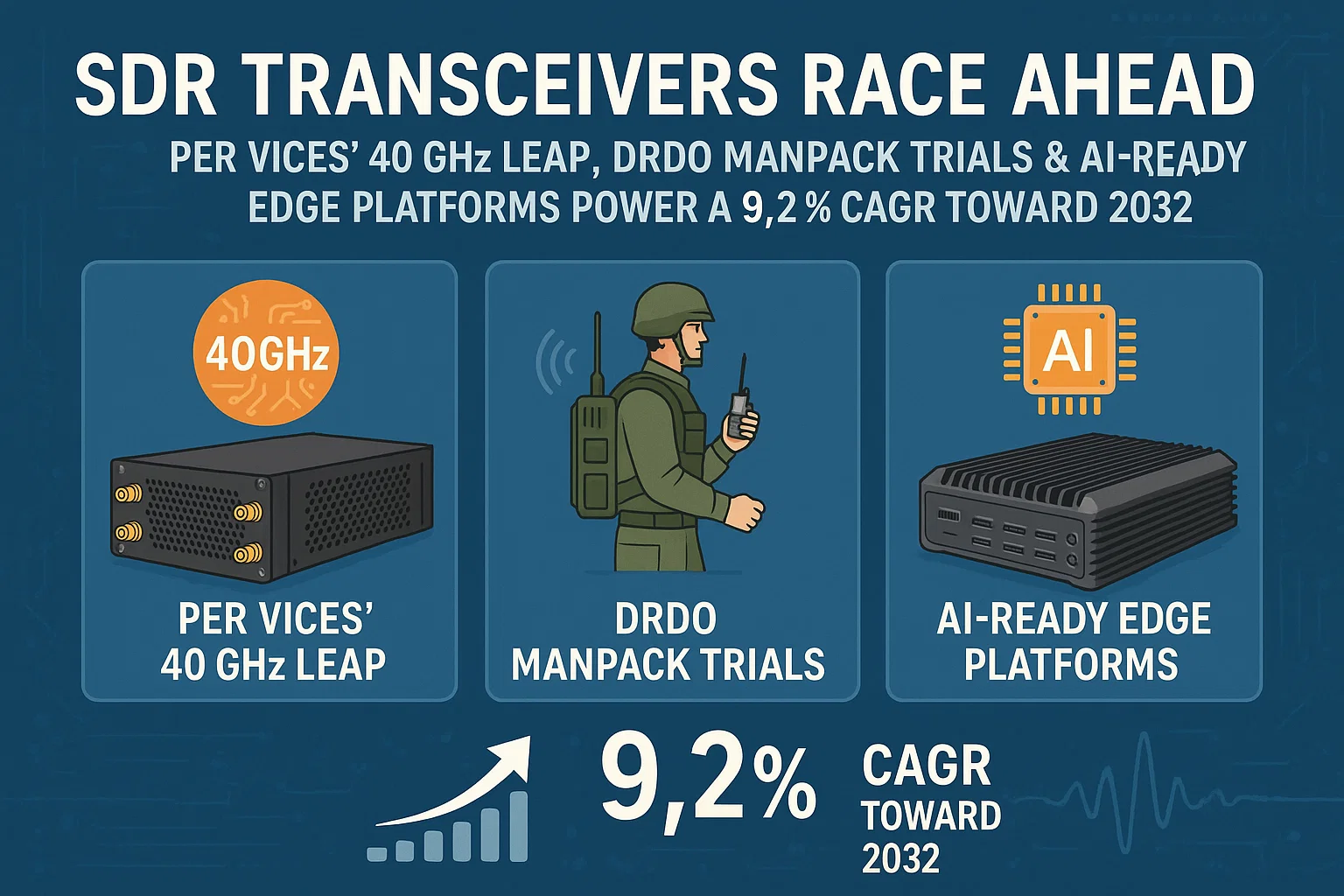
SDR Transceivers Race Ahead: Per Vices’ 40 GHz Leap, DRDO Manpack Trials & AI‑Ready Edge Platforms Power a 9.2 % CAGR Toward 2032
Software‑defined radio (SDR) transceivers have crossed a commercial Rubicon. Once niche lab curiosities, today they sit at the core of everything from India’s forward posts in the Himalayas to CubeSats bound for cislunar space. In dollar terms the sector was valued at US $ 1.27 billion in 2024 and, on current trajectories, is expected to more than double to US $ 2.38 billion by 2032 (CAGR 9.2 %, 2025‑32). But the metric that really matters is agility: every new waveform, security update or AI inference the radio can run is just a firmware push away.
Access Your Free Sample Report- Software Defined Radio Transceivers Market
Why “Radio as Software” Now?
- Spectrum volatility: 5G/6G, Wi‑Fi 7, satellite IoT and private‑LTE all jostle across sub‑6 GHz and mm‑wave bands; only reconfigurable RF chains survive.
- Security churn: Post‑quantum crypto updates can brick fixed‑function radios; SDRs simply re‑image.
- AI at the edge: Cognitive radios that sense, decide and adapt within micro‑seconds cut latency and jammer exposure.
- Economic pressure: From Pentagon memos calling for “software‑defined warfare” to emerging‑market telcos skipping vendor lock‑in, software beats bespoke hardware on lifecycle cost.
Headline Developments Since 2024
| Date | Player | What Happened | So What? |
| Jun 2024 | Per Vices | Launched Calamine, a 4‑channel SDR that tunes DC → 40 GHz with 300 MSPS per chain. | Sets a new commercial bandwidth record; single box covers HF SIGINT to Ku‑band SATCOM. |
| Jul 2025 | DRDO (India) | Field‑trials its indigenous Manpack SDR & Compact Trans‑Horizon Comms System in Uttarakhand’s high‑altitude terrain. | Validates local supply chain, boosts Aatmanirbharta goals. |
| Feb 2025 | Creomagic | Unveils CreoAir Pro MANET SDR for UAV swarms—40 Mbps links, AES‑256, cognitive spectrum hopping. | Shows SWaP‑C shrink and AI‑driven LPI/LPD features aimed at contested skies. |
| Nov 2024 | Epiq Solutions | Ships Matchstiq X40, an NVIDIA‑Orin‑powered edge‑AI SDR (1 MHz–18 GHz, 450 MHz IBW). | Marries GPU TOPS with RF front ends, removing cloud dependence for signal classification. |
| Nov 2024 | Mavenir + Aramco Digital | $1 bn Open‑RAN deal talks; first Saudi move into SDR‑heavy cloud‑RAN. | Underscores SDR’s pull in telecom infrastructure beyond defense. |
Inside the Tech: Calamine’s DC‑to‑40 GHz Feat
Per Vices squeezed four phase‑coherent receive chains and 16‑bit converters into a 2U chassis. Dual 10 GbE outputs stream 20 Gb/s, while on‑board Arria V FPGAs handle DDC/DUC. Users can shove a GNSS spoofing detector and a Ku‑band SATCOM modem into one rack slot—unheard of five years ago. The strategic cherry: firmware toggles between wideband surveillance and beam‑forming transmitter in minutes.
Manpack SDRs Go High‑Altitude
DRDO’s July 2025 trials in the rugged Joshimath sector matter for two reasons:
- Thermal headroom: electronics survived −15 °C mornings and 45 °C midday sun without derating.
- Inter‑agency interoperability: eight CAPFs plus MoHA joined, proving common waveforms between army and internal‑security units for the first time.
The success clears a procurement path rumoured at ₹3,000 crore (~US $360 m) for >15,000 units—material to our CAGR model.
Download Sample Report PDF- Software Defined Radio Transceivers Market
Edge AI Arrives: Matchstiq X40 Deep Dive
Traditional SDR pipelines spit IQ to a workstation; the Matchstiq puts 70 TOPS beside the RF front end. Early demo apps include:
- RF anomaly detection for drone‑borne EW.
- LTE band‑locking that blocks rogue femtocells in 12 ms.
- Acoustic‑RF fusion where mics trigger spectrum snapshots only when shot‑locator cracks are heard—cutting duty‑cycle power by 60 %.
All in a 1 kg slab the size of a paperback. Expect copycat designs to proliferate in 2026‑27.
UAV & Robotics Comms: Creomagic’s MANET Play
CreoAir Pro wraps an adaptive video encoder, smart MIMO steering and frequency‑hopping spread spectrum into 150 g. For ISR drones the killer feature is sub‑250 µs hop time, out‑pacing most commercial jammers by a factor of two. Its open REST API also means defense primes can plug in proprietary encryption modules without NDA headaches—part of a broader “platformisation” of SDR.
Telecom Pivot: Open‑RAN & Cloud‑Native SDR
Reuters’ scoop on Aramco Digital’s bid for Mavenir tells a wider story: 5G operators now treat the radio unit (RU) as deployable software atop COTS hardware. Large‑scale SDRs paired with x86 or ARM servers enable band‑on‑demand cells—spin up 700 MHz for coverage at night, 3.5 GHz for capacity at rush hour. Saudi Arabia’s plan to stand up the first Middle‑Eastern Open‑RAN lab by 2027 further globalises the SDR supply web.
Policy Winds: The Pentagon’s “Software‑Defined Warfare” Memo
March 2025 saw SecDef Pete Hegseth order all DoD programs to default to the Software Acquisition Pathway (SWP). Translation: if your radio can’t field‑upgrade waveforms, don’t bother bidding. The directive also tilts contracting towards commercial‑off‑the‑shelf SDR vendors, slashing the legacy primes’ lock. For our forecast this converts into faster adoption cycles (3‑4 years vs. 7‑10 years historically).
Market Sizing & Forecast Rationale
| Year | Revenue (US $m) | Growth Drivers |
| 2024 | 1,270 | Record R&D outlays post‑COVID; 5G private‑network pilots. |
| 2025 | 1,390 | Defense field trials (India, EU, US); early Open‑RAN rollouts. |
| 2028 | 1,800 | AI‑enabled cognitive radios reach TRL‑9; mass UAV comms refresh. |
| 2032 | 2,380 | Satellite IoT constellations, 6G testbeds, export of mature military SDRs to Global South. |
The CAGR of 9.2 % outpaces the broader RF components market (~6 %), owing to software‑licensing uplifts and recurring security‑update revenue.
Regional Dynamics
- Asia‑Pacific: India’s Make‑II procurement path fast‑tracks domestic SDR fabs; China’s PLA standardises on tri‑band manpack sets by 2026.
- North America: Pentagon’s push plus private‑LTE for energy grids keeps demand robust; venture funding flows to spectrum‑sharing start‑ups.
- Middle East: Vision 2030 drives cloud‑RAN labs; oil & gas firms use SDR sensor nets for flare‑stack monitoring.
Technical Headwinds
- Converter bottlenecks: 14‑bit, 10 GSPS ADCs still pinch; expect relief as TSMC 2 nm nodes go RF‑friendly.
- On‑device AI heat density: Jetson‑class modules at 20 W force active cooling; future RISC‑V DSPs may halve that.
- Supply‑chain security: Verified firmware signatures (e.g., SecBoot2.0) must scale to thousands of fielded nodes.
Standards & Open‑Source Momentum
GNU Radio, srsRAN and OpenAirInterface now support 3GPP Rel‑18 features; their code contributions doubled YoY in 2024‑25. Expect native 6G simulation stacks by 2027, accelerating academic‑industrial loops. While not strictly “news”, their community velocity underpins many of the commercial launches detailed above.
What to Watch (2025‑27)
| Quarter | Anticipated Milestone | Potential Market Impact |
| Q4 2025 | Per Vices ships Calamine‑TX with 20 W transmit power | Opens direct sat‑backhaul without BUCs. |
| Q2 2026 | NATO selects common COALWN wideband waveform | 100 k+ radio retrofit contracts. |
| Q1 2027 | First sub‑THz SDR demo at 140 GHz/8 GHz IBW | Kicks off 6G field trials; new converter suppliers emerge. |
Click Here To Download Full Sample Report- Software Defined Radio Transceivers Market
Strategic Takeaways for Stakeholders
- OEMs: Embrace modular FPGAs and open APIs; the Pentagon and telcos want plug‑and‑play.
- Investors: Look for firms that bundle AI firmware subscriptions—that’s the annuity.
- Research Labs: Focus on cryo‑CMOS and optical mixing to jump the 40 GHz ceiling.
- Policy‑makers: Provide export‑control clarity; SDRs straddle dual‑use lines.
The Road to 2032
SDR transceivers have pivoted from flexible curiosities to mission‑critical infrastructure. Calamine’s 40 GHz sweep, DRDO’s rugged manpacks, Creomagic’s UAV links and Matchstiq’s edge‑AI muscle all confirm a single direction of travel: radios that evolve as fast as the code they run. With a projected 9.2 % CAGR and geopolitical drivers converging, the next seven years will see SDRs move from specialist racks into every frontline squad, smart factory and LEO satellite. In the spectrum battles of the 2030s, software is the new RF front end.

Comments (0)