
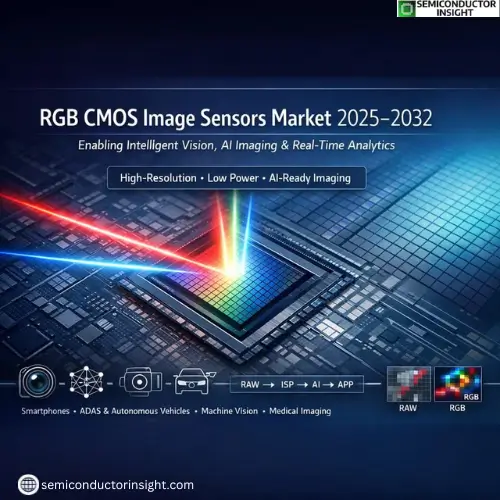
RGB CMOS Image Sensors Market Surges as Visual Intelligence Expands across Devices
RGB CMOS image sensors are semiconductor devices that capture visual information by separating incoming light into red, green, and blue components, enabling accurate color reproduction. These sensors convert optical signals into electronic data, forming the core imaging engine behind smartphones, cameras, automotive vision systems, medical imaging tools, and industrial inspection equipment.
RGB CMOS Image Sensor Market has progressed beyond simple picture capturing. Today, these sensors are deeply embedded in machine vision, artificial intelligence, and real-time analytics, supporting systems that not only see but also interpret their surroundings.
Importance of RGB CMOS Image Sensors within Semiconductor Frameworks
Within the broader semiconductor value chain, RGB CMOS image sensors occupy a strategic position. They sit at the intersection of analog signal processing, digital conversion, and system-level integration, requiring advanced fabrication, precise color filtering, and optimized pixel architectures.
As devices demand higher resolution, lower power consumption, and improved low-light performance, RGB CMOS sensors are increasingly designed alongside processors, memory, and AI accelerators. This tight integration elevates their importance from a peripheral component to a system-defining element.
Market Forces Accelerating Adoption
- Consumer electronics remain a dominant demand driver, particularly smartphones, tablets, and wearable devices.
- Consumers expect vivid color accuracy, faster autofocus, and improved photography under challenging lighting conditions, pushing manufacturers to adopt higher-performance RGB sensor designs.
- Automotive applications are another accelerating force.
- Advanced driver assistance systems and in-cabin monitoring rely on RGB CMOS image sensors for object recognition, lane detection, driver attention tracking, and surround-view imaging.
- The transition toward semi-autonomous and autonomous vehicles is expanding the role of color imaging in safety-critical environments.
- In industrial settings, RGB CMOS image sensors are increasingly used for quality inspection, robotic guidance, and process monitoring.
- Their ability to distinguish color variations supports defect detection and precision manufacturing.
Technology Direction and Sensor Architecture Evolution
Recent development in RGB CMOS image sensors focuses on pixel miniaturization, back-side illumination, and stacked sensor architectures. These advances allow more light to reach the photodiode, improving sensitivity without increasing sensor size.
Color filter optimization is another area of innovation. Improved filter materials and layouts enhance color separation, reducing noise and improving image fidelity. Combined with on-chip signal processing, modern RGB sensors deliver cleaner images while consuming less power.
Manufacturers are also embedding computational features directly into sensor designs, enabling faster image processing and reducing reliance on external processors. This trend supports edge computing and real-time decision-making in compact devices.
Quick Look at Key Highlights:
October 2025:
- Sony Semiconductor Solutions Corporation (Sony) announced the upcoming release of the IMX775 CMOS RGB-IR image sensor with the industry’s smallest*1 pixel size of 2.1 µm, delivering both RGB and IR imaging on a single chip and a resolution of approximately 5 effective megapixels,*2 designed for in-cabin monitoring cameras.
- The new RGB-IR image sensor has a high resolution of about 5 effective megapixels and can take wide-angle pictures of the inside of the car, including the driver and passengers.
- It also has the highest*1 near-infrared sensitivity and RGB dynamic range in the industry, and it can take pictures in both visible light (RGB) and 940 nm near-infrared light (NIR) on a single chip.
October 2025:
- OMNIVISION, a leading global developer of semiconductor technology, including advanced digital imaging, analog and display solutions, announced its latest-generation automotive image sensor: the OX08D20 8‑megapixel (MP) CMOS image sensor with TheiaCel technology.
- This new gadget is an improvement over the well-liked OX08D10 sensor for external cameras employed in autonomous driving (AD) and advanced driver assistance systems (ADAS).
- OMNIVISION is the primary sponsor of the device, which will be unveiled at AutoSens Europe (Booth 300) in Barcelona, Spain.
Application Landscape and End-Use Expansion
Beyond consumer and automotive markets, healthcare is emerging as a meaningful growth area. RGB CMOS image sensors are used in endoscopy, diagnostic imaging, and digital microscopy, where accurate color representation supports clinical interpretation.
Security and surveillance systems continue to adopt high-resolution RGB sensors to improve facial recognition, motion tracking, and environmental awareness. Smart cities and connected infrastructure projects are further expanding deployment across public spaces.
Augmented reality and virtual reality platforms also rely on RGB imaging for spatial mapping and user interaction, opening new opportunities as immersive technologies mature.
For a more thorough report, please contact us using our most recent report:
https://semiconductorinsight.com/report/rgb-cmos-image-sensors-market/
Manufacturing Challenges and Cost Considerations
Producing RGB CMOS image sensors requires tight process control and high yield management. Pixel uniformity, defect reduction, and color consistency are critical quality metrics, particularly for high-volume consumer applications.
As sensor complexity increases, manufacturers must balance performance gains with cost pressures. Efficient wafer utilization, packaging innovation, and supply chain optimization are central to maintaining profitability while meeting customer expectations.
RGB CMOS image sensors market is evolving toward intelligent vision, where sensors act as active participants in decision-making rather than passive data collectors. As devices become more connected and autonomous, the demand for accurate, responsive, and energy-efficient color imaging will continue to grow.
Long-term opportunity lies in combining RGB sensing with AI, edge computing, and system-on-chip architectures, positioning image sensors as a cornerstone of next-generation electronic systems.

Comments (0)