
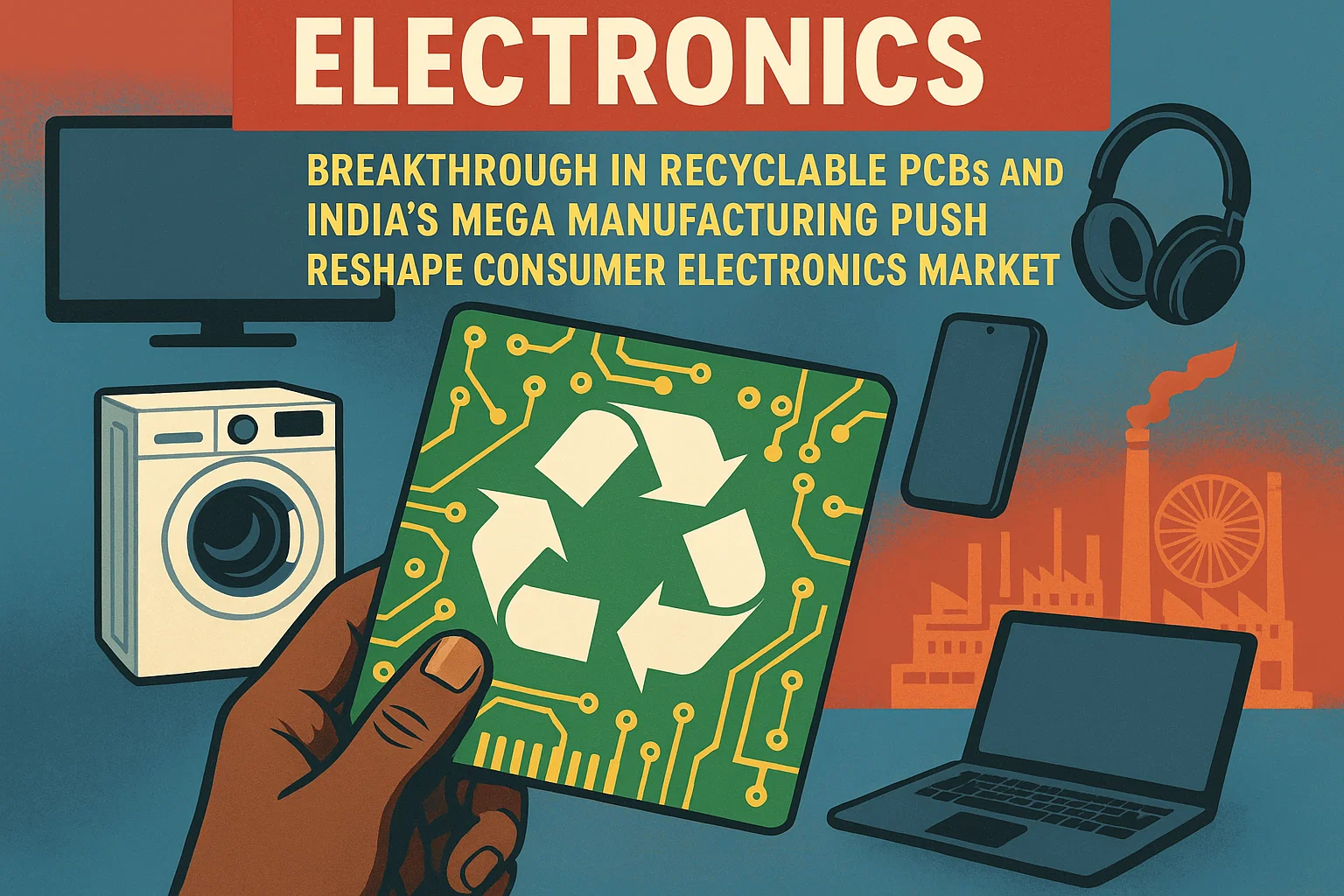
Revolutionizing Electronics: Breakthrough in Recyclable PCBs and India’s Mega Manufacturing Push Reshape Consumer Electronics Market
The Consumer Electronics Printed Circuit Board (PCB) market is undergoing a significant transformation driven by sustainability innovations, advanced design methodologies, strategic global shifts, and a surge in consumer demand for miniaturized, high-performance devices. Valued at US$ 15.34 billion in 2024, this dynamic market is projected to grow to US$ 24.78 billion by 2032, expanding at a CAGR of 6.9% between 2025 and 2032.
From recyclable PCBs to AI-powered design automation, the PCB landscape is redefining the core of modern electronics—from smartphones and wearables to smart home devices and augmented reality gear.
Access Your Free Sample Report- Consumer Electronic PCBA Board Market
Market Overview: A Rapidly Growing Backbone of Consumer Devices
Printed circuit boards serve as the neural backbone of electronic devices, offering structured support and connectivity for electronic components. As consumer electronics become more compact, complex, and integrated, PCBs are evolving with higher layer counts, increased signal integrity, and eco-conscious designs.
The consistent rise in global tech consumption—particularly wearables, IoT devices, tablets, and smart TVs—continues to fuel demand for advanced PCBAs. Increasing adoption of 5G, artificial intelligence (AI), and edge computing is also driving innovations in layout design, heat dissipation, and board flexibility.
Key Recent Developments in the PCB Industry
1. Sustainable PCB Innovations Leading the Charge
One of the most significant breakthroughs has been the introduction of sustainable and recyclable PCB technologies aimed at reducing electronic waste.
a. ProForm Technology: Reversible and Reusable Boards
A team of researchers introduced ProForm, a solder‑free PCB prototyping method using thermoformed substrates. This innovation enables reversible mounting of components—ideal for prototyping and educational use. ProForm allows PCBs to be reconfigured multiple times, making prototyping more sustainable and less waste-intensive.
b. DissolvPCB: Water-Soluble Circuit Boards
Another radical innovation is DissolvPCB, a circuit board that dissolves in water. Created with water‑soluble substrates and liquid metal conductors, it allows for easy component recovery, contributing to circular electronics design. In an industry plagued by landfill waste, this offers a path to eco-friendly disposal and reuse.
c. PCB Renewal with Epoxy Rewrites
In yet another eco-centric approach, researchers have developed a method that allows the reconfiguration of copper traces on a PCB using conductive epoxy. This “renewable PCB” can be erased and rewritten multiple times, extending the board’s lifecycle and cutting down on raw material consumption.
These innovations are laying the groundwork for a future where electronic waste is minimized, and PCBs are as renewable as the software they run.
2. India’s Rise as a Global PCB Manufacturing Hub
The geopolitical landscape in electronics manufacturing is shifting rapidly. With the “China Plus One” strategy gaining momentum, countries like India are emerging as pivotal alternatives in the global supply chain.
a. Syrma SGS & Shinhyup’s ₹1,800 Crore Mega Facility
India is set to host its largest-ever multi‑layer PCB manufacturing facility through a joint venture between Syrma SGS and Shinhyup (South Korea). Located in Andhra Pradesh, this ₹1,800 crore (US$ 215 million) plant will be operational by 2026–27 and is poised to transform India’s domestic production capacity.
b. Policy Push: Anti-Dumping Duty on Bare PCBs
To stimulate domestic manufacturing, India introduced a 30% anti-dumping duty on imported bare PCBs, mainly from China. This move has significantly boosted local capacity and investment in raw material sourcing, though long-term growth will depend on developing indigenous supply chains for copper, epoxy resins, and laminates.
c. BPL’s New Facility in Bengaluru
Homegrown electronics company BPL recently inaugurated a modern PCB production unit in Doddaballapur, Bengaluru. The facility aligns with India’s broader Production Linked Incentive (PLI) scheme and adds much-needed momentum to regional infrastructure.
Download Sample Report PDF- Consumer Electronic PCBA Board Market
3. Technological Advancements in PCB Design and Fabrication
As devices get thinner and smarter, PCB technology is keeping pace with innovations that enable higher component density, better heat management, and flexibility.
a. HDI and Flex-Rigid PCBs
High-Density Interconnect (HDI) and flex-rigid PCBs are becoming essential for mobile phones, smartwatches, and medical wearables. These boards allow for:
- Smaller footprints
- Reduced signal loss
- Faster data transfer
- Improved mechanical flexibility
This trend is especially critical for wearables and AR/VR gear, where space constraints and ruggedness go hand in hand.
b. 3D Printed PCBs
While still in early adoption, 3D-printed PCBs are revolutionizing prototyping with lower costs and faster turnaround. Startups and academic labs are using additive manufacturing to design complex multilayer boards in hours rather than days or weeks.
c. AI-Powered Design Automation
AI is also transforming the EDA (Electronic Design Automation) space. Companies like Diode Computers—which raised US$11.4M in Series A funding—are developing AI-driven PCB design tools. These tools analyze schematic layouts and optimize routing paths automatically, reducing design cycles and improving board reliability.
4. Global Demand Drivers and Use Case Expansion
Consumer preferences are evolving rapidly, creating new use cases and quality expectations for PCBs.
a. IoT and Smart Home Devices
From voice assistants to smart plugs, IoT-enabled devices need low-power, high-efficiency PCBs that offer robust connectivity, even in fluctuating environments.
b. 5G Smartphones and Tablets
5G integration is pushing PCB design towards millimeter-wave compatibility, requiring advanced materials like Teflon, ceramic, and PTFE, along with tighter impedance control.
c. Wearables and Medical Tech
Devices like fitness trackers, glucose monitors, and smartwatches require biocompatible, flexible PCBs with enhanced durability. This market is expected to grow exponentially as remote health monitoring gains traction.
d. AR/VR and Gaming
The rise of immersive tech means PCBs must support high refresh rates, low latency, and multilayer signal management, making them a cornerstone of the extended reality revolution.
Forecast Breakdown: 2025–2032
| Year | Market Size (US$ Billion) | Notable Trends |
| 2024 | 15.34 | Surge in IoT and wearables |
| 2026 | 17.45 | Rise of HDI and flexible PCBs |
| 2028 | 20.12 | Growth in 5G and AR/VR usage |
| 2030 | 22.91 | India emerges as global PCB hub |
| 2032 | 24.78 | Sustainable PCB tech mainstreamed |
With a compound annual growth rate (CAGR) of 6.9%, the market is poised for healthy expansion, driven by technology and geopolitical tailwinds.
Regional Dynamics: Asia Dominates, but Diversifies
China
Still the largest PCB manufacturer globally but facing increased production costs, labor issues, and geopolitical scrutiny.
India
Rapidly scaling capacity thanks to government incentives, foreign joint ventures, and supply-chain diversification.
South Korea & Taiwan
Continue to lead in substrate-level PCBs for semiconductors, especially for 5G and AI applications.
USA & Europe
Focus shifting towards specialty PCBs—military, aerospace, and medical—backed by reshoring policies and stricter sustainability standards.
Challenges and Opportunities
Challenges
- Sourcing of raw materials (e.g., copper, resin)
- E-waste management and recycling standards
- Trade restrictions and export duties
- Supply chain disruptions (semiconductors, logistics)
Opportunities
- Surge in global demand for wearables and IoT
- Advances in design automation
- Domestic manufacturing booms in emerging markets
- Regulatory tailwinds pushing for sustainable production
Click Here To Download Full Sample Report- Consumer Electronic PCBA Board Market
Future Outlook: Intelligent, Circular, and Hyper-Efficient
By 2032, the Consumer Electronics PCBA market will be defined not just by its volume but by its efficiency, sustainability, and design intelligence. As sustainable PCBs become more mainstream and AI co-design tools mature, we may soon see a world where:
- Circuit boards are completely recyclable or biodegradable.
- PCBAs self-monitor for defects and optimize performance.
- Consumer electronics become modular and repair-friendly.
The printed circuit board—often overlooked—remains at the core of every innovation in consumer electronics. Whether powering the latest smartwatches or making devices more sustainable and repairable, PCB innovation is what makes next-gen electronics possible.
As this US$ 15.34 billion industry grows toward US$ 24.78 billion by 2032, one thing is clear: the humble circuit board is being reborn as a platform for intelligence, sustainability, and resilience.

Comments (0)