
Revolutionizing Chip Designs through the Current Shunt Monitor Market
Imagine cracking open a modern chip and seeing tiny circuits quietly tracking every milliamp of current flowing through high-power paths without missing a beat. That’s exactly what current shunt monitors do in the semiconductor world. They sit right at the heart of power electronics, turning a simple voltage drop across a low-resistance shunt into precise, actionable data.
No flashy marketing hype here just solid engineering that keeps everything from electric vehicle battery packs to industrial motor drives running smoothly and efficiently. These monitors, often built as specialized current sense amplifiers, have become indispensable in semiconductor designs where every bit of accuracy counts for energy savings and system reliability.
Semiconductor Foundations behind Shunt Monitoring Technology
- At their core, current shunt monitors rely on a basic principle straight from Ohm’s law.
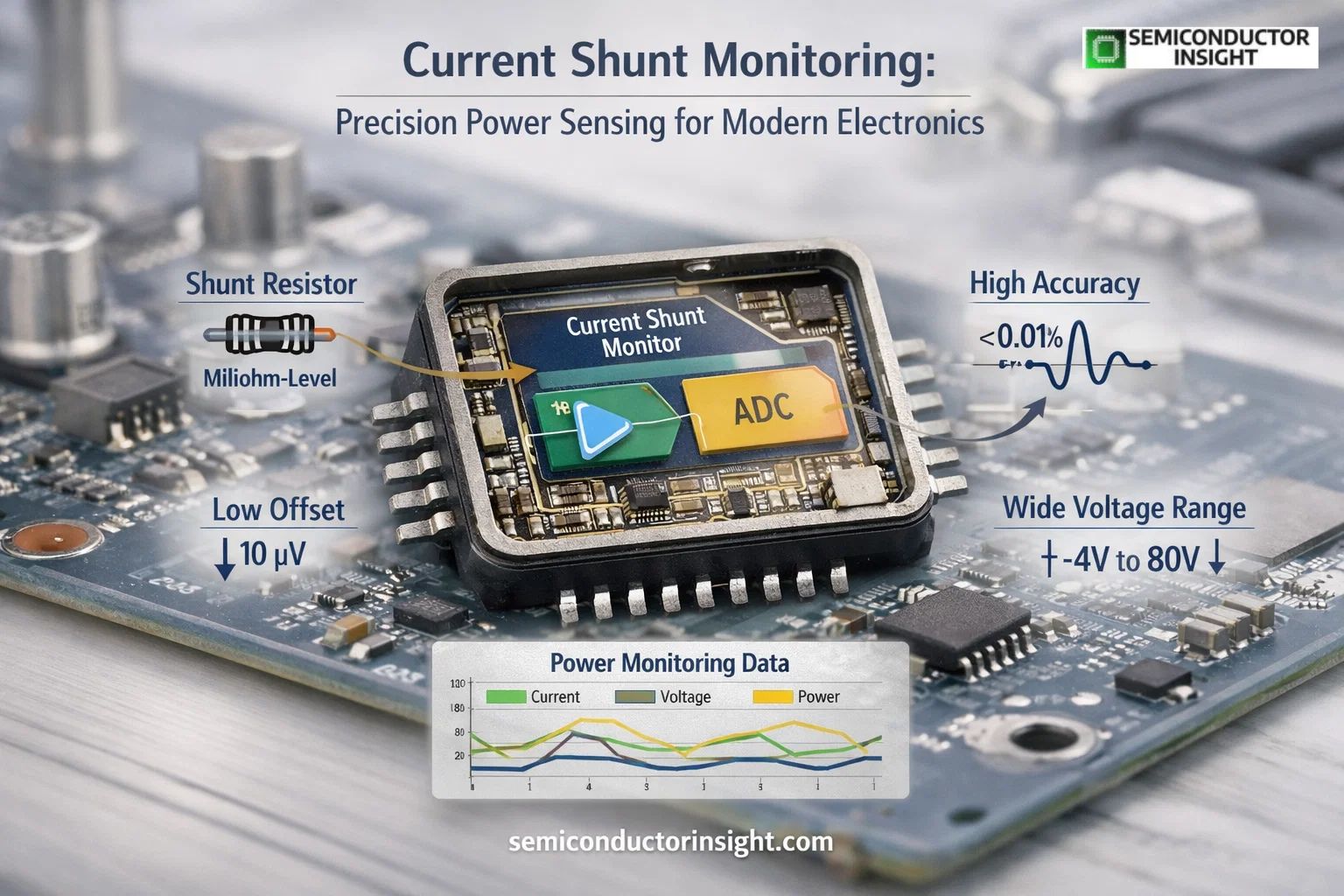
- A precision shunt resistor usually just a few milliohms gets placed in the current path, and the tiny voltage drop across it gets amplified by a differential amplifier integrated right into the silicon.
- Recent study’s entry on current sensing nails it: this approach works for both AC and DC, stays low-cost, and delivers high reliability because the physics is straightforward.
- Semiconductor makers like Texas Instruments and Analog Devices have refined these into ICs that handle common-mode voltages from negative a few volts all the way up to 80 V or more while running on much lower supply rails.
- That capability alone lets designers monitor high-side currents in tough environments without extra isolation tricks or ground-plane disruptions.
- What sets the integrated versions apart from older discrete op-amp setups is the matched resistive gain network baked into the chip itself.
- You get fixed gains anywhere from 20 V/V up to 1000 V/V with errors as low as 0.01 percent, plus temperature stability that discrete parts can only dream of.
- Offsets drop to around 10 microvolts in newer devices, meaning you can use smaller shunt resistors and waste less power in the process.
- It’s pure semiconductor magic turning what used to be a board full of components into a single, tiny package that fits neatly beside power MOSFETs or microcontrollers.
How Shunt Monitors Blend Seamlessly into Chip Architectures?
In modern semiconductor designs, current shunt monitors are no longer standalone components but are deeply integrated into system-on-chip solutions and power management ICs. They work alongside analog front ends, ADCs, and digital interfaces to deliver real-time feedback, especially in battery management systems for electric vehicles where precise monitoring of charge and discharge currents ensures safety and performance even under fluctuating conditions.
Their role is equally critical in motor control and power applications. By feeding real-time current data into control loops, they help adjust signals dynamically, maintaining efficiency, stable torque, and controlled heat levels. Widely used in telecom and audio systems as well, these monitors support extreme temperature ranges from –40 °C to 125 °C, allowing them to operate reliably alongside high-power semiconductor components in demanding environments.
Where Smart Sensing Solutions Drive Performance?
- Look at industrial equipment and you’ll see shunt monitors protecting welding machines, electrolysis setups, and heavy motor drives by spotting overcurrent conditions instantly.
- In consumer electronics, they quietly monitor battery draw in mobile devices, helping the power management chip decide when to throttle clocks or dim screens. Even in renewable energy inverters, these circuits ensure DC-link currents stay balanced so the whole semiconductor-based conversion chain operates at peak efficiency.
- One clever trick engineers love is the ability to power the monitor from the sensed line itself in some designs, eliminating extra supply pins and simplifying layouts. Others add comparator outputs right on the die for built-in fault detection another example of how semiconductor integration turns a basic sensing function into smart, self-protecting silicon.
- High common-mode rejection ratios (up to 120 dB) keep the tiny sense signal clean even when massive voltage swings hit the inputs, which is exactly why these parts shine in automotive and telecom environments where noise is everywhere.
Don’t Forget to Surf Our Updated Report for More Detailed Analysis: https://semiconductorinsight.com/report/current-shunt-monitor-market/
Pushing the Silicon Envelope with Ongoing Shunt Monitor Innovations
Semiconductor fabs keep refining the process nodes and materials to squeeze better performance into smaller footprints. Newer devices feature zero-drift architectures that virtually eliminate offset drift over temperature and time, while bandwidths climb into the hundreds of kilohertz so they can track fast transients in switching converters. Some even embed the shunt resistor itself on-chip for ultra-precise, factory-calibrated measurements that cut down external component count and board space.
- Designers now combine these monitors with digital power monitors that output current, voltage, and power data over I2C or SPI, letting the main microcontroller close the loop without extra analog-to-digital conversions.
- It’s all part of the broader trend toward smarter, more integrated analog signal chains inside power semiconductors.
- Whether you’re laying out a server PSU, an EV traction inverter, or a precision industrial sensor node, current shunt monitors have evolved from nice-to-have to must-have building blocks that make the entire semiconductor ecosystem more efficient and reliable.
These little circuits might not grab headlines like the latest AI processor, but they quietly enable every watt saved, every fault prevented, and every system optimized across countless applications. In the fast-moving world of semiconductors, that kind of behind-the-scenes precision is what keeps innovation rolling forward.

Comments (0)