
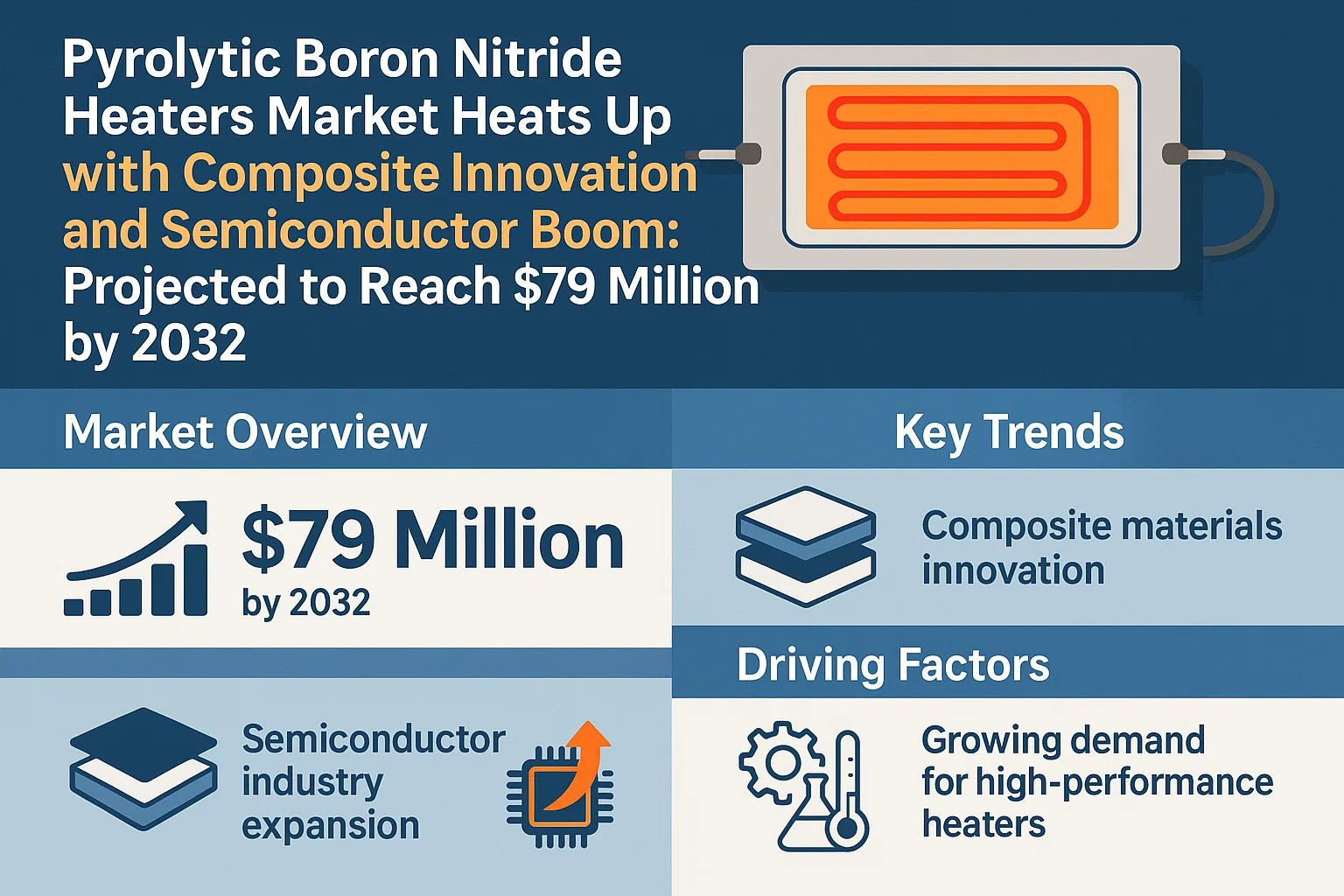
Pyrolytic Boron Nitride Heaters Market Heats Up with Composite Innovations and Semiconductor Boom: Projected to Reach $79 Million by 2032
The thermal management solutions sector is quietly undergoing a transformation—driven largely by materials capable of thriving under extreme conditions. Among these, Pyrolytic Boron Nitride (PBN) has emerged as a critical component in high-temperature applications, particularly in the form of PBN heaters. These high-performance, chemically inert, and thermally stable ceramic heaters are being increasingly deployed across semiconductor manufacturing, aerospace, advanced electronics, and energy sectors.
The Pyrolytic Boron Nitride Heaters Market, valued at US$ 58 million in 2024, is projected to reach US$ 79 million by 2032, growing at a CAGR of 3.9% during the forecast period (2025–2032). This measured yet consistent growth reflects steady adoption across cutting-edge applications, even amid supply chain volatility and high production complexity.
Access Your Free Sample Report- Pyrolytic Boron Nitride Heaters Market
What Are Pyrolytic Boron Nitride Heaters?
PBN heaters are high-purity ceramic components fabricated through chemical vapor deposition (CVD). PBN’s unique properties—such as excellent thermal shock resistance, high dielectric strength, chemical inertness, and stability up to 2000 °C in inert atmospheres—make it ideal for creating heaters used in ultra-clean and high-vacuum environments.
These heaters are often paired with pyrolytic graphite (PG), forming PBN/PG composite heaters. The PBN serves as an encapsulating insulator while PG functions as a resistive heating element. Together, they offer consistent heating performance in semiconductor wafer production, CVD systems, molecular beam epitaxy, and specialty crucibles.
Market Overview and Forecast
- 2024 Market Value: US$ 58 million
- Projected 2032 Market Value: US$ 79 million
- CAGR (2025–2032): 3.9%
The growth trajectory may seem modest at first glance, but it reflects the specialized, capital-intensive nature of the industry. PBN heaters serve precision markets, where reliability and performance are more critical than volume.
Key Drivers
- Rising demand for ultra-clean materials in semiconductor manufacturing
- Expanding deployment of wide-bandgap semiconductors like GaN and SiC
- Increase in vacuum and high-temperature applications in aerospace and defense
- Continuous growth in EVs, solar panels, and advanced battery systems
- Development in quantum computing and nanofabrication labs
Regional Market Trends
United States
The U.S. is witnessing strong demand due to:
- Domestic semiconductor fabs under the CHIPS Act
- A push for localized defense production
- NASA and private aerospace ventures increasing adoption of PBN components
South Korea
With industry powerhouses like Samsung and SK Hynix, South Korea is one of the fastest-growing PBN heater markets, with a CAGR approaching 5.6%. The focus is on OLED displays, memory chips, and compound semiconductors.
Japan
Japan remains a leader in precision ceramics and thin-film deposition systems. PBN heaters are being used in R&D for quantum photonics and 5G/6G RF components.
Germany / EU
In Europe, tight REACH regulations are promoting PBN adoption due to its non-toxicity and thermal efficiency. The green hydrogen economy and electric aviation trends are contributing to market demand.
Key Technological Developments
- Composite Material Innovations
- Manufacturers are now combining PBN with silicon carbide (SiC) and graphene to enhance thermal conductivity and reduce brittleness.
- These hybrid materials offer better energy efficiency, corrosion resistance, and lifetime under cycling loads.
- Next-Gen Chemical Vapor Deposition (CVD)
- Advancements in CVD processes allow for:
- Larger, crack-free PBN components (> 300 mm)
- Uniform material thickness with improved tolerance
- Lower production defects and enhanced yields
- Oxidation-Resistant Coatings
- New surface treatments are extending component lifespan by 40–50% in high-oxygen or reactive chemical environments.
- 3D-Structured Heating Elements
- Research is progressing toward custom-designed multi-zone PBN heaters for applications requiring spatially controlled temperature gradients.
- Smart Monitoring Capabilities
- Integration of temperature feedback mechanisms and sensor-embedded PBN heater modules is under experimental development, enabling real-time performance adjustments.
Download Sample Report PDF- Pyrolytic Boron Nitride Heaters Market
Challenges in Manufacturing and Supply Chain
Despite growing demand, the PBN heater industry faces significant constraints:
Raw Material Dependency
- Ultra-pure boron and nitrogen precursors are tightly controlled, with fewer than five global suppliers dominating the space.
- Political and logistical hurdles—particularly between the U.S., China, and Russia—have affected availability and pricing.
High Production Complexity
- PBN is not sintered like traditional ceramics; it’s grown via high-temperature CVD (>2,000 °C).
- This process requires:
- Precision reactors
- Inert gas control
- Expertise in thermal gradient management
- Less than 12% of ceramic firms globally have the capability to produce high-quality, large-diameter PBN heaters.
Cost Constraints
- PBN heaters are significantly more expensive than alumina or silicon nitride alternatives, limiting use to high-margin applications.
- Average unit cost remains high: $800–$5,000 per heater, depending on dimensions and purity.
Trade Restrictions & Tariffs
- Export controls on high-temperature ceramics and advanced materials have led to:
- Longer lead times (by 30–45 days)
- Tariff-related cost hikes of 25–35%
- EU compliance surcharges of $120–150 per shipment
Application-Specific Growth Areas
- Semiconductor Manufacturing
- PBN heaters are indispensable in:
- MOCVD systems for compound semiconductors (e.g., GaN, GaAs)
- Wafer processing and annealing stages
- High-vacuum sputtering and etching chambers
- As fabs transition to smaller nodes (3nm and below), ultra-pure PBN becomes increasingly essential.
- Electric Vehicles (EVs)
- PBN’s thermal conductivity and chemical resistance make it ideal for:
- Battery testing systems
- Encapsulation of solid-state battery prototypes
- Power electronics thermal management
- Aerospace & Defense
- Space-grade PBN heaters are used in:
- Ion propulsion systems
- Satellite instrumentation requiring uniform heat distribution
- Hypersonic flight components subjected to extreme thermal shock
- Solar & Renewable Energy
- PBN crucibles and heaters are used in:
- Thin-film solar cell manufacturing
- High-efficiency crystal growth systems for PV modules
- Quantum Computing
- PBN heaters are finding roles in:
- Ultra-clean vacuum environments for superconducting qubits
- Temperature-controlled cryogenic chambers
- Photonics labs working with exotic materials
Key Industry Players
Here are some of the prominent companies innovating in the PBN heaters space:
| Company | Focus Area |
| Momentive Technologies | Ultra-pure ceramics for semiconductors |
| Morgan Advanced Materials | Aerospace-grade PBN solutions |
| Shin-Etsu Chemical Co. | Japanese leader in high-tech ceramics |
| Innovacera | PBN/PG composite heater modules |
| Xing Tai Long Special Ceramics | High-volume production for Asia |
| Beijing Boyu Semiconductor | Localized solutions for Chinese fabs |
These players are investing in R&D, automation, and composite materials to improve performance, scalability, and reduce cost barriers.
Strategic Insights & Industry Outlook
Innovation Roadmap
- Expect further integration of sensing, feedback, and data telemetry into PBN heaters for Industry 4.0 compliance.
- R&D into graphene-doped PBN may unlock applications requiring both high thermal conductivity and mechanical durability.
Competitive Landscape
- Although PBN holds advantages in purity and performance, emerging materials like aluminum nitride (AlN) and SiC are gaining attention due to their lower costs and scalable manufacturing methods.
- Nonetheless, for ultra-high vacuum and chemically sensitive environments, PBN remains unmatched.
Click Here To Download Full Sample Report- Pyrolytic Boron Nitride Heaters Market
A Steady Burn Toward High-Precision Heat
The Pyrolytic Boron Nitride Heaters market represents a mission-critical segment of the advanced materials landscape. While growth rates remain modest, the technical barriers to entry, niche applications, and unparalleled material properties ensure that PBN heaters continue to thrive in high-value environments.
From enabling the next generation of microchips to insulating spacecraft systems, PBN heaters are at the heart of some of the most ambitious technologies of our time. As demand for miniaturization, performance, and purity continues to rise, so too will the importance of this sophisticated ceramic marvel.

Comments (0)